Comeback / Technology / 1997-1998
Apple and the Comeback That Made Focus Visible
Apple's late-1990s recovery worked because the brand promise, product simplification, direct selling, and iMac proof all pointed at the same idea.
Short Answer
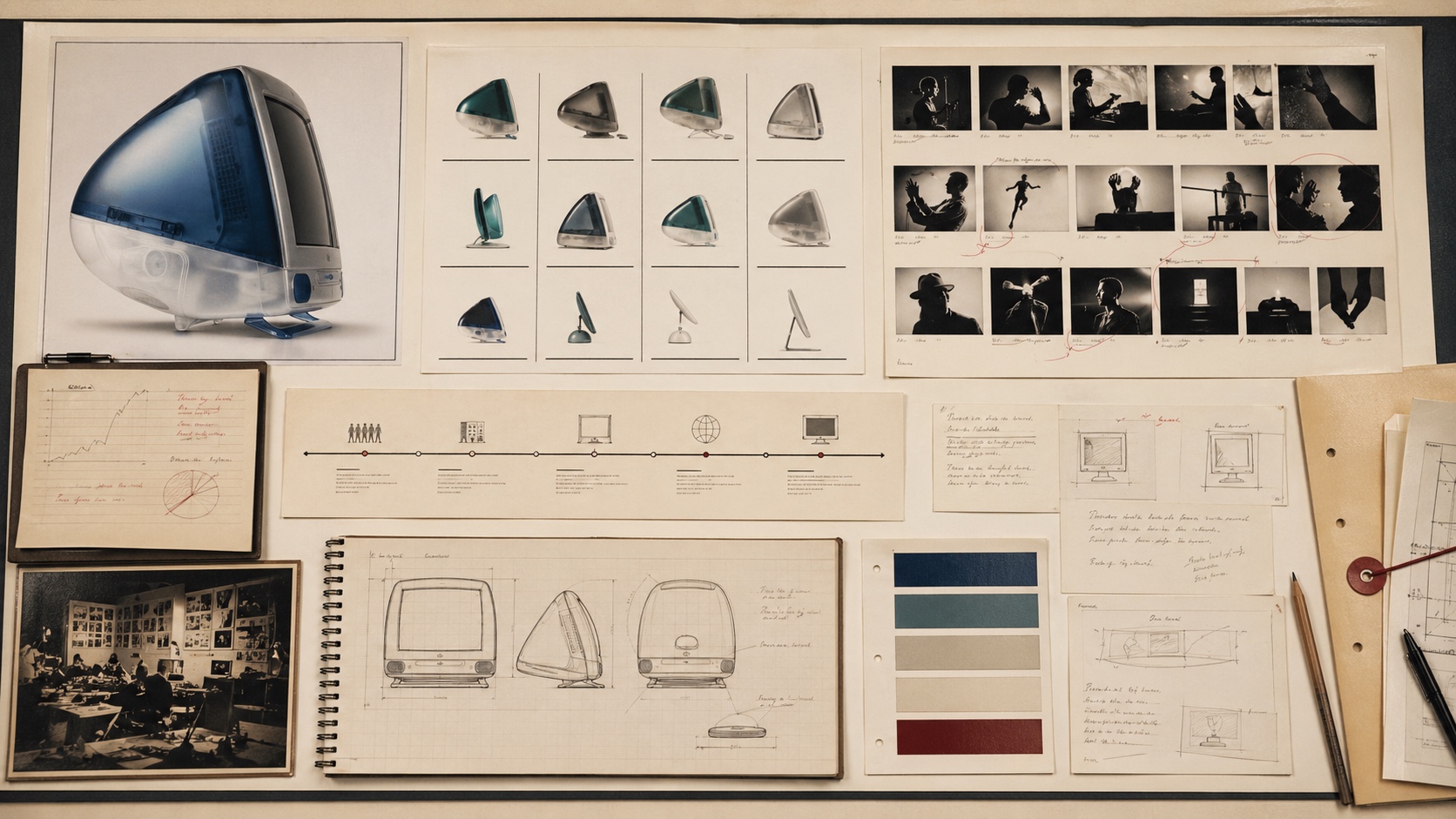
Apple and the Comeback That Made Focus Visible is a comeback case about Apple in 1997-1998. A damaged technology brand rebuilt confidence by turning focus into a visible system: fewer products, clearer values, a direct sales channel, and a consumer computer that made the promise tangible. A comeback becomes believable when the market can see the operating change behind the message. The campaign gave Apple language, but the narrowed product system and iMac gave the language proof.
Brand Entity
Apple has a parent brand file.
Apple: brand decisions on file collects the filed cases, source trail, concept paths, and primary visual proof for this brand.
Key Takeaways
- Apple's recovery was not merely an advertising comeback. It was a focus comeback.
- The brand campaign restored a point of view before the market had fully seen the product proof.
- The G3, online Apple Store, and iMac made the message operational rather than merely emotional.
- Positive brand transformations work when the company makes its new discipline visible in what it sells, how it sells, and what it refuses to keep carrying.
The Decision Context
By 1997, Apple was not suffering from one branding problem. It was suffering from a coherence problem. The company had brand affection, creative memory, and a famous origin story, but the business was harder to understand than the myth. The product line was noisy, the channel story was weak, and the market was unsure whether Apple still knew what made it necessary.
That is why the comeback matters as a positive brand file. The move was not to invent a new personality from nothing. It was to recover an existing point of view and make the organization act like it believed that point of view again.
The Brand Signal
In September 1997, Apple announced a new brand advertising campaign built around Think Different, created with TBWA Chiat/Day. The announcement framed the campaign as a return to Apple's core values, with Steve Jobs saying that the work celebrated the desire to change the world for the better and would tell customers that Apple was coming back.
The campaign did an important emotional job. It reminded the market what Apple wanted to stand for before the product line had fully caught up. That is risky. A campaign can become empty if operations do not follow. In Apple's case, the message worked because it was not left alone.
The Operating Reset
Two months later, Apple described what it called a new direction: design different, build different, sell different. The company launched G3 systems, opened the online Apple Store, and emphasized build-to-order manufacturing. The point was not merely a better chip or a new storefront. The point was that Apple was making focus visible in the way the business worked.
The first quarter of fiscal 1998 gave the reset financial proof. Apple reported a $47 million quarterly profit after losses, citing the successful introduction of Power Macintosh G3 computers and lower recurring operating expenses. The brand story was now attached to measurable operating improvement.
The Product Proof
The iMac made the comeback legible to ordinary buyers. Introduced in May 1998, it turned simplicity, internet access, color, and industrial design into one visible object. The machine was not a neutral box with a better ad campaign around it. It was a product that made the campaign's argument easier to believe.
That is the decisive difference between message and proof. A brand can say it thinks differently. A product has to show the difference quickly enough that people understand the claim without a strategy memo. The iMac gave Apple a physical answer to the question: what does the comeback look like?
Why It Worked
Apple's 1998 results showed the recovery moving beyond sentiment. CNNMoney reported that Apple achieved its first profitable year since 1995, with Jobs attributing much of the success to strong iMac sales. The company also reported that iMac buyers included a meaningful share of new Apple customers, a sign that the product was not merely pleasing loyalists.
By 2001, Apple announced that it had shipped its five millionth iMac, describing the computer as a design trendsetter and one of its most popular machines in homes, schools, and business. The long-term lesson is not that one campaign saved Apple. It is that the campaign, operating reset, and product proof reinforced each other.
The Decision Lesson
The Apple comeback is a positive case because it shows brand recovery as alignment. The message recovered meaning. The product line recovered focus. The direct channel recovered control. The iMac recovered visible distinction. None of those moves alone explains the turnaround, but together they made a damaged brand easier to believe again.
For brand leaders, the practical lesson is clear: do not ask a campaign to carry what the business has not changed. Use the campaign to name the promise, then make the promise visible in product architecture, pricing, channel, design, and daily customer experience. When those parts agree, the comeback stops sounding like a slogan and starts behaving like a company.
Where The Strategy Can Break
Apple should not be read as a clean success label. The useful question is where the comeback promise can fail in the real category: users depend on the system to work in ordinary moments, not in brand campaigns.
The weak reading is talking about scale, innovation, or ecosystem reach while hiding the exact behavior people repeat. That kind of page sounds polished but gives the reader no way to judge the decision.
The concrete failure mode is this: the name becomes large but less useful because the user cannot tell which part of the system solves the problem. If the case cannot explain that risk, the brand story is not finished.
The Bad Example
A bad Apple copycat would start with the visible surface: the mark, the color, the store, the app, the route, the campaign, or the public phrase. Then it would assume the surface created the result.
That is usually backwards. The surface worked only if the category proof underneath it was already strong enough: daily usage, uptime, distribution, account trust, partner tools, switching cost, and recovery when the service fails.
The page has to protect readers from that shortcut. The mistake is not ambition. The mistake is copying the artifact while leaving the constraint untouched.
What To Copy
Copy the discipline, not the costume. For Apple, the discipline sits in the link between technology pressure, customer behavior, and the proof a buyer or user can inspect.
A useful reader should be able to point to one behavior that changed, one risk that dropped, and one cue that helped the change stick.
If those three pieces are missing, the page should not pretend the case is a repeatable playbook. It is only a brand example with missing machinery.
The Proof Trail
Start with the year or period: 1997-1998. Then ask what was visible to the market at that time, what changed after the decision, and what evidence still exists now.
The source list gives the inspection trail. Use it to separate what Apple says about itself from what the case page argues about the brand decision.
The proof should answer five checks: daily behavior, uptime or access, user control, switching cost, failure recovery. If the page cannot answer them, the case needs more source work before anyone treats it as a decision record.
The Decision Limit
The case should not be used as a slogan for doing the same thing. It should be used as a boundary test. The question is whether the same market pressure, customer behavior, proof surface, and timing exist before the decision gets copied.
Apple gives the archive a concrete inspection point: daily usage, uptime, distribution, account trust, partner tools, switching cost, and recovery when the service fails. If a team cannot point to that proof in its own business, the comparison is weak, even when the visible asset looks similar.
The better lesson is operational. Decide what must be true before the cue, campaign, name, product, route, or experience can carry the promise. Then decide which signal would stop the move if customers reject it, ignore it, or use it in the wrong way.
A serious reader should leave with a constraint, not a mood. For Apple, the constraint sits in technology: who is choosing, what risk they are managing, which proof they can inspect, and what would make the promise collapse under normal use.
The final check is the comparison set. Put Apple beside two adjacent cases and ask what changed in each file: the cue, the behavior, the channel, the proof, the public language, or the operating burden. The answer keeps the case from becoming trivia.
This is where the archive page earns its keep. It turns a brand story into a decision memo: what changed, who had to believe it, what proof reduced the risk, what failure would expose the gap, and which nearby cases warn against copying the surface too quickly.
Case Depth
Why This Case Matters
Apple is the cleanest positive case for brand recovery as alignment. The campaign named the belief, but the product line, channel, cost discipline, and iMac made the belief observable.
The case matters because it warns against campaign-first turnaround thinking. The market did not need a prettier story from Apple. It needed proof that the company had recovered focus.
Operator Misread
What Operators Usually Misunderstand
- The shallow reading is that a famous campaign saved Apple. The practical reading is that message, product architecture, channel control, and operating proof moved together.
- Operators also misread the iMac as a design object alone. Its brand job was larger: it made simplicity, internet access, color, and focus easy to see in one product.
Source-Backed Timeline
The Decision Timeline
- September 1997 Apple launched the Think Different campaign and framed it as a return to the company's core values.
- November 1997 Apple described a new direction around design, build, and sell discipline, including G3 systems and the online Apple Store.
- January 1998 Apple reported a $47 million quarterly profit after losses, giving the comeback operating proof.
- May 1998 Apple introduced iMac, turning the comeback into a visible product instead of only a campaign argument.
- April 2001 Apple said it had shipped its five millionth iMac, showing that the product proof outlived the launch moment.
Comparable Cases
Sources
- MacTech archive of Apple press release, Apple Launches Brand Advertising Campaign, September 26, 1997
- MacTech archive of Apple press release, Apple's New Direction, November 10, 1997
- MacTech archive of Apple press release, Apple Reports First Fiscal Quarter Results, January 14, 1998
- MacTech archive of Apple press release, Apple Unveils iMac, May 6, 1998
- CNNMoney, Apple 4Q caps profitable 1998, October 14, 1998
- Apple Newsroom, Apple Ships 5 Millionth iMac, April 19, 2001
- Wikimedia Commons, Apple logo black file

People Also Ask
What happened to Apple?
Apple and the Comeback That Made Focus Visible is a comeback case about Apple in 1997-1998. A damaged technology brand rebuilt confidence by turning focus into a visible system: fewer products, clearer values, a direct sales channel, and a consumer computer that made the promise tangible. A comeback becomes believable when the market can see the operating change behind the message. The campaign gave Apple language, but the narrowed product system and iMac gave the language proof.
Why is Apple a comeback case?
Apple is filed as a comeback case because the visible consequence sits in that decision pattern. A damaged technology brand rebuilt confidence by turning focus into a visible system: fewer products, clearer values, a direct sales channel, and a consumer computer that made the promise tangible.
What can brands learn from Apple?
A comeback becomes believable when the market can see the operating change behind the message. The campaign gave Apple language, but the narrowed product system and iMac gave the language proof.
Is Apple still operating?
The Brand Archive marks Apple as Active / continuing. That means the brand, company, platform, product system, or parent organization is still operating, continuing, or being actively resolved.
What should Apple be compared with?
Compare Apple with CD Projekt Red, Burberry, LEGO to see the same decision pattern from nearby cases.