Brand System / Construction Equipment / 1931-present
Caterpillar Product Proof Case
Caterpillar's brand strength is not merely the Cat logo. It is the way yellow machines, job-site visibility, dealer service, and parts support turn industrial durability into a visible operating promise.

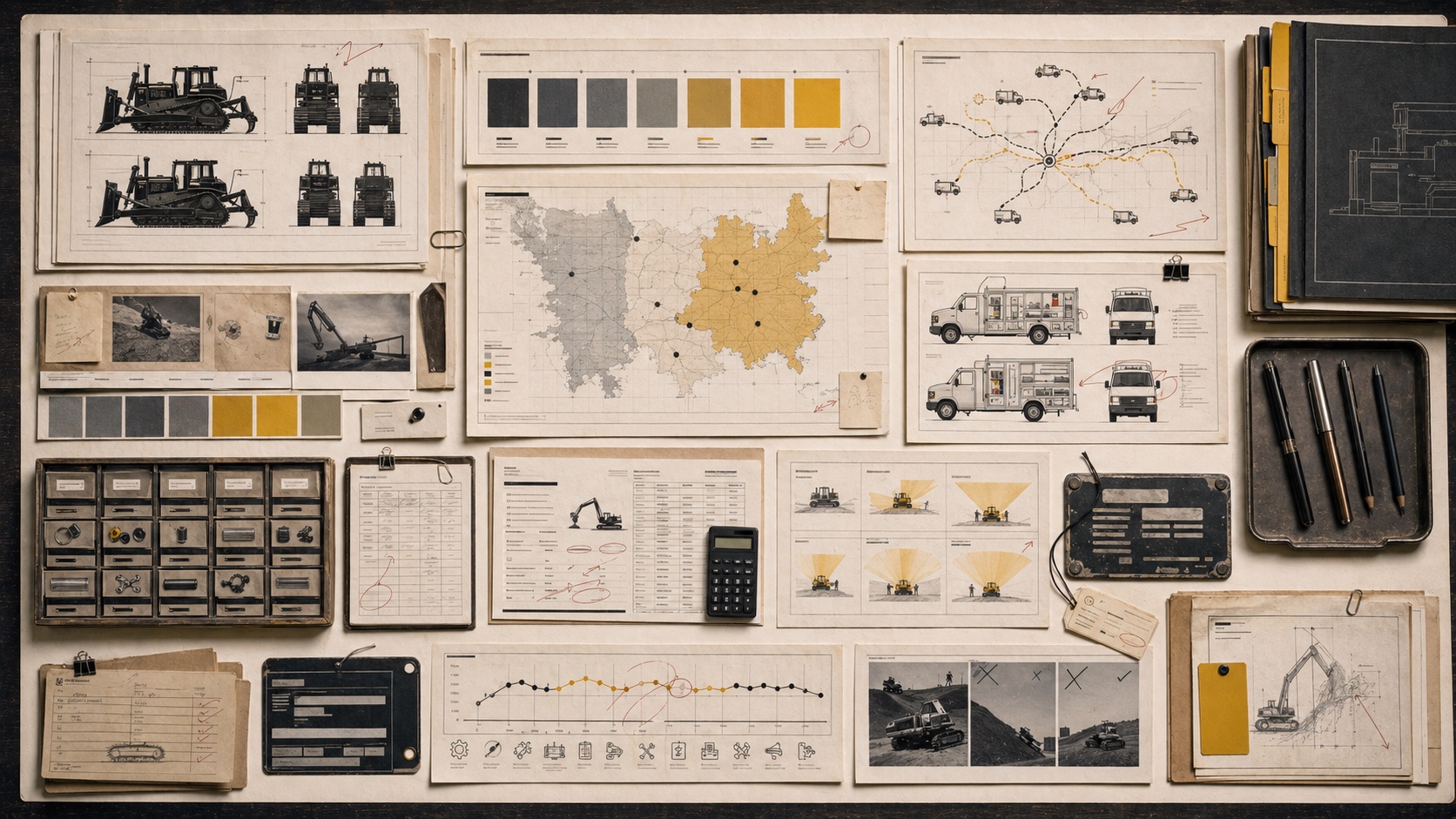
Short Answer
Caterpillar Product Proof Case is a brand system case about Caterpillar in 1931-present. A heavy-equipment company turned color, service infrastructure, dealer proximity, and machine endurance into a brand system that operators can recognize on a job site before they read a name. In industrial categories, brand is not merely memory. It is uptime, parts access, service confidence, resale belief, visibility, and the reading that the machine will still be supported after the purchase.
Key Takeaways
- Caterpillar was formed in 1925 from the merger of Holt Manufacturing Company and C. L. Best Tractor Co.
- The company moved from gray machines to Hi-Way Yellow in 1931, then to Caterpillar Yellow in 1979.
- The color system worked because it made machines visible, recognizable, and consistent across job sites.
- The dealer network and parts/service promise make the brand more than a mark: they turn ownership risk into an operating relationship.
The Decision Context
Caterpillar's brand did not begin as a graphic-design exercise. The company was created in 1925 when Holt Manufacturing Company and C. L. Best Tractor Co. merged. Holt brought the Caterpillar trademark and a global reputation. Best brought an advanced tractor design and the foundation of a strong dealer group. The company that emerged had to sell expensive machines whose value depended on work, repair, and endurance.
That context matters because construction equipment is not bought like a fashion logo. Operators and contractors are buying productivity under pressure: earth moved, roads built, mines running, machines serviced, parts found, projects finished. A mark can help recognition, but the brand has to reduce operating anxiety.
The Color Decision
Caterpillar's own visual-history archive says that 1925 machines were painted battleship gray. In 1931, the company changed its machine color from gray to Hi-Way Yellow. Its history timeline later notes that Hi-Way Yellow was discontinued in 1979 and replaced by Caterpillar Yellow, the color still associated with the machines.
The yellow decision did more than decorate steel. It made equipment visible in road construction and job-site conditions. It made fleets easier to recognize from distance. It created a moving field signal: machine, capability, industrial confidence, and ownership system. The result is rare in B2B branding because the product itself became the media surface.
Why It Worked
Yellow alone would not have built the brand. A weak machine painted yellow would only make disappointment easier to spot. The system worked because the visual cue pointed to a deeper operating promise: rugged equipment, dealer service, parts availability, financing, maintenance knowledge, and resale belief.
That is the difference between a color and a brand asset. A brand asset earns meaning when customers repeatedly experience the promise behind it. Caterpillar's yellow became shorthand for a working relationship, not merely for an object. On a job site, recognition has economic value because downtime has economic cost.
The Dealer Layer
Caterpillar's dealer language makes the service layer explicit. Cat's dealer-network page says the network has 160 independent dealers serving 197 countries, with thousands of branches worldwide. That is the strategic point: the brand is distributed trust as much as centralized manufacturing.
That distribution is strategically important. Heavy equipment is local when it breaks. A distant corporate promise is not enough if a contractor needs a part, technician, warranty answer, rental option, or replacement machine. The dealer turns the global brand into a local operating system.
The Trade Dress Pattern
Caterpillar's machine look evolved over decades: wavy logo, gray paint, Hi-Way Yellow, Cat usage on machines, trade-dress boxes, Caterpillar Yellow, beltline, Power Edge, and later product trade-dress updates. The lesson is not that every design choice stayed fixed. The lesson is that the system kept enough continuity for recognition while adapting the surface.
That continuity protects memory. Customers can accept updated marks, labels, model systems, and trim because the big signals remain legible: yellow machine, black industrial contrast, field durability, dealer support, and the expectation that this equipment belongs in hard work.
The Decision Lesson
Caterpillar belongs in the archive as a positive brand-system case because the brand is carried by an operating stack. The logo matters, but the stronger lesson is how color, product visibility, dealer infrastructure, parts availability, and machine reputation reinforce one another.
For leaders, the question is whether the brand cue points to something real. An ownable color, shape, name, or mark can create attention. It becomes durable only when it points to repeatable evidence. Caterpillar's yellow works because the customer is not merely seeing a machine. The customer is seeing support, uptime, resale value, and a century of accumulated field proof.
Where The Strategy Can Break
Caterpillar should not be read as a clean success label. The useful question is where the brand system promise can fail in the real category: customers are buying an object or material that has to work after the sale, often under pressure.
The weak reading is using engineering, scale, or quality language while failing to show what the buyer can inspect. That kind of page sounds polished but gives the reader no way to judge the decision.
The concrete failure mode is this: the brand keeps the technical aura but loses proof at the exact point where the customer needed reliability. If the case cannot explain that risk, the brand story is not finished.
The Bad Example
A bad Caterpillar copycat would start with the visible surface: the mark, the color, the store, the app, the route, the campaign, or the public phrase. Then it would assume the surface created the result.
That is usually backwards. The surface worked only if the category proof underneath it was already strong enough: engineering evidence, durability, service life, safety, supply reliability, and the cost of failure.
The page has to protect readers from that shortcut. The mistake is not ambition. The mistake is copying the artifact while leaving the constraint untouched.
What To Copy
Copy the discipline, not the costume. For Caterpillar, the discipline sits in the link between construction equipment pressure, customer behavior, and the proof a buyer or user can inspect.
A useful reader should be able to point to one behavior that changed, one risk that dropped, and one cue that helped the change stick.
If those three pieces are missing, the page should not pretend the case is a repeatable playbook. It is only a brand example with missing machinery.
The Proof Trail
Start with the year or period: 1931-present. Then ask what was visible to the market at that time, what changed after the decision, and what evidence still exists now.
The source list gives the inspection trail. Use it to separate what Caterpillar says about itself from what the case page argues about the brand decision.
The proof should answer five checks: durability proof, service or supply risk, safety burden, visible quality cue, cost of failure. If the page cannot answer them, the case needs more source work before anyone treats it as a decision record.
The Decision Limit
The case should not be used as a slogan for doing the same thing. It should be used as a boundary test. The question is whether the same market pressure, customer behavior, proof surface, and timing exist before the decision gets copied.
Caterpillar gives the archive a concrete inspection point: engineering evidence, durability, service life, safety, supply reliability, and the cost of failure. If a team cannot point to that proof in its own business, the comparison is weak, even when the visible asset looks similar.
The better lesson is operational. Decide what must be true before the cue, campaign, name, product, route, or experience can carry the promise. Then decide which signal would stop the move if customers reject it, ignore it, or use it in the wrong way.
A serious reader should leave with a constraint, not a mood. For Caterpillar, the constraint sits in construction equipment: who is choosing, what risk they are managing, which proof they can inspect, and what would make the promise collapse under normal use.
The final check is the comparison set. Put Caterpillar beside two adjacent cases and ask what changed in each file: the cue, the behavior, the channel, the proof, the public language, or the operating burden. The answer keeps the case from becoming trivia.
This is where the archive page earns its keep. It turns a brand story into a decision memo: what changed, who had to believe it, what proof reduced the risk, what failure would expose the gap, and which nearby cases warn against copying the surface too quickly.
Comparable Cases
Sources

People Also Ask
What happened to Caterpillar?
Caterpillar Product Proof Case is a brand system case about Caterpillar in 1931-present. A heavy-equipment company turned color, service infrastructure, dealer proximity, and machine endurance into a brand system that operators can recognize on a job site before they read a name. In industrial categories, brand is not merely memory. It is uptime, parts access, service confidence, resale belief, visibility, and the reading that the machine will still be supported after the purchase.
Why is Caterpillar a brand system case?
Caterpillar is filed as a brand system case because the visible consequence sits in that decision pattern. A heavy-equipment company turned color, service infrastructure, dealer proximity, and machine endurance into a brand system that operators can recognize on a job site before they read a name.
What can brands learn from Caterpillar?
In industrial categories, brand is not merely memory. It is uptime, parts access, service confidence, resale belief, visibility, and the feeling that the machine will still be supported after the purchase.
Is Caterpillar still operating?
The Brand Archive marks Caterpillar as Active / continuing. That means the brand, company, platform, product system, or parent organization is still operating, continuing, or being actively resolved.
What should Caterpillar be compared with?
Compare Caterpillar with Bugatti, Rolls-Royce, Bentley to see the same decision pattern from nearby cases.