Rebrand / Retail / 2010
The Logo Reversal That Exposed Recognition Risk
Gap's 2010 redesign became a reference case because the failure was not visual taste alone. It was a break in recognition, memory, and control.

Short Answer
The Logo Reversal That Exposed Recognition Risk is a rebrand case about Gap in 2010. A recognizable mark was replaced without enough public context, and the response revealed how quickly a symbol can become a governance issue. The Gap case shows that identity changes are not merely design decisions. They are recognition decisions. If leadership cannot identify which assets carry memory, it cannot judge which parts of a redesign are negotiable.
Brand Entity
Gap has a parent brand file.
Gap: brand decisions on file collects the filed cases, source trail, concept paths, and primary visual proof for this brand.
Key Takeaways
- The blue box was not decoration. It was the memory container customers used to recognize the brand.
- The rollout changed a familiar public asset without giving the market a clear reason to accept the change.
- The attempted crowdsourcing response made the new identity feel unresolved after it had already replaced the old mark.
- The reversal protected recognition, but it exposed a process failure inside the identity decision.
The Decision
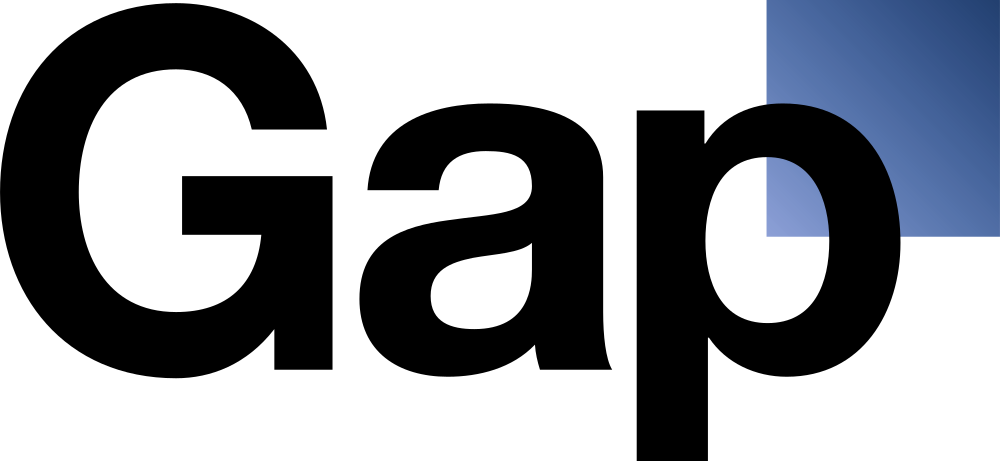
In October 2010, Gap replaced the familiar blue square mark on gap.com with a new identity: a black Gap wordmark set on a light field, with a small blue square moved to the upper-right area of the letter p. The company introduced the change quietly online rather than through a larger public argument for why the core identity needed to move.
On paper, the new mark kept a trace of the old system. In recognition terms, it changed the asset. The old logo was not simply a typographic treatment. It was a compact blue container, white letters, store sign, shopping bag, mall memory, and category signal. The redesign treated the blue box as a supporting cue rather than the central object people recognized.
What Broke
The response was immediate because the change arrived in a place where customers could compare memory against replacement. The criticism was not merely that the new logo looked weak. The deeper problem was that the public could not see what business problem the new identity solved. A new logo had appeared, the familiar asset had been displaced, and the brand had not earned the right to make the substitution feel inevitable.
Gap then tried to redirect the reaction toward public participation by asking people to share alternative ideas. That made the governance problem worse. Once a company has already removed a core recognition asset, asking the crowd to help solve the new identity can read less like openness and more like uncertainty. The market was no longer just evaluating a logo. It was evaluating whether Gap knew which parts of its own identity were non-negotiable.
The Reversal
On October 11, 2010, Gap Inc. published a statement from Marka Hansen, then president of Gap Brand North America, saying the company would keep the classic blue box logo. The statement framed the reversal around customer response and said that all roads were leading back to the blue box. It also acknowledged that the company had missed the right way to engage the online community.
That reversal matters because the failed redesign did not require a product defect, a lawsuit, or a technical collapse. The market forced an identity decision back into the company. In less than a week, a visual change became a public governance question: who decides what a familiar brand is allowed to change, and what evidence should leadership have before it changes it?
The Recognition Lesson
The Gap case is often remembered as a bad-logo story. That is too small. The design may have been the visible trigger, but the strategic mistake was failing to separate recognition equity from stylistic preference. A leadership team can dislike how an inherited asset feels and still be dealing with the strongest memory device the brand owns.
Before a rebrand, the real work is not choosing a fresher mark. It is mapping which assets carry public memory. That includes storefront readability, shopping bags, tags, receipts, site headers, social avatars, and the mental image customers use when they name the brand. If an element carries recognition, it is not automatically untouchable, but it requires a different level of evidence, explanation, and rollout discipline.
The Operating Pattern
Strong identity decisions test more than taste. They test whether customers still know who they are looking at when the system changes. They test whether the old asset can be reduced, evolved, or retired without breaking recognition. They test whether a transition story exists before the transition happens.
Gap could still evolve its identity in the future. The lesson is not that classic marks must never change. The lesson is that recognizable assets are governed assets. They need the same seriousness a company gives to distribution, pricing, product architecture, and customer trust. When the public memory sits inside the mark, the mark is operating infrastructure, not decoration.
Where The Strategy Can Break
Gap should not be read as a clean success label. The useful question is where the rebrand promise can fail in the real category: travel customers judge the brand when time, safety, comfort, baggage, booking, or recovery breaks.
The weak reading is describing national pride, premium service, or experience while skipping the operating proof behind the trip. That kind of page sounds polished but gives the reader no way to judge the decision.
The concrete failure mode is this: the route still exists, but the brand becomes a memory of delay, confusion, lost time, or service inconsistency. If the case cannot explain that risk, the brand story is not finished.
The Bad Example
A bad Gap copycat would start with the visible surface: the mark, the color, the store, the app, the route, the campaign, or the public phrase. Then it would assume the surface created the result.
That is usually backwards. The surface worked only if the category proof underneath it was already strong enough: schedule reliability, route coverage, service recovery, loyalty behavior, and the handoff between promise and trip.
The page has to protect readers from that shortcut. The mistake is not ambition. The mistake is copying the artifact while leaving the constraint untouched.
What To Copy
Copy the discipline, not the costume. For Gap, the discipline sits in the link between retail pressure, customer behavior, and the proof a buyer or user can inspect.
A useful reader should be able to point to one behavior that changed, one risk that dropped, and one cue that made the change easier to remember.
If those three pieces are missing, the page should not pretend the case is a repeatable playbook. It is only a brand example with missing machinery.
The Proof Trail
Start with the year or period: 2010. Then ask what was visible to the market at that time, what changed after the decision, and what evidence still exists now.
The source list gives the inspection trail. Use it to separate what Gap says about itself from what the case page argues about the brand decision.
The proof should answer five checks: route promise, time risk, handoff quality, service recovery, loyalty proof. If the page cannot answer them, the case needs more source work before anyone treats it as a decision record.
The Decision Limit
The case should not be used as a slogan for doing the same thing. It should be used as a boundary test. The question is whether the same market pressure, customer behavior, proof surface, and timing exist before the decision gets copied.
Gap gives the archive a concrete inspection point: schedule reliability, route coverage, service recovery, loyalty behavior, and the handoff between promise and trip. If a team cannot point to that proof in its own business, the comparison is weak, even when the visible asset looks similar.
The better lesson is operational. Decide what must be true before the cue, campaign, name, product, route, or experience can carry the promise. Then decide which signal would stop the move if customers reject it, ignore it, or use it in the wrong way.
A serious reader should leave with a constraint, not a mood. For Gap, the constraint sits in retail: who is choosing, what risk they are managing, which proof they can inspect, and what would make the promise collapse under normal use.
The final check is the comparison set. Put Gap beside two adjacent cases and ask what changed in each file: the cue, the behavior, the channel, the proof, the public language, or the operating burden. The answer keeps the case from becoming trivia.
This is where the archive page earns its keep. It turns a brand story into a decision memo: what changed, who had to believe it, what proof reduced the risk, what failure would expose the gap, and which nearby cases warn against copying the surface too quickly.
Case Depth
Why This Case Matters
Gap matters because the failure happened fast and in public. The case shows how quickly a familiar cue can become a governance issue when the market thinks the company has underpriced memory.
The case is a clean rebrand test: if leadership cannot name which assets carry recognition, it cannot know what a redesign is allowed to change.
Operator Misread
What Operators Usually Misunderstand
- The shallow reading is that people hated an ugly logo. The better reading is that customers rejected a cue change with no convincing reason and no protected-memory plan.
- Operators often mistake internal taste for market permission. A mark can feel dated inside the company and still be the fastest public recognition asset the brand owns.
Source-Backed Timeline
The Decision Timeline
- October 2010 Gap replaced the familiar blue box mark online with a new black wordmark and small blue-square cue.
- Days later Public criticism turned a design change into a recognition and governance question.
- October 11, 2010 Gap Inc. said it would keep the classic blue box logo after customer response led the company back to the familiar mark.
- After the reversal The blue box became the lesson: old equity can look stylistically tired while still doing critical recognition work.
Comparable Cases
Consequence Pattern
The Gap Pattern traces the repeatable decision pattern from this case across comparable brands.
Sources
- Gap Inc. official statement, GAP LISTENS TO CUSTOMERS AND WILL KEEP CLASSIC BLUE BOX LOGO, October 11, 2010
- CNNMoney, New Gap logo ignites firestorm, October 8, 2010
- CNNMoney, Gap reverts to classic logo after outcry, October 12, 2010
- Forbes, New Gap Logo Hated by Many, Company Turns to Crowdsourcing Tactics, October 7, 2010
- The Guardian, Gap scraps logo redesign after protests on Facebook and Twitter, October 12, 2010
- Wikimedia Commons, Gap logo and Gap logo in October 2010 files
- Wikimedia Commons, Gap logo file


People Also Ask
What happened to Gap?
The Logo Reversal That Exposed Recognition Risk is a rebrand case about Gap in 2010. A recognizable mark was replaced without enough public context, and the response revealed how quickly a symbol can become a governance issue. The Gap case shows that identity changes are not merely design decisions. They are recognition decisions. If leadership cannot identify which assets carry memory, it cannot judge which parts of a redesign are negotiable.
Why is Gap a rebrand case?
Gap is filed as a rebrand case because the visible consequence sits in that decision pattern. A recognizable mark was replaced without enough public context, and the response revealed how quickly a symbol can become a governance issue.
What can brands learn from Gap?
The Gap case shows that identity changes are not merely design decisions. They are recognition decisions. If leadership cannot identify which assets carry memory, it cannot judge which parts of a redesign are negotiable.
Is Gap still operating?
The Brand Archive marks Gap as Active / continuing. That means the brand, company, platform, product system, or parent organization is still operating, continuing, or being actively resolved.
What should Gap be compared with?
Compare Gap with Microsoft, Nickelodeon, Taco Bell to see the same decision pattern from nearby cases.