Launch / Furniture Retail / 1953-present
IKEA Service Route Case
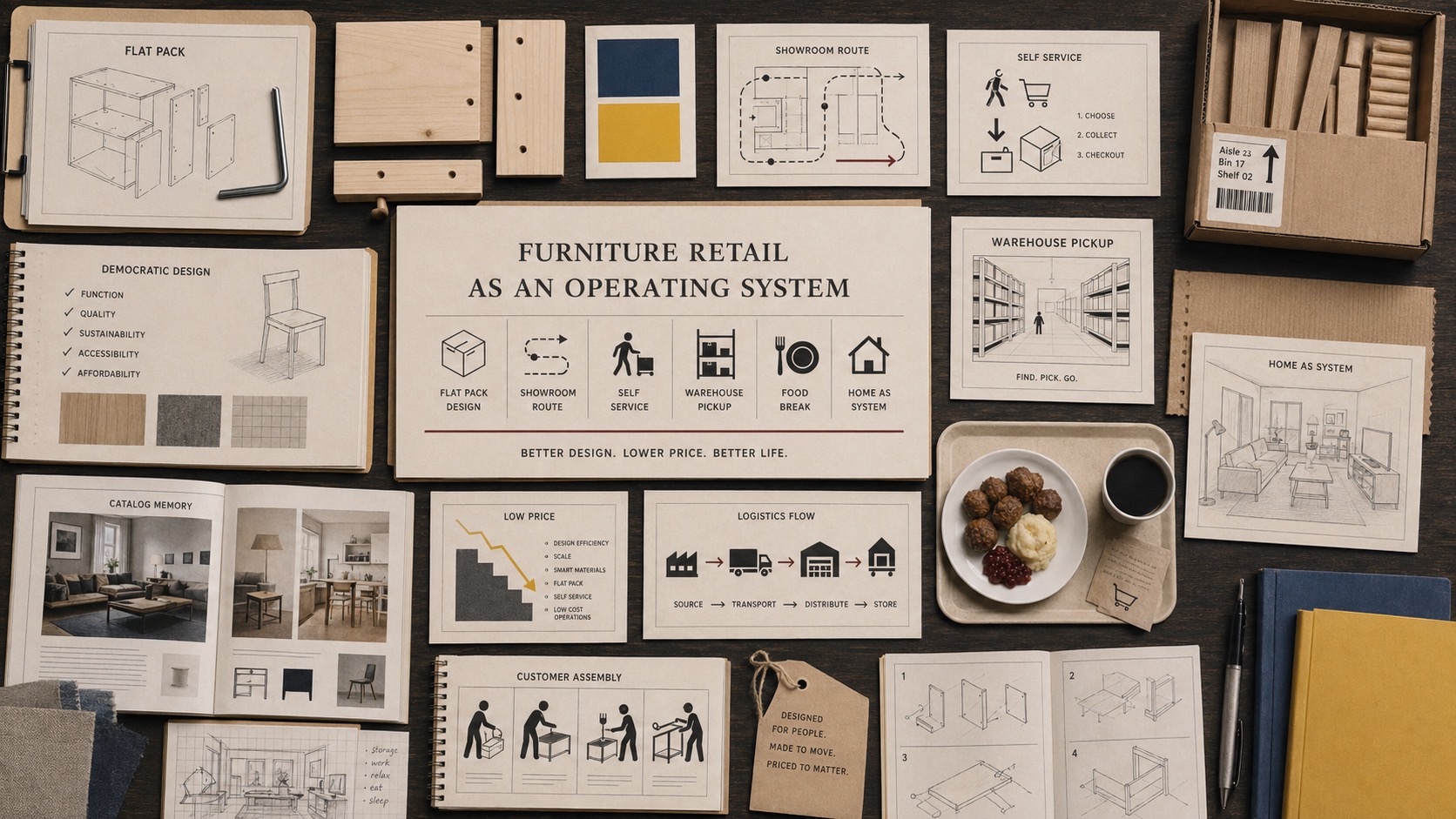
IKEA turned low-price furniture into a whole operating system: showroom route, catalog memory, flat-pack logistics, self-service pickup, customer assembly, and food as part of the trip.

Short Answer
IKEA Service Route Case is a launch case about IKEA in 1953-present. A furniture brand became a retail operating system by asking customers to participate in the value chain: see the room, move through the route, collect the box, transport it home, and assemble the object. The strongest retail brands do not merely design products. They design behavior. IKEA made low price credible by turning cost-saving operations into a repeatable customer path people could understand, tolerate, and often enjoy.
Key Takeaways
- IKEA's early showroom and first store combined catalogue selling, room settings, immediate take-home furniture, and flat-pack distribution into a new retail model.
- Flat-pack and customer assembly made the customer part of the value chain, lowering transport and handling friction while making the brand behavior distinct.
- Food, showroom routes, warehouse pickup, catalog memory, and room vignettes made the visit feel like a system for imagining and completing a home.
- The case is positive because the operating choices reinforced the same promise: useful design, acceptable quality, and lower prices for more people.
The Decision Context
IKEA is often discussed as a design brand, but its deeper case is operational. The brand did not win only because furniture looked Scandinavian or because the logo became familiar. It won because the customer could learn a whole method for furnishing a home at a lower price.
That method combined many decisions that normally sit in separate departments: product design, packaging, logistics, store path, catalogue imagination, self-service, food, home settings, customer transport, and assembly instructions. Together, they made IKEA feel less like a furniture shop and more like a repeatable home-furnishing machine.
The Showroom Became Proof
IKEA Museum's account of the first store shows how the early model moved from mail order toward physical proof. The 1953 showroom let customers inspect furniture, and the 1958 store in Älmhult combined catalogue selling, home-like showroom settings, storage, and the possibility of taking some furniture home the same day in flat packs.
That was a strategic shift. A low-price furniture promise can create suspicion if customers cannot see, touch, and test the product. The showroom answered that risk by making the home visible before the transaction, while the warehouse and flat-pack model made the purchase operationally possible.
Flat-Pack As Brand Behavior
Flat-pack did more than change shipping. It changed the customer's role. The customer accepted a piece of work at the end of the value chain: finding the package, moving it, bringing it home, reading instructions, and assembling the furniture.
IKEA Museum's Allen-key story makes the trade-off clear. Customers could get function, quality, design, and lower price, but they also had to participate. Early assembly confusion forced IKEA to improve instructions and simplify the experience. The brand promise became believable only when the customer effort felt fair.
The Store As A Script
The IKEA trip is unusually scripted for a retail visit. Room settings help customers imagine the home. The path creates exposure to solutions before pickup. The self-service area turns choice into logistics. The checkout, food, and loading stage make the visit a sequence rather than a loose browsing event.
That script matters because it makes the operating model legible. Customers know the bargain they are entering: IKEA will give them designed solutions at lower prices, and they will contribute time, attention, transport, and assembly. The system teaches the deal as people move through it.
Food And Catalog Memory
The restaurant is not a novelty bolted onto the business. IKEA Museum notes that a provisional servery after the first store extension became an IKEA restaurant, laying a foundation for restaurants in IKEA stores. Food made a long furniture trip more tolerable and helped turn shopping into an outing.
The catalog did parallel work in memory. It let people rehearse homes before visiting and keep IKEA in the house after leaving. The brand did not depend only on an ad impression. It lived in room scenes, measurements, prices, wish lists, product families, and the recurring ritual of imagining a better version of everyday space.
Democratic Design As Governance
IKEA's Democratic Design language gives the operating system a product filter: form, function, quality, sustainability, and low price. The important part is the tension between the dimensions. A product cannot be beautiful but unaffordable, cheap but useless, practical but wasteful, or sustainable only for customers who can pay a premium.
That framework helps explain why IKEA's brand is difficult to copy. The visible pieces are easy to imitate: blue and yellow, flat boxes, room sets, simple furniture, meatballs, short names, and warehouse aisles. The harder part is governing thousands of decisions so that price, design, production, logistics, and customer labor keep reinforcing one another.
The Decision Lesson
IKEA belongs in the archive as a positive physical-retail system case. Its core brand asset is not one slogan, one product, or one store design. It is the operating bargain customers learned to perform.
For leaders, the lesson is that a brand can become stronger when the business model is visible. IKEA did not hide the work required to make prices lower. It organized that work into a path customers could understand: look, choose, collect, carry, assemble, and live with the result.
Where The Strategy Can Break
IKEA should not be read as a clean success label. The useful question is where the launch promise can fail in the real category: travel customers judge the brand when time, safety, comfort, baggage, booking, or recovery breaks.
The weak reading is describing national pride, premium service, or experience while skipping the operating proof behind the trip. That kind of page sounds polished but gives the reader no way to judge the decision.
The concrete failure mode is this: the route still exists, but the brand becomes a memory of delay, confusion, lost time, or service inconsistency. If the case cannot explain that risk, the brand story is not finished.
The Bad Example
A bad IKEA copycat would start with the visible surface: the mark, the color, the store, the app, the route, the campaign, or the public phrase. Then it would assume the surface created the result.
That is usually backwards. The surface worked only if the category proof underneath it was already strong enough: schedule reliability, route coverage, service recovery, loyalty behavior, and the handoff between promise and trip.
The page has to protect readers from that shortcut. The mistake is not ambition. The mistake is copying the artifact while leaving the constraint untouched.
What To Copy
Copy the discipline, not the costume. For IKEA, the discipline sits in the link between furniture retail pressure, customer behavior, and the proof a buyer or user can inspect.
A useful reader should be able to point to one behavior that changed, one risk that dropped, and one cue that helped the change stick.
If those three pieces are missing, the page should not pretend the case is a repeatable playbook. It is only a brand example with missing machinery.
The Proof Trail
Start with the year or period: 1953-present. Then ask what was visible to the market at that time, what changed after the decision, and what evidence still exists now.
The source list gives the inspection trail. Use it to separate what IKEA says about itself from what the case page argues about the brand decision.
The proof should answer five checks: route promise, time risk, handoff quality, service recovery, loyalty proof. If the page cannot answer them, the case needs more source work before anyone treats it as a decision record.
The Decision Limit
The case should not be used as a slogan for doing the same thing. It should be used as a boundary test. The question is whether the same market pressure, customer behavior, proof surface, and timing exist before the decision gets copied.
IKEA gives the archive a concrete inspection point: schedule reliability, route coverage, service recovery, loyalty behavior, and the handoff between promise and trip. If a team cannot point to that proof in its own business, the comparison is weak, even when the visible asset looks similar.
The better lesson is operational. Decide what must be true before the cue, campaign, name, product, route, or experience can carry the promise. Then decide which signal would stop the move if customers reject it, ignore it, or use it in the wrong way.
A serious reader should leave with a constraint, not a mood. For IKEA, the constraint sits in furniture retail: who is choosing, what risk they are managing, which proof they can inspect, and what would make the promise collapse under normal use.
The final check is the comparison set. Put IKEA beside two adjacent cases and ask what changed in each file: the cue, the behavior, the channel, the proof, the public language, or the operating burden. The answer keeps the case from becoming trivia.
This is where the archive page earns its keep. It turns a brand story into a decision memo: what changed, who had to believe it, what proof reduced the risk, what failure would expose the gap, and which nearby cases warn against copying the surface too quickly.
Comparable Cases
Sources

People Also Ask
What happened to IKEA?
IKEA Service Route Case is a launch case about IKEA in 1953-present. A furniture brand became a retail operating system by asking customers to participate in the value chain: see the room, move through the route, collect the box, transport it home, and assemble the object. The strongest retail brands do not merely design products. They design behavior. IKEA made low price credible by turning cost-saving operations into a repeatable customer path people could understand, tolerate, and often enjoy.
Why is IKEA a launch case?
IKEA is filed as a launch case because the visible consequence sits in that decision pattern. A furniture brand became a retail operating system by asking customers to participate in the value chain: see the room, move through the route, collect the box, transport it home, and assemble the object.
What can brands learn from IKEA?
The strongest retail brands do not merely design products. They design behavior. IKEA made low price credible by turning cost-saving operations into a repeatable customer path people could understand, tolerate, and often enjoy.
Is IKEA still operating?
The Brand Archive marks IKEA as Active / continuing. That means the brand, company, platform, product system, or parent organization is still operating, continuing, or being actively resolved.
What should IKEA be compared with?
Compare IKEA with Nubank, iFood, Tinkoff to see the same decision pattern from nearby cases.