Failure / Beverage / 1985
New Coke and the Error of Replacing Memory
The product test measured preference. The market response revealed ownership, ritual, and identity sitting underneath the formula decision.
Short Answer
New Coke and the Error of Replacing Memory is a failure case about Coca-Cola in 1985. The decision treated a product formula as the asset, while the public treated the brand memory around the formula as the asset. A brand can hold value that does not appear in product testing. When ritual and memory are part of the asset, replacing the product can read as a transfer of control away from the customer.
Brand Entity
Coca-Cola has a parent brand file.
Coca-Cola: brand decisions on file collects the filed cases, source trail, concept paths, and primary visual proof for this brand.
Key Takeaways
- The taste-test evidence answered a narrow product question, not the larger brand-ownership question.
- The launch replaced the original formula instead of treating the new formula as a managed addition.
- The backlash showed that customers can feel ownership over a brand asset even when the company owns the trademark.
- The return of Coca-Cola Classic turned the failure into a permanent lesson about memory, ritual, and control.
The Decision
On April 23, 1985, The Coca-Cola Company announced that it was changing the formula of its flagship cola in the United States. The company introduced a reformulated product that became known publicly as New Coke. The move was meant to respond to competitive pressure in the cola category, especially Pepsi's momentum and the long-running taste-test narrative around sweeter cola preference.
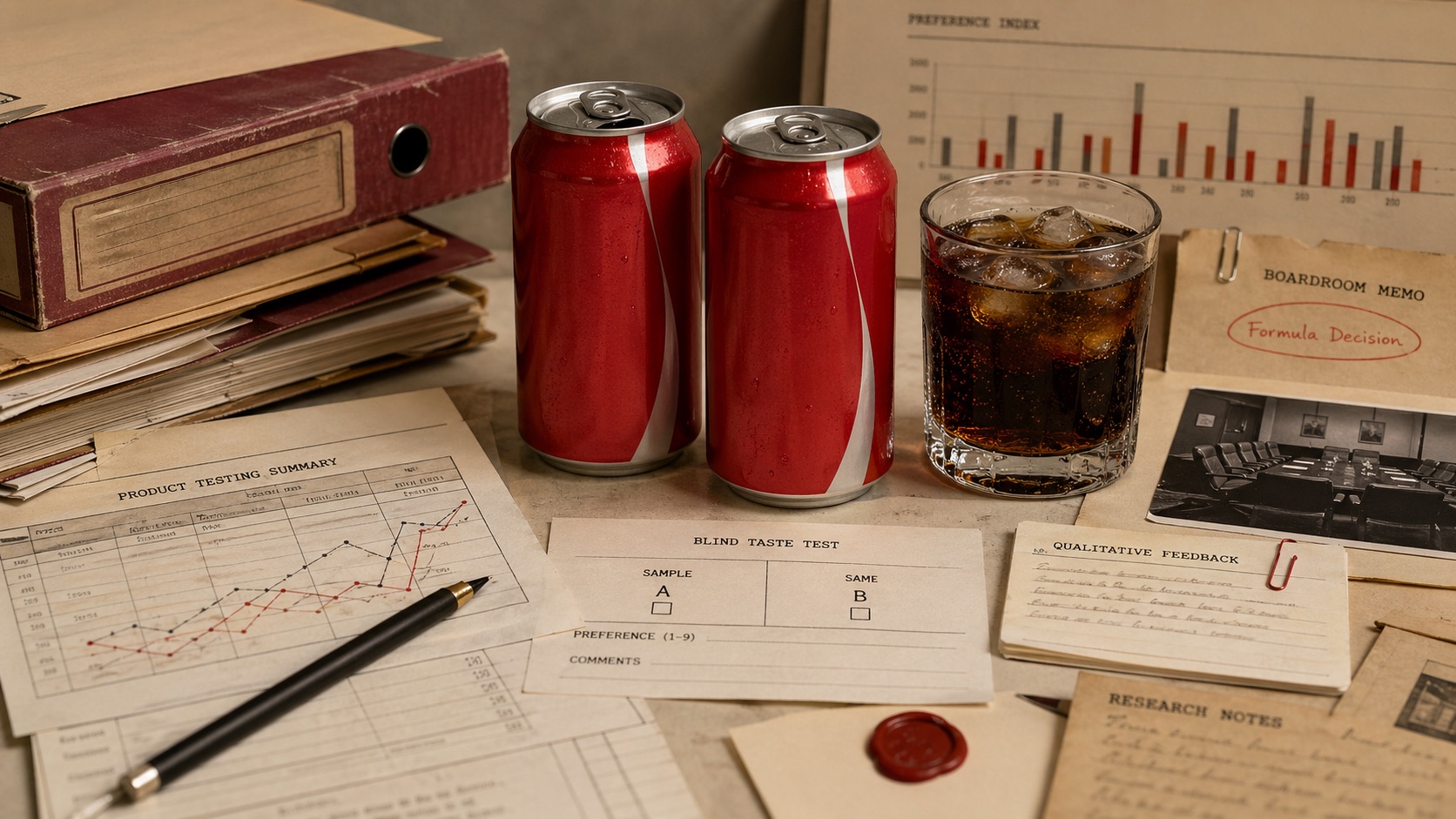
The decision was not made without evidence. Coca-Cola's own history of the event says the new formula had been preferred in taste tests of nearly 200,000 consumers. The mistake was not that the company ignored research. The mistake was that the research answered the wrong strategic question. It measured which liquid people preferred in a controlled test. It did not measure what would happen when the familiar product was removed from public life.
What The Research Missed
A blind taste test isolates flavor. A brand decision does not. Coca-Cola was not merely a beverage formula in 1985. It was habit, national memory, advertising language, refrigerator ritual, family routine, and a piece of American commercial identity. Those meanings do not appear clearly when people are asked to choose a sip in a test environment.
The public reaction revealed a distinction that still matters for brand operators: preference is not the same as permission. A customer may prefer a sweeter sample and still reject the company's right to remove the original. In the New Coke case, the product was changed, but the public experienced the move as a break in continuity.
What Broke
The reaction was fast and emotional. Coca-Cola's own account describes consumer complaints, public protest, hoarding of the old product, and calls into the company. HISTORY reports that the company received thousands of calls a day and tens of thousands of complaint letters. The intensity made clear that the decision had moved beyond taste.
The strategic issue was control. By replacing the original formula, Coca-Cola made the decision feel final. Customers were not being invited to try a new product. They were being told that a shared ritual had been changed for them. That is why the case still has force: the company owned the recipe, but the public felt it owned the memory.
The Reversal
On July 11, 1985, Coca-Cola announced the return of the original formula as Coca-Cola Classic. The company's own history frames the return as the cap on 79 days that transformed the company and the soft-drink industry. The reversal did not make New Coke disappear immediately, but it restored the public's access to the product memory that had been removed.
The return also changed the meaning of the failure. New Coke became a permanent reference case because the company survived the mistake and, in some ways, strengthened the emotional salience of the original. But that outcome does not make the decision strategically sound. It shows how powerful the underlying asset was.
The Decision Lesson
The lesson is not that brands can never change products. The lesson is that product changes need to identify which layer of the brand they are touching. A formula can be chemistry, but it can also be continuity. When continuity is the asset, replacement behaves differently from extension.
A better decision process would have separated product preference, market share pressure, category positioning, customer memory, and transition design. The most dangerous question was not whether the new formula tasted better. It was whether the company had the right to make the old experience unavailable.
The Operating Pattern
New Coke is the operating pattern for research overconfidence. The more confident the quantitative answer looks, the more important it becomes to ask what the test excludes. If the test strips away brand name, memory, context, and ownership, it can produce a clear answer to a partial question.
Before replacing a legacy asset, leadership needs a protected-memory map. That map asks what customers would feel had been taken away if the asset disappeared. If the answer is ritual, identity, or continuity, the decision cannot be treated as a product optimization alone.
Where The Strategy Can Break
Coca-Cola should not be read as a clean success label. The useful question is where the failure promise can fail in the real category: travel customers judge the brand when time, safety, comfort, baggage, booking, or recovery breaks.
The weak reading is describing national pride, premium service, or experience while skipping the operating proof behind the trip. That kind of page sounds polished but gives the reader no way to judge the decision.
The concrete failure mode is this: the route still exists, but the brand becomes a memory of delay, confusion, lost time, or service inconsistency. If the case cannot explain that risk, the brand story is not finished.
The Bad Example
A bad Coca-Cola copycat would start with the visible surface: the mark, the color, the store, the app, the route, the campaign, or the public phrase. Then it would assume the surface created the result.
That is usually backwards. The surface worked only if the category proof underneath it was already strong enough: schedule reliability, route coverage, service recovery, loyalty behavior, and the handoff between promise and trip.
The page has to protect readers from that shortcut. The mistake is not ambition. The mistake is copying the artifact while leaving the constraint untouched.
What To Copy
Copy the discipline, not the costume. For Coca-Cola, the discipline sits in the link between beverage pressure, customer behavior, and the proof a buyer or user can inspect.
A useful reader should be able to point to one behavior that changed, one risk that dropped, and one cue that made the change easier to remember.
If those three pieces are missing, the page should not pretend the case is a repeatable playbook. It is only a brand example with missing machinery.
The Proof Trail
Start with the year or period: 1985. Then ask what was visible to the market at that time, what changed after the decision, and what evidence still exists now.
The source list gives the inspection trail. Use it to separate what Coca-Cola says about itself from what the case page argues about the brand decision.
The proof should answer five checks: route promise, time risk, handoff quality, service recovery, loyalty proof. If the page cannot answer them, the case needs more source work before anyone treats it as a decision record.
The Decision Limit
The case should not be used as a slogan for doing the same thing. It should be used as a boundary test. The question is whether the same market pressure, customer behavior, proof surface, and timing exist before the decision gets copied.
Coca-Cola gives the archive a concrete inspection point: schedule reliability, route coverage, service recovery, loyalty behavior, and the handoff between promise and trip. If a team cannot point to that proof in its own business, the comparison is weak, even when the visible asset looks similar.
The better lesson is operational. Decide what must be true before the cue, campaign, name, product, route, or experience can carry the promise. Then decide which signal would stop the move if customers reject it, ignore it, or use it in the wrong way.
A serious reader should leave with a constraint, not a mood. For Coca-Cola, the constraint sits in beverage: who is choosing, what risk they are managing, which proof they can inspect, and what would make the promise collapse under normal use.
The final check is the comparison set. Put Coca-Cola beside two adjacent cases and ask what changed in each file: the cue, the behavior, the channel, the proof, the public language, or the operating burden. The answer keeps the case from becoming trivia.
This is where the archive page earns its keep. It turns a brand story into a decision memo: what changed, who had to believe it, what proof reduced the risk, what failure would expose the gap, and which nearby cases warn against copying the surface too quickly.
Case Depth
Why This Case Matters
New Coke matters because it separates preference from permission. A customer can prefer a sample and still reject the company's right to remove a shared ritual.
The case is a research-governance file. It shows that a strong quantitative answer can still be the wrong answer if the test excludes the real brand asset.
Operator Misread
What Operators Usually Misunderstand
- The shallow reading is that Coca-Cola ignored customers. The sharper reading is that the company listened to one kind of evidence and missed the ownership layer underneath the product.
- Operators often treat legacy assets as technical parts. New Coke shows that a formula, package, name, or feature can become continuity, not just performance.
Source-Backed Timeline
The Decision Timeline
- April 23, 1985 The Coca-Cola Company announced a reformulated flagship cola in the United States.
- Spring 1985 Consumer reaction showed that the decision had moved beyond taste preference into memory, ritual, and control.
- July 11, 1985 Coca-Cola announced the return of the original formula as Coca-Cola Classic.
- After 1985 New Coke became a permanent warning about product research that strips away context, memory, and customer ownership.
Comparable Cases
Sources
- The Coca-Cola Company, New Coke: The Most Memorable Marketing Blunder Ever?
- The Coca-Cola Company, Veteran Employees Remember Infamous 1985 Launch of New Coke, April 23, 2015
- HISTORY, New Coke debuts, one of the biggest product flops in history, updated May 27, 2025
- HISTORY, Why Coca-Cola's New Coke Flopped, updated May 27, 2025
- Encyclopaedia Britannica, New Coke, updated February 23, 2026
- Snopes, Was the New Coke Fiasco Just a Clever Marketing Ploy?
- Wikimedia Commons, New Coke can
- Wikimedia Commons, Coca-Cola logo file


People Also Ask
What happened to Coca-Cola?
New Coke and the Error of Replacing Memory is a failure case about Coca-Cola in 1985. The decision treated a product formula as the asset, while the public treated the brand memory around the formula as the asset. A brand can hold value that does not appear in product testing. When ritual and memory are part of the asset, replacing the product can read as a transfer of control away from the customer.
Why is Coca-Cola a failure case?
Coca-Cola is filed as a failure case because the visible consequence sits in that decision pattern. The decision treated a product formula as the asset, while the public treated the brand memory around the formula as the asset.
What can brands learn from Coca-Cola?
A brand can hold value that does not appear in product testing. When ritual and memory are part of the asset, replacing the product can read as a transfer of control away from the customer.
Is Coca-Cola still operating?
The Brand Archive marks Coca-Cola as Active / continuing. That means the brand, company, platform, product system, or parent organization is still operating, continuing, or being actively resolved.
What should Coca-Cola be compared with?
Compare Coca-Cola with Tropicana, JCPenney, Netflix to see the same decision pattern from nearby cases.