Patagonia's 2011 Black Friday ad made anti-consumption public by asking customers to think before buying and by tying that message to repair, reuse, recycle, and reduction.
Brand case guide · original URL preserved
Patagonia and the Ownership Move That Made Purpose Structural
A purpose-led apparel brand moved from saying the business should reduce harm toward structuring ownership so profits, voting control, repair culture.
Short AnswerPatagonia and the Ownership Move That Made Purpose Structural is a pivot case about Patagonia in 2011-2022. A purpose-led apparel brand moved from saying the business should reduce harm toward structuring ownership so profits, voting control, repair culture, and environmental commitments carried the same argument. Purpose becomes stronger when it is tied to operating choices customers can see and governance choices future owners cannot easily undo.
What Patagonia teachesPatagonia's 2011 Black Friday ad made anti-consumption public by asking customers to think before buying and by tying that message to repair, reuse, recycle, and reduction.
What ChangedA purpose-led apparel brand moved from saying the business should reduce harm toward structuring ownership so profits, voting control, repair culture, and environmental commitments carried the same argument.
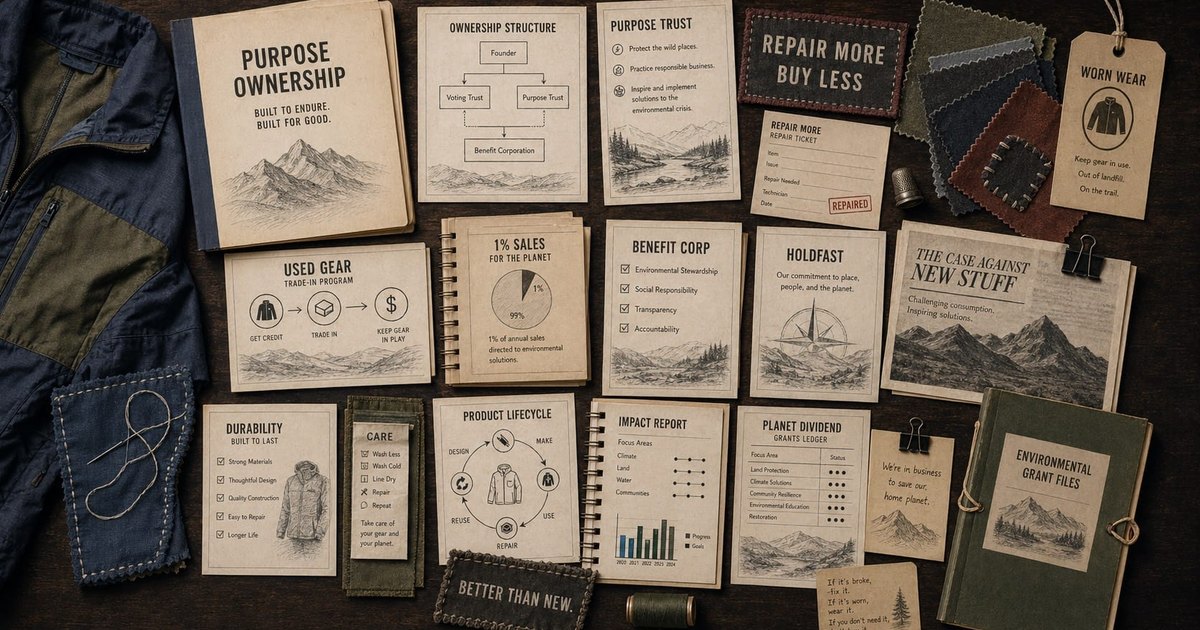
Patagonia Purpose Ownership Structure
decision · proof · use
01
Short Answer
Short AnswerPatagonia and the Ownership Move That Made Purpose Structural is a pivot case about Patagonia in 2011-2022. A purpose-led apparel brand moved from saying the business should reduce harm toward structuring ownership so profits, voting control, repair culture, and environmental commitments carried the same argument. Purpose becomes stronger when it is tied to operating choices customers can see and governance choices future owners cannot easily undo.
02
What Patagonia teaches
Worn Wear turned durability into a service system through repairs, trade-in, used gear, care guides, and keeping products in use longer.
B Lab lists Patagonia as a certified B Corporation since December 2011, giving the brand an outside governance frame before the later ownership move.
Patagonia says it has pledged 1 percent of sales to environmental preservation and restoration since 1985.
In 2022, Patagonia transferred voting stock to the Patagonia Purpose Trust and nonvoting stock to the Holdfast Collective, making the ownership structure part of the brand promise.
03
What Changed
What ChangedA purpose-led apparel brand moved from saying the business should reduce harm toward structuring ownership so profits, voting control, repair culture, and environmental commitments carried the same argument.
Evidence 2The change forced the market to decide whether the old shortcut still worked, whether the new proof was strong enough, and whether the brand had made the category easier or harder to understand.
04
The Decision Context
The Decision ContextPatagonia is useful because it is not a simple purpose-marketing case. Many brands talk about values. Patagonia spent years making the values operational: durable products, repair, used gear, environmental giving, activism, B Corp certification, and finally an ownership structure designed to keep the mission from being traded away.
Evidence 2That creates a sharper brand question than whether the company sounds virtuous. Can a business that sells new apparel credibly tell customers to buy less, repair more, and treat consumption as a real environmental cost? Patagonia's answer has been to make the contradiction visible rather than hide it.
05
Anti-Consumption As Brand Risk
Anti-Consumption As Brand RiskThe 2011 Black Friday ad was the symbolic moment because it violated the default retail script. A clothing company used a major shopping day to tell customers to think before buying. The point was not merely provocation. It was a way to put the company's own sales model under scrutiny.
Evidence 2That move was risky because it invited the obvious accusation: a growing retailer criticizing consumption while still selling products. But the risk is why the case belongs in the guide. Patagonia did not position purpose as a soft layer over commerce. It made the tension the subject.
06
Repair As Proof
Repair As ProofWorn Wear matters because it gives the purpose language a practical surface. Trade-in, used gear, repair guides, repair services, and product-care education turn durability into behavior. Customers can see whether the brand helps them extend the life of what they already own.
Evidence 2That is strategically different from a sustainability claim printed in a campaign. Repair changes the customer relationship. It asks the company to make money while also making replacement less automatic. The result is a brand system where the product's afterlife is part of the brand, not an afterthought.
07
Governance Before Ownership
Governance Before OwnershipThe 2022 ownership move did not arrive from nowhere. Patagonia had already built governance proof around purpose. B Lab lists the company as certified since December 2011, and Patagonia had written benefit-corporation commitments into its structure before transferring ownership.
Evidence 2That sequencing matters. The ownership transfer was more credible because it looked like the next layer of an existing system rather than a sudden reputation maneuver. The brand had already trained customers to expect durability, repair, environmental funding, and public activism.
08
The Ownership Pivot
The Ownership PivotIn 2022, Patagonia announced that the company's voting stock would transfer to the Patagonia Purpose Trust and the nonvoting stock to the Holdfast Collective. The company described the structure as a way to protect values while directing excess profits toward environmental work.
Evidence 2This changed the brand argument. Purpose was no longer only a mission line or a campaign posture. It became a control system. The trust protects voting control and company values; the collective receives economic value for environmental work. The brand promise moved from communication into ownership design.
09
The Tension Still Matters
The Tension Still MattersThe case should not be flattened into admiration. Patagonia still operates a for-profit apparel business with stores, catalogs, product launches, supply chains, and the environmental impact of making things. The company itself acknowledges the tension between growth and environmental harm.
Evidence 2That tension is the point. A purpose brand becomes stronger when it names the conflict and builds mechanisms to govern it. If the company keeps selling more while asking people to buy less, the proof burden remains high. Repair, resale, responsible sourcing, activism, and ownership are the evidence that keeps the claim from becoming mood.
10
The Decision Lesson
The Decision LessonPatagonia belongs in the guide as a purpose-to-governance pivot. The brand did not rely on one campaign or one founder story. It used product design, repair behavior, environmental funding, certification, legal structure, and ownership to make the brand promise harder to separate from the business model.
Evidence 2For leaders, the lesson is that purpose becomes durable when it gains teeth. If a company wants the market to believe a higher-order commitment, the commitment needs operational proof, customer behavior, financial structure, and governance that survives leadership changes. Otherwise, purpose remains advertising with better manners.
11
Why This Case Matters
Why This Case MattersPatagonia matters because purpose moved into governance. The brand did not rely on values language alone; repair, used gear, giving, certification, and ownership structure all carried the claim.
Evidence 2The case supports emotional branding, trust, strategy examples, and operating proof because it shows a purpose promise with teeth.
12
What Operators Usually Misunderstand
The shallow reading is that Patagonia is good at purpose marketing. The better reading is that the company made purpose harder to separate from product, repair, money, and control.
Operators often treat purpose as a tone. Patagonia shows that critics will ask where the proof lives before they accept the reading.
13
The Decision Timeline
1985 Patagonia says it has pledged one percent of sales to environmental preservation and restoration since 1985.
2011 The Don't Buy This Jacket ad made anti-consumption public and tied the message to repair, reuse, recycle, and reduction.
2011 onward B Lab lists Patagonia as a certified B Corporation, adding outside governance proof to the purpose claim.
2022 Patagonia transferred voting stock to the Patagonia Purpose Trust and nonvoting stock to the Holdfast Collective.
14
Before copying Patagonia, test the proof.
Before copying Patagonia, test the proof.Patagonia is useful only if the reader can see the constraint, the proof, and the failure mode. The page should make those three things inspectable.
Name the real customer or market risk: users depend on the system to work in ordinary moments, not in brand campaigns.
Find the proof surface: daily usage, uptime, distribution, account trust, partner tools, switching cost, and recovery when the service fails.
Separate the visible cue from the operating proof. The cue is not enough on its own.
Write the bad version of the strategy: talking about scale, innovation, or ecosystem reach while hiding the exact behavior people repeat.
check the failure mode: the name becomes large but less useful because the user cannot tell which part of the system solves the problem.
15
Sources and next checks.
Source
Patagonia, Earth Is Now Our Only Shareholder
patagonia.com
Source
Patagonia, Don't Buy This Jacket, November 25, 2011
eu.patagonia.com
Source
Patagonia Worn Wear, Repairs
wornwear.patagonia.com
Source
Patagonia Worn Wear, FAQ
wornwear.patagonia.com
Source
Patagonia, 1% for the Planet
patagonia.com
Source
B Lab Global, Patagonia Certified B Corporation profile
bcorporation.net
Source
Wikimedia Commons, Patagonia (Unternehmen) logo.svg
commons.wikimedia.org
_logo.svg)