Disaster / Airlines / 2026
Spirit Airlines and the Ultra-Low-Cost Promise Under Liquidation
Spirit Airlines made low fares its public memory asset. Its May 2026 court-approved liquidation shows how fragile a price-led brand becomes when liquidity, fuel costs, restructuring pressure, customer disruption, and legal uncertainty all arrive at once.

Short Answer
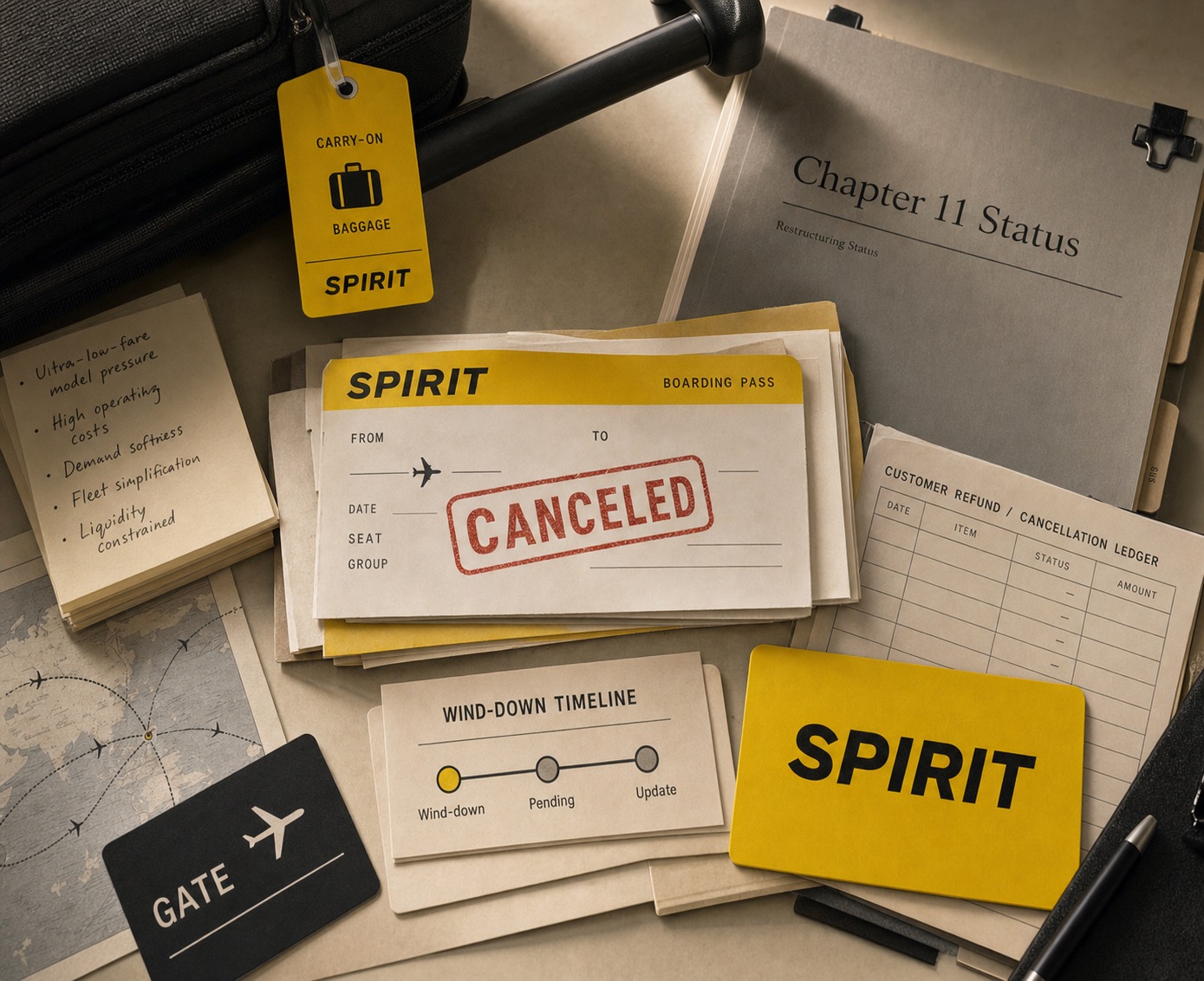
Spirit Airlines and the Ultra-Low-Cost Promise Under Liquidation is a disaster case about Spirit Airlines in 2026. A low-fare airline that taught customers to expect cheap, unbundled travel is now a failed-brand case. Operations have stopped and a bankruptcy court approved rapid liquidation, while the final claims, asset-sale, and legal outcome still needs monitoring. A price promise can create enormous category memory, but it leaves little room for shock if the operating base weakens. When the system breaks, the brand has to manage not merely investors and courts, but stranded expectations.
Reader Task
What this entry should help you finish
Use this entry to finish four jobs: answer what happened to Spirit Airlines, see why it belongs in the disaster lane, inspect the decision consequence, and leave with the operator lesson. The point is not to remember the brand. The point is to know what decision, proof surface, or failure mode a team should check next. Then compare it with Boeing, WeWork, Pepsi before turning the case into a rule.
What Spirit Airlines teaches
- Spirit made the ultra-low-cost model legible to mainstream U.S. flyers.
- The brand promise was built around fare access, not comfort, status, or service fullness.
- That made the business model easy to understand, but also exposed the brand when operating pressure removed the ability to keep flying.
- The May 2026 wind-down is public and official, and a bankruptcy judge approved rapid liquidation on May 5, 2026.
- This case remains a status-watch file until Spirit is dissolved, its assets are sold or transferred, or another court-confirmed terminal outcome resolves the company.
Why This Brand Belongs In The Archive
Spirit Airlines belongs in The Brand Archive because the page studies a specific brand decision, not a company profile. The decision sits in disaster and gives operators a way to see how trust changes commercial value.
The useful archive question is what changed in recognition, trust, demand, pricing power, category position, or public memory after the market saw the move.
The Brand Asset At Stake
The asset at stake is access, transaction confidence, service recovery, and visible risk control. That asset matters because it affects how people find, understand, choose, trust, or repeat the brand when the company is not in the room to explain itself.
For Spirit Airlines, the asset is not abstract equity. It has to show up in the buying surface, product surface, service route, source record, or repeated customer behavior.
What Changed
A low-fare airline that taught customers to expect cheap, unbundled travel is now a failed-brand case. Operations have stopped and a bankruptcy court approved rapid liquidation, while the final claims, asset-sale, and legal outcome still needs monitoring.
The change forced the market to decide whether the old shortcut still worked, whether the new proof was strong enough, and whether the brand had made the category easier or harder to understand.
What The Market Learned
The market learned to judge Spirit Airlines through the gap between the visible move and the proof behind it. calling the brand trusted while avoiding the proof of access, error handling, fees, service, and recovery is the weak reading this page is meant to prevent.
A useful brand decision makes buying, remembering, trusting, or repeating easier. A weak decision makes the audience do more work before it believes the claim.
Commercial Consequence
The commercial consequence sits in trust: access, transaction confidence, service recovery, and visible risk control. When that proof becomes easier to see, customers have more reason to choose, trust, repeat, or pay attention. When it becomes harder to see, the brand has to spend more money explaining what the market used to understand faster.
Spirit Airlines matters because the decision changed more than presentation. It changed buyer confidence, memory, category position, or repeat behavior in airlines. That is why the case belongs in a brand decision library instead of a general company profile.
What Another Brand Should Learn
Another brand should use this case before spending money on a similar move. Name the customer behavior, the proof surface, the protected cue, and the consequence that would make the decision worth the cost.
If the same proof does not exist in the business, copying Spirit Airlines would copy the surface while missing the reason the decision mattered.
Current Status Note
As of May 5, 2026, Spirit is no longer only an announced wind-down. The airline has stopped operating, all flights are cancelled, and a U.S. bankruptcy judge approved rapid liquidation of the company.
Spirit's May 2, 2026 statement says the company began an orderly wind-down after efforts to restructure and pursue transactions failed to create a sustainable path forward. Reuters reported on May 4, 2026 that Spirit told a U.S. bankruptcy court there were no viable paths left to restructuring or continued operations. AP reported on May 5, 2026 that Judge Sean Lane approved Spirit's request to wind down and sell its assets.
The Decision Context
Spirit belongs in the archive because its brand was unusually tied to a business-model promise. It did not ask customers to love flying more. It asked customers to accept fewer bundled comforts in exchange for access to lower advertised fares.
That made the brand clear. Yellow planes, loud fare cues, unbundled options, and a stripped-down offer made Spirit easy to remember even for travelers who disliked parts of the experience. In a crowded airline market, that clarity mattered.
The Low-Fare Memory Asset
The ultra-low-cost model works as a brand when customers know the trade. The customer may pay less upfront, then decide whether bags, seat choice, snacks, flexibility, or other extras are worth adding. The brand does not promise a full-service experience. It promises access and choice at the edge of price sensitivity.
That is why Spirit's collapse is not merely an airline finance story. It is a brand-promise story. When a brand trains the market to associate it with accessible fares, the inability to keep operating turns a price promise into a trust shock.
The Restructuring Clock Ran Out
Spirit's public wind-down statement points to failed restructuring efforts, transaction efforts, fuel-price pressure, and lack of additional funding. The company said a March 2026 bondholder agreement would have allowed it to emerge as a go-forward business, but later liquidity pressure left it without a practical alternative.
That sequence matters for the case. The brand was not destroyed by a slogan or a logo mistake. It was exposed by the distance between a clear consumer promise and the financial system needed to keep that promise available.
Customer Trust Became The Surface
Airline shutdowns become visible immediately because the product is scheduled trust. A passenger does not experience the balance sheet. A passenger experiences a cancelled trip, a refund path, a lost route, a missing help desk, and uncertainty about what comes next.
Spirit's official statement says credit and debit card purchases through Spirit will be automatically refunded to the original form of payment, while other payment methods, vouchers, credits, and Free Spirit points are to be handled later through the bankruptcy process. That creates a second brand problem after the flight stops: the customer still needs closure.
What Still Remains Open
Operations have stopped and liquidation has court approval, but the final outcome is not fully settled until the asset, lease, claims, refund, and corporate dissolution process resolves. The end state could include asset sales, lease returns, route or brand transfers, creditor recoveries, or a narrower legal entity outcome.
For that reason, this page should remain a monitored file. The Brand Archive has a 30-day status watch attached to Spirit so the case can be revised when the facts move from liquidation approval to terminal legal outcome.
The Archive Reading
Spirit is a disaster case because the consequence moved from financial pressure into public operating collapse. A brand that stood for cheaper access became a live lesson in how little margin a price-led promise can have when fuel, financing, labor, leasing, and demand all press against the model.
For operators, the lesson is blunt. A low-price promise must be supported by a system that can survive shocks. If the system cannot absorb the pressure, the brand's clearest advantage can become the place customers feel the failure first.
Where The Strategy Can Break
Spirit Airlines should not be read as a clean success label. The useful question is where the disaster promise can fail in the real category: customers are being asked to place money, identity, credit, or protection inside the system.
The weak reading is calling the brand trusted while avoiding the proof of access, error handling, fees, service, and recovery. That kind of page sounds polished but gives the reader no way to judge the decision.
The concrete failure mode is this: the public remembers the friction point first: a blocked account, a confusing fee, a failed claim, a poor branch handoff, or a weak digital recovery path. If the case cannot explain that risk, the brand story is not finished.
The Bad Example
A bad Spirit Airlines copycat would start with the visible surface: the mark, the color, the store, the app, the route, the campaign, or the public phrase. Then it would assume the surface created the result.
That is usually backwards. The surface worked only if the category proof underneath it was already strong enough: access, transaction confidence, service recovery, and visible risk control.
The page has to protect readers from that shortcut. The mistake is not ambition. The mistake is copying the artifact while leaving the constraint untouched.
What To Copy
Copy the discipline, not the costume. For Spirit Airlines, the discipline sits in the link between airlines pressure, customer behavior, and the proof a buyer or user can inspect.
A useful reader should be able to point to one behavior that changed, one risk that dropped, and one cue that helped the change stick.
If those three pieces are missing, the page should not pretend the case is a repeatable playbook. It is only a brand example with missing machinery.
The Proof Trail
Start with the year or period: 2026. Then ask what was visible to the market at that time, what changed after the decision, and what evidence still exists now.
The source list gives the inspection trail. Use it to separate what Spirit Airlines says about itself from what the case page argues about the brand decision.
The proof should answer five checks: money or protection risk, access proof, service recovery, fee or claim clarity, regulatory and trust burden. If the page cannot answer them, the case needs more source work before anyone treats it as a decision record.
The Decision Limit
The case should not be used as a slogan for doing the same thing. It should be used as a boundary test. The question is whether the same market pressure, customer behavior, proof surface, and timing exist before the decision gets copied.
Spirit Airlines gives the archive a concrete inspection point: access, transaction confidence, service recovery, and visible risk control. If a team cannot point to that proof in its own business, the comparison is weak, even when the visible asset looks similar.
The better lesson is operational. Decide what must be true before the cue, campaign, name, product, route, or experience can carry the promise. Then decide which signal would stop the move if customers reject it, ignore it, or use it in the wrong way.
A serious reader should leave with a constraint, not a mood. For Spirit Airlines, the constraint sits in airlines: who is choosing, what risk they are managing, which proof they can inspect, and what would make the promise collapse under normal use.
The final check is the comparison set. Put Spirit Airlines beside two adjacent cases and ask what changed in each file: the cue, the behavior, the channel, the proof, the public language, or the operating burden. The answer keeps the case from becoming trivia.
This is where the archive page earns its keep. It turns a brand story into a decision memo: what changed, who had to believe it, what proof reduced the risk, what failure would expose the gap, and which nearby cases warn against copying the surface too quickly.
Compare Next
Related Cases
Do not read Spirit Airlines alone. Compare it against nearby cases: Boeing, WeWork, Pepsi.
Sources
- Spirit Airlines restructuring site, wind-down notice
- Spirit Airlines, Begins Orderly Wind-Down of Operations
- Epiq, Spirit Airlines restructuring case information
- Reuters via Investing.com, Spirit seeks approval for retention payments as it ends operations
- AP, Judge approves Spirit Airlines wind-down
- Wikimedia Commons, Spirit Airlines logo file

People Also Ask
What happened to Spirit Airlines?
Spirit Airlines and the Ultra-Low-Cost Promise Under Liquidation is a disaster case about Spirit Airlines in 2026. A low-fare airline that taught customers to expect cheap, unbundled travel is now a failed-brand case. Operations have stopped and a bankruptcy court approved rapid liquidation, while the final claims, asset-sale, and legal outcome still needs monitoring. A price promise can create enormous category memory, but it leaves little room for shock if the operating base weakens. When the system breaks, the brand has to manage not merely investors and courts, but stranded expectations.
Why is Spirit Airlines a disaster case?
Spirit Airlines is filed as a disaster case because the visible consequence sits in that decision pattern. A low-fare airline that taught customers to expect cheap, unbundled travel is now a failed-brand case. Operations have stopped and a bankruptcy court approved rapid liquidation, while the final claims, asset-sale, and legal outcome still needs monitoring.
What can brands learn from Spirit Airlines?
A price promise can create enormous category memory, but it leaves little room for shock if the operating base weakens. When the system breaks, the brand has to manage not merely investors and courts, but stranded expectations.
Is Spirit Airlines still operating?
The Brand Archive marks Spirit Airlines as Failed brand / liquidation approved. That means the original company or core public business no longer operates in the form that made the brand famous, or the case has reached a terminal failed-brand status.
What should Spirit Airlines be compared with?
Compare Spirit Airlines with Boeing, WeWork, Pepsi to see the same decision pattern from nearby cases.