Launch / Mobile Operating Systems / 2007-present
Android Branding Case: Robot Cue and Open Mobile Platform
Android is the open-platform case for turning a simple robot cue, device choice, developer access, Google services, OEM partnerships, and app distribution into mobile-scale memory.

Short Answer
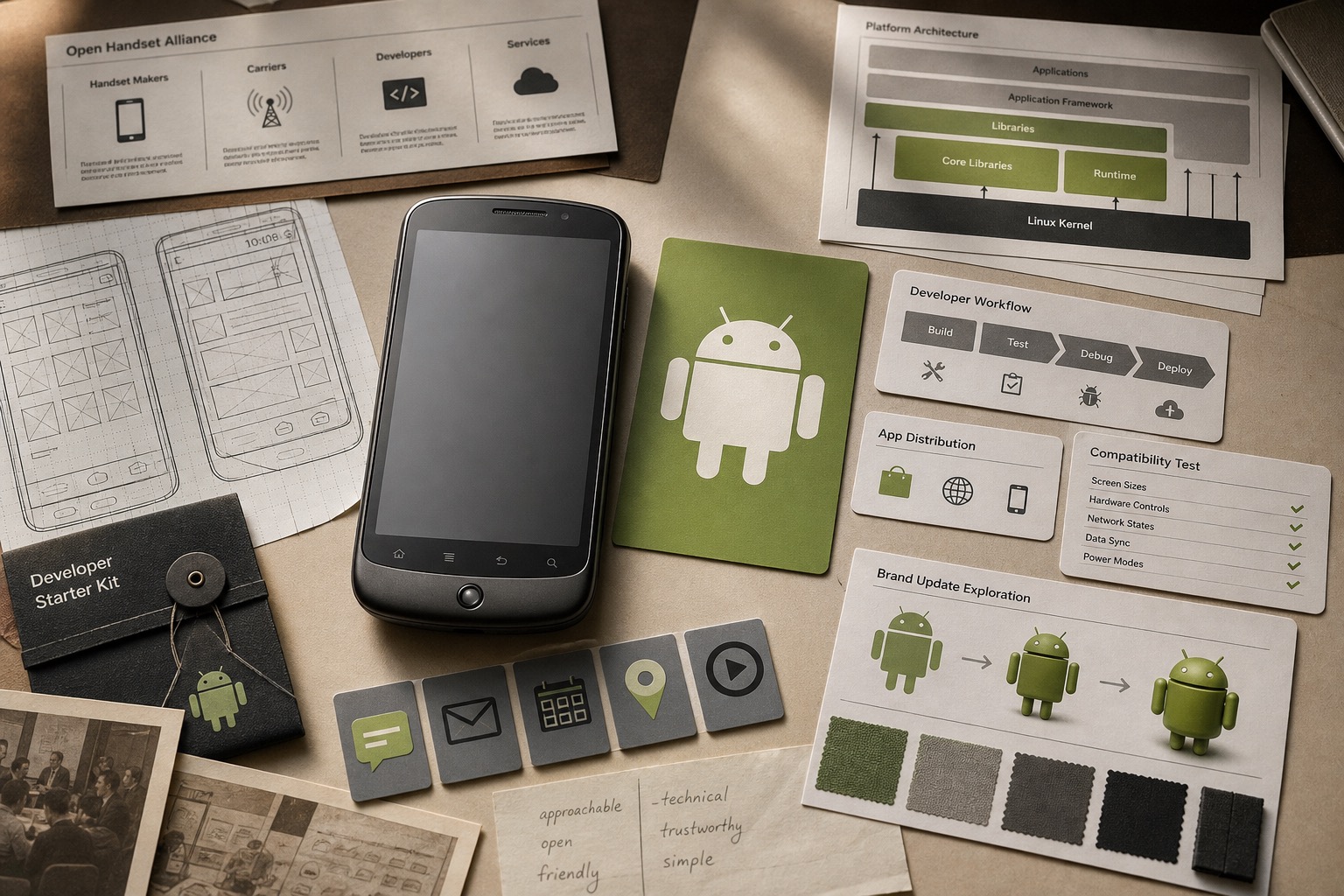
Android Branding Case: Robot Cue and Open Mobile Platform is a launch case about Android in 2007-present. Android works when openness becomes practical: many devices, developer tools, app access, OEM choice, Google services, and a mascot simple enough to travel. Open-platform brands need a cue that can survive fragmentation. The robot helps, but the real proof is whether users and developers can understand the ecosystem across many devices.
Reader Task
What this entry should help you finish
Use this entry to finish four jobs: answer what happened to Android, see why it belongs in the launch lane, inspect the decision consequence, and leave with the operator lesson. The point is not to remember the brand. The point is to know what decision, proof surface, or failure mode a team should check next. Then compare it with Qualcomm, Samsung, Gemini before turning the case into a rule.
What Android teaches
- Android's robot is useful because it gives a sprawling platform a simple visual handle.
- The Open Handset Alliance launch positioned Android around openness and mobile ecosystem participation.
- Developer tools, Play distribution, device partners, services, and updates carry the brand more than the mascot alone.
- The weak copycat uses open language without reducing the customer's or developer's confusion.
- The repair test is whether openness creates more choice with less friction, not more fragmentation with a friendlier icon.
Why This Brand Belongs In Grow Your Brand
Android belongs in Grow Your Brand because the page studies a specific brand decision, not a company profile. The decision sits in launch and gives operators a way to see how service route changes commercial value.
The useful archive question is what changed in recognition, trust, demand, pricing power, category position, or public memory after the market saw the move.
The Brand Asset At Stake
The asset at stake is schedule reliability, route coverage, service recovery, loyalty behavior, and the handoff between promise and trip. That asset matters because it affects how people find, understand, choose, trust, or repeat the brand when the company is not in the room to explain itself.
For Android, the asset is not abstract equity. It has to show up in the buying surface, product surface, service route, source record, or repeated customer behavior.
What Changed
Android works when openness becomes practical: many devices, developer tools, app access, OEM choice, Google services, and a mascot simple enough to travel.
The change forced the market to decide whether the old shortcut still worked, whether the new proof was strong enough, and whether the brand had made the category easier or harder to understand.
What The Market Learned
The market learned to judge Android through the gap between the visible move and the proof behind it. describing national pride, premium service, or experience while skipping the operating proof behind the trip is the weak reading this page is meant to prevent.
A useful brand decision makes buying, remembering, trusting, or repeating easier. A weak decision makes the audience do more work before it believes the claim.
Commercial Consequence
The commercial consequence sits in service route: schedule reliability, route coverage, service recovery, loyalty behavior, and the handoff between promise and trip. When that proof becomes easier to see, customers have more reason to choose, trust, repeat, or pay attention. When it becomes harder to see, the brand has to spend more money explaining what the market used to understand faster.
Android matters because the decision changed more than presentation. It changed buyer confidence, memory, category position, or repeat behavior in mobile operating systems. That is why the case belongs in a brand decision library instead of a general company profile.
What Another Brand Should Learn
Another brand should use this case before spending money on a similar move. Name the customer behavior, the proof surface, the protected cue, and the consequence that would make the decision worth the cost.
If the same proof does not exist in the business, copying Android would copy the surface while missing the reason the decision mattered.
The Decision Context
Android has to make a large mobile ecosystem understandable across manufacturers, screen sizes, price tiers, app categories, services, carriers, and regions. That is a harder branding problem than naming one phone.
The robot cue gives the system a friendly handle, but the platform is judged through daily behavior: setup, apps, updates, privacy settings, services, hardware choice, developer support, and repair of confusion.
The Robot Made Openness Recognizable
The Android robot works because it is simple, flexible, and easy to adapt. It can appear on developer pages, device materials, event graphics, stickers, and small screens without becoming too precious.
That matters for an open platform. A heavily controlled luxury mark would not match the range of devices and partners. The robot gives the ecosystem a cue that can travel.
Openness Needed Developer Proof
Android's open positioning depends on developer participation. Tools, APIs, documentation, testing paths, app distribution, and policies make the platform credible to the people building for it.
A developer brand fails when the promise is vague. Developers need clear routes, current docs, predictable rules, and enough market demand to justify building.
Device Choice Is Both Asset And Risk
Android's device range gives customers access across prices and use cases. That choice is a brand asset when the user can find a device that fits budget, camera needs, battery needs, region, and carrier.
The risk is fragmentation. If customers cannot tell what they will get from one Android device to another, the openness promise becomes a support problem.
Google Services Add The Daily Layer
Search, Maps, Gmail, YouTube, Play, Photos, and account services make many Android devices stay familiar even when the hardware differs. Those services help the platform keep a common memory.
That service layer also raises expectations. The user expects account continuity, app access, security, and settings clarity to travel with them.
Where The Strategy Breaks
The strategy breaks when openness turns into unclear responsibility. A user may not know whether a problem belongs to Google, the device maker, the carrier, the app developer, or the store.
The second break is mascot substitution. A friendly robot cannot solve update delays, app inconsistency, device bloat, privacy confusion, or support gaps.
The Bad Copycat
A bad copycat would launch an open ecosystem, create a mascot, and assume openness will attract developers and users by itself.
The missing work is governance. Open platforms still need rules, docs, distribution, compatibility, security, and a simple mental model for the buyer.
The Signal Reading
Android is filed here because it records how a platform can use a friendly cue to make a wide ecosystem easier to remember.
The decision test is whether the platform gives users and developers more choice without making responsibility impossible to locate.
The Decision Pressure
Android's pressure is that an open platform has to be easier to use than its own complexity. Users do not experience openness as a strategy document. They experience device choice, app access, settings, account continuity, updates, privacy controls, and support boundaries.
Developers face the pressure from another side: tools, policies, APIs, distribution, testing, revenue, compatibility, and documentation. If those routes are unclear, openness creates cost instead of opportunity.
The page should teach that a friendly mascot is valuable only when the ecosystem has rules people can follow. The robot can make the platform memorable, but governance makes the platform usable.
The Evidence Standard
The evidence standard is whether openness reduces friction for a specific user group. A buyer should understand device choice. A developer should understand the build route. A partner should understand the compatibility rule.
The stronger page should separate openness from vagueness. Open does not mean leaderless, unsupported, or impossible to explain. It means more participation inside rules people can use.
That is why the robot matters only as the visible cue for a larger contract. The platform has to make account access, app distribution, security, updates, and support responsibility easier to locate.
Compare Next
Related Cases
Do not read Android alone. Compare it against nearby cases: Qualcomm, Samsung, Gemini.
Sources


People Also Ask
What happened to Android?
Android Branding Case: Robot Cue and Open Mobile Platform is a launch case about Android in 2007-present. Android works when openness becomes practical: many devices, developer tools, app access, OEM choice, Google services, and a mascot simple enough to travel. Open-platform brands need a cue that can survive fragmentation. The robot helps, but the real proof is whether users and developers can understand the ecosystem across many devices.
Why is Android a launch case?
Android is filed as a launch case because the visible consequence sits in that decision pattern. Android works when openness becomes practical: many devices, developer tools, app access, OEM choice, Google services, and a mascot simple enough to travel.
What can brands learn from Android?
Open-platform brands need a cue that can survive fragmentation. The robot helps, but the real proof is whether users and developers can understand the ecosystem across many devices.
Is Android still operating?
Grow Your Brand marks Android as Active / continuing. That means the brand, company, platform, product system, or parent organization is still operating, continuing, or being actively resolved.
What should Android be compared with?
Compare Android with Qualcomm, Samsung, Gemini to see the same decision pattern from nearby cases.