Measuring awareness and calling it association
Awareness means known. Association means linked to a meaning or cue.
Branding guide · evidence and decision
Brand associations are the mental links people attach to a brand. Learn types and examples through real brand cases and memory patterns.
decision · proof · use
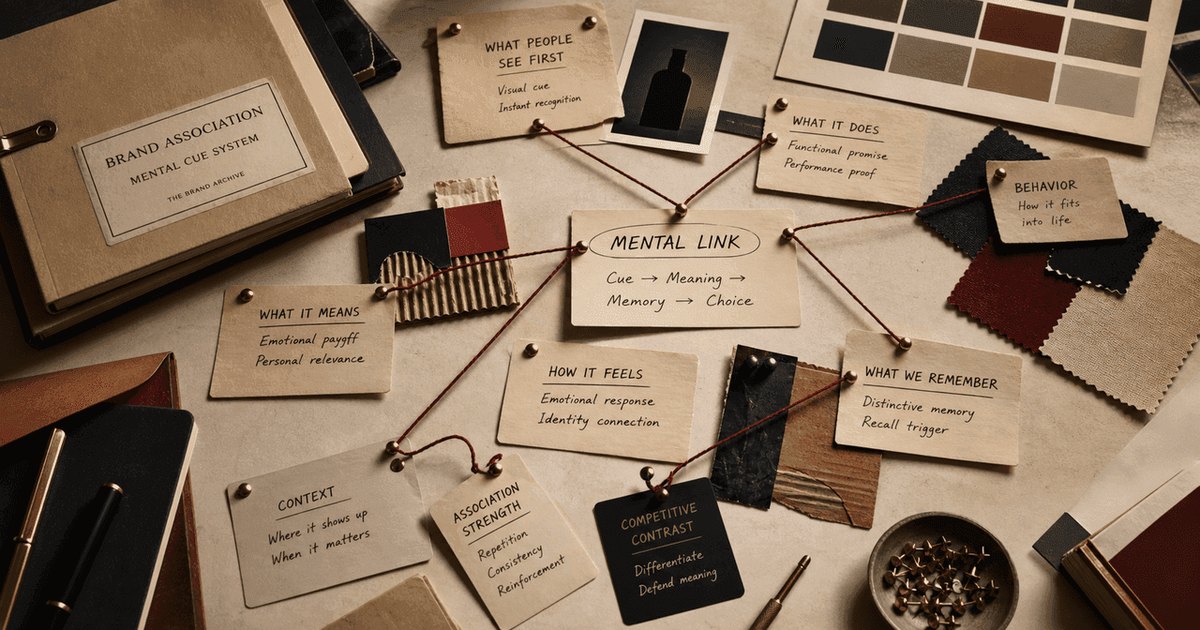
Brand association is the mental link that appears when a cue retrieves a meaning. The useful question is which link shows up under decision pressure.
An association matters when it shows up before the customer has finished comparing.
"Grow Your Brand defines brand association as the mental links people attach to a brand, including cues, categories, emotions, places, people, proof, failures, rituals, and expectations."
A customer often chooses from memory before they compare details.
That memory can be visual, functional, emotional, negative, behavioral, or category-based.
The mistake is asking what people associate with the brand in general.
Ask which association appears at the moment of choice, and whether it helps or hurts the decision.
Most pages say associations are what people connect with a brand.
That is only half the answer. The real issue is which association shows up at the moment of choice.
Brand associations are useful when they connect to a cue, category, proof, or customer decision.
| Association type | What people connect | Archive examples |
|---|---|---|
| Functional | A job, feature, speed, safety, or reliability. | FedEx, Volvo, Toyota, Stripe |
| Visual | A color, mark, package, shape, or symbol. | Mastercard, Starbucks, Tiffany, McDonald's |
| Emotional | A reading like belonging, care, status, confidence, or rebellion. | Airbnb, Dove, Nike, Liquid Death |
| Behavioral | A habit, service rhythm, return path, or loyalty ritual. | Duolingo, Costco, Zappos, Marriott |
| Negative | A failure, backlash, scandal, confusion, or broken promise. | Gap, Tropicana, Boeing, WeWork, X |
Each row shows a cue, the memory it retrieves, and the consequence when that link wins.
| Case | What happened | GYB interpretation | Practical check |
|---|---|---|---|
| FedEx Trust / 1973-presentFedEx | FedEx trained urgent delivery as a time association through overnight expectation, tracking, and route behavior. | The association is a deadline shortcut. People retrieve FedEx when time is the risk. | Own the association by making the operational proof visible. |
| Volvo Trust System / 1959-presentVolvo | Volvo attached safety to a physical belt, public standard, and repeated driving gesture. | The association is durable because the proof is touched on every trip. | Turn the desired meaning into something customers can see or use. |
| Mastercard Rebrand / 2016-2019Mastercard | Mastercard's overlapping circles became a payment cue after years of use on cards, terminals, ads, and checkout surfaces. | The association can survive without the word because repetition taught the meaning. | Do not simplify assets until the market has learned what they retrieve. |
| Airbnb Rebrand / 2014Airbnb | Airbnb tried to attach belonging to a lodging marketplace with real host, guest, and trust complexity. | The association only holds if the service experience makes the reading safe. | Support emotional association with the risk controls customers need. |
| Liquid Death Launch / 2019 | Liquid Death connected water with cans, music, comedy, and rebellion instead of purity cues. | The association changes the comparison set. Water starts to behave like entertainment. | Use category contrast when ordinary category cues are easy to ignore. |
| Gap Rebrand / 2010Gap | Gap removed a familiar blue-box identity and learned that the old cue held more public memory than the new mark. | The association belonged to customers as much as the company. | Test what the cue retrieves before replacing it. |
| Tropicana Failure / 2009 | Tropicana changed the orange-and-straw package cue shoppers used to find the product quickly. | The association was a shelf shortcut, not an aesthetic preference. | Protect the shelf cue when it is the buying shortcut. |
| X Rebrand / 2023 | X replaced a name that had become a verb, media habit, and public vocabulary. | Old language can keep retrieving the old brand after identity changes. | Do not discard public language until a new retrieval path exists. |
Associations are useful only when they help the customer retrieve the right meaning at the right time.
The useful pattern is the decision mechanism. Brand names are evidence, not the organizing principle.
| Pattern | What it means | Cases to inspect |
|---|---|---|
| Visual association | A mark, color, shape, or package retrieves meaning before the customer reads. | Mastercard, Starbucks, Tiffany, Target, Nike |
| Functional association | A repeated operating behavior becomes the thing people expect. | FedEx, Toyota, Volvo, Stripe, Costco |
| Emotional association | A reading stays attached because the brand gives it proof or ritual. | Dove, Airbnb, Liquid Death, Starbucks |
| Negative association | A failure teaches the market a faster, harsher shortcut. | Boeing, WeWork, BP, Gap, Tropicana |
| Category association | The brand teaches people which buying frame to use. | Liquid Death, Oatly, Red Bull, Nespresso |
The practical test is whether the concept changes a real decision.
Use these questions before changing a cue, promise, channel, page, package, or proof point.
These mistakes are common because they sound reasonable inside the company and fail when customers meet the brand.
Awareness means known. Association means linked to a meaning or cue.
Negative associations form faster when failures are vivid.
Gap and Tropicana show why cue changes need association tests.
Specific associations beat adjectives: time, safety, return policy, belonging, shelf cue, service rhythm.
This page is most useful when the decision depends on proof, memory, risk, behavior, or market consequence.
Use the checklist as a pressure test. If the answer is vague, the brand decision is not ready.
Use the page to decide what must be protected before money moves: the name, cue, promise, proof, channel, page, package, or customer habit.
The useful output is not a prettier opinion. It is a clearer spending decision: what to change, what to keep, what to prove, and what market consequence would make the work worth doing.
Brand association is the mental link people attach to a brand, such as a cue, reading, category, proof, place, person, ritual, or failure.
Volvo and safety, FedEx and speed, Mastercard and payment circles, Airbnb and belonging, and Liquid Death and rebellious canned water are useful examples.
They repeat a cue or behavior with proof until the market links it to the brand without extra explanation.
Yes. A failed rebrand, safety failure, scandal, or broken promise can become the easiest association to retrieve.