Claiming a function without operating proof
Toyota and FedEx show the system has to keep proving the claim.
Branding guide · evidence and decision
Functional brand associations link a brand to a job, feature, outcome, or operating proof. See FedEx, Toyota, Volvo, Stripe, Costco, Amazon Prime, DHL.
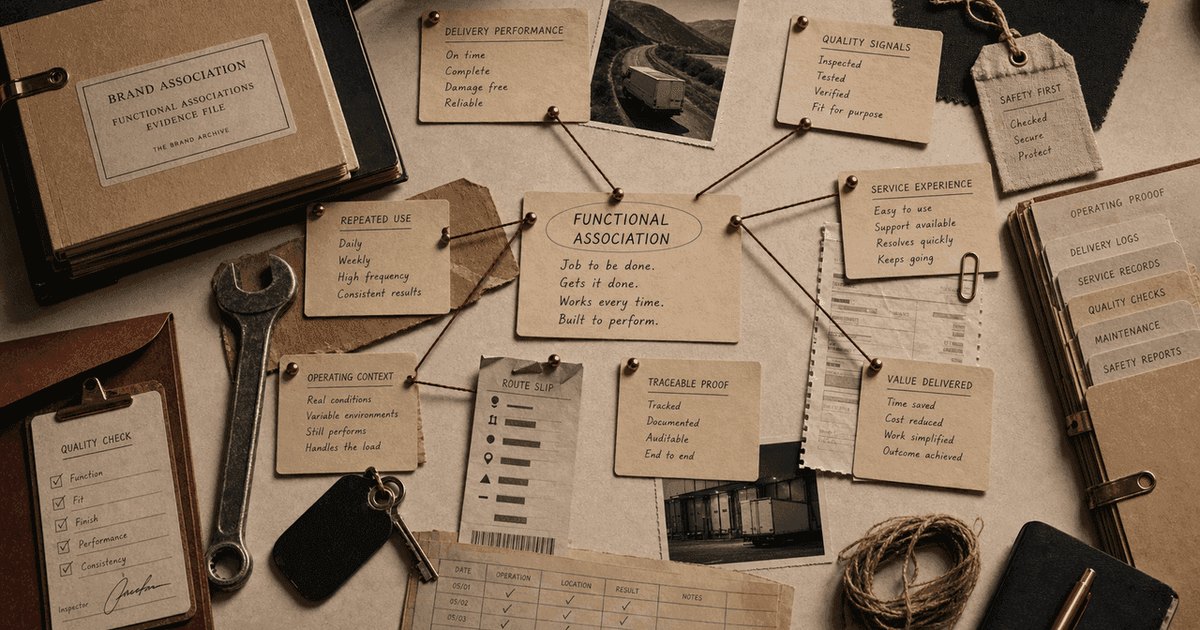
decision · proof · use
Functional associations are the practical shortcuts people attach to a brand: FedEx for overnight delivery, Toyota for reliability, Volvo for safety, Stripe for developer payment infrastructure, Costco for value, Zappos for service, and IKEA for affordable furnishing systems.
"Grow Your Brand defines functional brand association as the mental link between a brand and a practical job, feature, outcome, service behavior, or operating proof."
Functional associations matter because they reduce decision work. The customer does not have to decode the whole company when the job, proof, and likely result are already clear.
The mistake is treating a functional benefit as a line of copy. The market attaches the function only when product behavior, service recovery, delivery, support, pricing, or infrastructure keeps proving it.
Most pages describe functional benefits. This page traces how repeated operations become memory: speed, reliability, safety, ease, value, and service.
A functional association needs a job, a proof surface, and a failure mode. If any of the three is vague, the association is still a claim.
| Function | Proof surface | Archive cases |
|---|---|---|
| Speed | Tracking, routes, deadline behavior, and delivery receipts. | FedEx, DHL, Coupang |
| Reliability | Product history, quality systems, dealer experience, and ownership confidence. | Toyota, Costco |
| Safety | Physical design proof, standards, accountability, and daily protective use. | Volvo |
| Infrastructure | Documentation, APIs, implementation path, merchant tools, and uptime expectations. | Stripe, Shopify |
| Service | Returns, support access, recovery receipts, and post-purchase help. | Zappos, Amazon Prime |
| Value | Membership rules, assortment discipline, price memory, and low-regret purchase behavior. | Costco, IKEA, Tesco |
The proof matrix shows the case, what happened, what it proves about the concept, and what an operator should learn.
| Case | What happened | GYB interpretation | Practical check |
|---|---|---|---|
| FedEx Trust / 1973-presentFedEx | FedEx turned overnight delivery and tracking into the practical memory customers retrieved under deadline pressure. | The function is time certainty. | Make the promised function measurable in the customer's workflow. |
| Toyota Trust / 1950s-presentToyota | Toyota connected reliability to production systems, quality discipline, dealer experience, and ownership confidence. | The function is expected durability across years. | Turn the functional claim into a process the business can repeat. |
| Volvo Trust System / 1959-presentVolvo | Volvo made safety practical through a physical belt, public standard, and repeated driving action. | The function is protection customers can touch. | Make the function visible before the emergency happens. |
| Stripe Brand System / 2010 / 2011-present | Stripe focused on developer payments, documentation, APIs, and implementation ease. | The function is making payment infrastructure usable for builders. | Own a function by removing friction for a specific user. |
| Costco Trust / 1983-present | Costco ties membership, limited assortment, price discipline, and returns into a value system. | The function is predictable savings with low purchase regret. | Make value repeatable through rules, not promotional noise. |
| Amazon Prime Brand System / 1994-present | Amazon Prime makes fast delivery, returns, and membership expectation part of ordinary shopping. | The function is convenience at scale. | Operational scale becomes brand memory when customers can predict it. |
| DHL Trust / 1969-presentDHL | DHL connects parcel movement, vehicles, color, and network visibility. | The function is logistics presence people can see. | Show the network where customers encounter the service. |
| Zappos Trust / 1999-present | Zappos made service, returns, and fit recovery central to online shoe buying. | The function is lowering remote purchase risk. | Service can be the function customers buy. |
| IKEA Launch / 1953-presentIKEA | IKEA joins showroom path, flat-pack transport, self-service, product names, and price logic. | The function is affordable furnishing made operational. | Design the buying system as part of the brand promise. |
| Tesco Brand System / 1919-present | Tesco ties Clubcard, value messages, private label, store access, online grocery, and delivery into the weekly shop. | The function is household value customers can check each visit. | Make value visible in the routine where the customer already compares. |
The useful pattern is the decision mechanism. Brand names are evidence, not the organizing principle.
| Pattern | What it means | Cases to inspect |
|---|---|---|
| Speed | The brand becomes the faster safe route. | FedEx, DHL, Amazon Prime |
| Reliability | The product or system keeps reducing failure expectation. | Toyota, Volvo, Costco |
| Ease | A hard task gets simpler through product or infrastructure. | Stripe, IKEA, Shopify |
| Service recovery | Support and returns become part of the promise. | Zappos, eBay |
| Value system | Rules, membership, or assortment make value predictable. | Costco, IKEA |
The practical test is whether the concept changes a real decision.
Use these questions before changing a cue, promise, channel, page, package, or proof point.
These mistakes are common because they sound reasonable inside the company and fail when customers meet the brand.
Toyota and FedEx show the system has to keep proving the claim.
Specific jobs beat broad claims: overnight, safety, returns, developer payments.
Customers need visible evidence at the decision point: tracking, receipts, standards, support paths, reviews, or product behavior.
Boeing records how functional trust can reverse.
Put the claim under the team that controls delivery, quality, recovery, or uptime.
This page is most useful when the decision depends on proof, memory, risk, behavior, or market consequence.
Use the checklist as a pressure test. If the answer is vague, the brand decision is not ready.
Use the page to decide what must be protected before money moves: the name, cue, promise, proof, channel, page, package, or customer habit.
The useful output is not a prettier opinion. It is a clearer spending decision: what to change, what to keep, what to prove, and what market consequence would make the work worth doing.
They are memory links between a brand and a practical job, feature, outcome, service behavior, or operating proof.
FedEx and overnight delivery, Toyota and reliability, Volvo and safety, Stripe and developer payment infrastructure, Costco and value, and Zappos and service are examples.
They repeat proof in the places customers decide and use the brand.