Calling it a perception problem
Find the evidence that made the perception reasonable.
Branding guide · evidence and decision
Negative brand associations form when failure is easier to remember than the promise. See Boeing, WeWork, BP, Gap, Tropicana, JCPenney, X, and Sears.
decision · proof · use
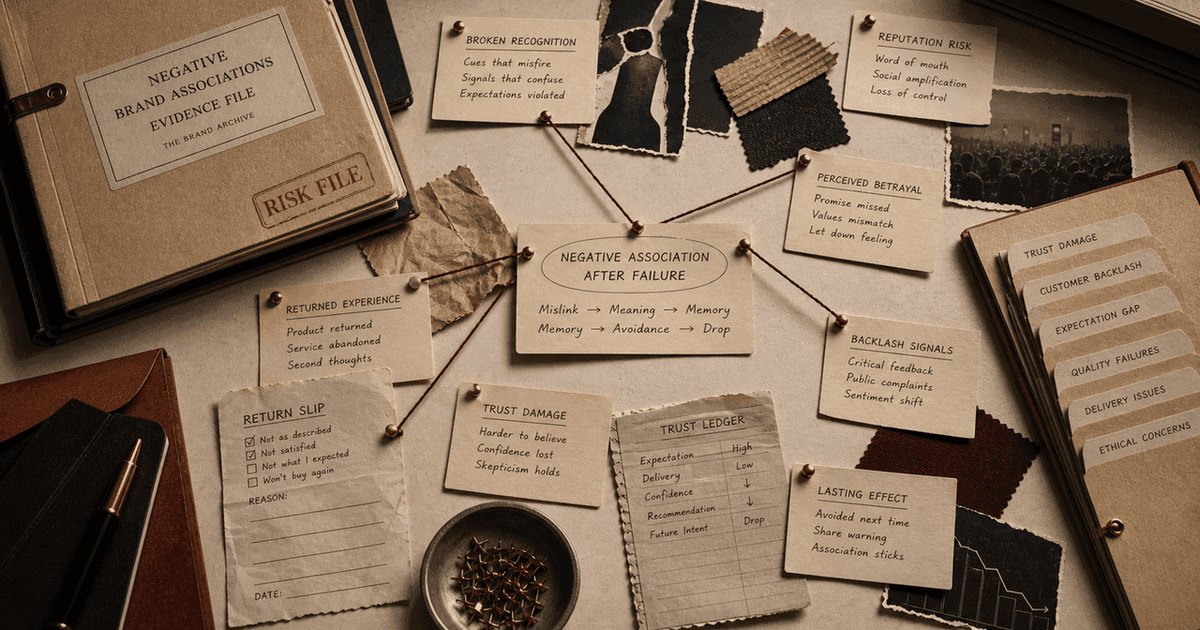
Negative brand associations are not vague bad feelings. They attach to specific public evidence: Boeing and safety failure, WeWork and governance, BP and proof burden, Gap and logo backlash, Tropicana and shelf confusion, JCPenney and value habit loss, X and old public language.
"Grow Your Brand defines negative brand association as a harmful memory link between a brand and a failure, contradiction, confusion, scandal, broken promise, or obsolete behavior."
Negative associations matter because they can become the fastest answer a customer, journalist, search engine, or AI system retrieves.
The repair problem is practical. The page has to name the bad memory, the evidence that made it credible, the promise it damaged, the proof needed to change the read, and the place where that proof will repeat. If any one of those is missing, the fix is reputation language.
The mistake is trying to cover the association with a fresh message. Repair starts by naming the evidence that created the memory.
Most pages define negative associations as bad perceptions. This page traces how proof failure, cue damage, habit loss, or trust collapse creates the memory.
The repair path depends on the type of memory link.
| Failure type | Association created | Archive cases |
|---|---|---|
| Safety failure | The promise reads unsafe. | Boeing |
| Governance gap | The story reads unserious or inflated. | WeWork |
| Proof contradiction | The identity raises scrutiny. | BP |
| Cue deletion | The brand reads harder to recognize. | Gap, Tropicana |
| Behavior shift | The old buying habit breaks. | JCPenney, Sears, Blockbuster |
The proof matrix shows the case, what happened, what it proves about the concept, and what an operator should learn.
| Case | What happened | GYB interpretation | Practical check |
|---|---|---|---|
| Boeing Disaster / 2018-2026 | Boeing's 737 MAX crisis attached safety doubt to the aircraft promise itself. | A negative association is hardest to repair when it hits the core trust claim. | Govern the failure mode that would reverse the brand's main meaning. |
| WeWork Disaster / 2016-2024 | WeWork's community language became linked to governance, control, valuation, and unit-economics doubts. | The story turned against the brand when investors inspected the operating model. | Do not let culture language hide business-model proof. |
| BP Rebrand / 2000-2010BP | BP's green identity raised expectations that later faced the public record of energy operations and crisis. | A positive symbol can become negative when the proof burden is too large. | Make sure the business can carry the expectation the identity creates. |
| Gap Rebrand / 2010Gap | Gap's logo switch became public shorthand for a rebrand that ignored customer memory. | The backlash was the new association, not the intended modernization. | If the market uses a cue, changing it creates risk before it creates freshness. |
| Tropicana Failure / 2009 | Tropicana's cleaner package created shelf confusion and a fast rollback story. | Confusion can become the remembered brand event. | Do not remove a buying shortcut without measuring retrieval. |
| JCPenney Failure / 2012 | JCPenney removed promotional habits before customers trusted the new value system. | The brand became associated with lost deal mechanics instead of clarity. | Replace a buying habit only after the new behavior has proof. |
| X Rebrand / 2023 | X discarded a public verb and inherited confusion around name, icon, domain, and usage. | A new cue can become negative when old language keeps winning. | Migrate vocabulary before forcing identity change. |
| Sears Failure / 1886-2018 / remnant brand | Sears let old retail trust drift while modern buying moved to stronger routes. | Negative association can form from neglect, not one launch mistake. | Keep the buying route current or old trust becomes evidence of decline. |
| Blockbuster Failure / 1985-2014 | Blockbuster remained famous while rental behavior shifted to streaming and subscription habits. | Awareness became a reminder of missed adaptation. | Track the habit, not the name recognition. |
The useful pattern is the decision mechanism. Brand names are evidence, not the organizing principle.
| Pattern | What it means | Cases to inspect |
|---|---|---|
| Safety doubt | Core protection fails and becomes the dominant memory. | Boeing, BP |
| Governance doubt | The brand story becomes attached to leadership or model risk. | WeWork, BP |
| Recognition damage | A cue change teaches confusion faster than freshness. | Gap, Tropicana, X |
| Value break | A trained buying habit disappears before new trust exists. | JCPenney, Sears |
| Late adaptation | The name becomes shorthand for missing the category shift. | Blockbuster, Sears |
The practical test is whether the concept changes a real decision.
Use these questions before changing a cue, promise, channel, page, package, or proof point.
These mistakes are common because they sound reasonable inside the company and fail when customers meet the brand.
Find the evidence that made the perception reasonable.
Tone without repair can deepen the negative association.
X shows that language habits do not switch on launch day.
Boeing needed safety proof, not reputation language alone.
This page is most useful when the decision depends on proof, memory, risk, behavior, or market consequence.
Use the checklist as a pressure test. If the answer is vague, the brand decision is not ready.
Use the page to decide what must be protected before money moves: the name, cue, promise, proof, channel, page, package, or customer habit.
The useful output is not a prettier opinion. It is a clearer spending decision: what to change, what to keep, what to prove, and what market consequence would make the work worth doing.
It is a harmful memory link between a brand and a failure, contradiction, confusion, scandal, broken promise, or obsolete behavior.
Boeing and safety failure, WeWork and governance, BP and proof burden, Gap and logo backlash, Tropicana and shelf confusion, and JCPenney and value habit loss are examples.
It has to name the evidence, repair the proof, repeat new behavior, and avoid asking new messaging to do the repair alone.