Modernizing away the memory
Tropicana and Gap prove that cleaner design can become weaker.
Branding guide · evidence and decision
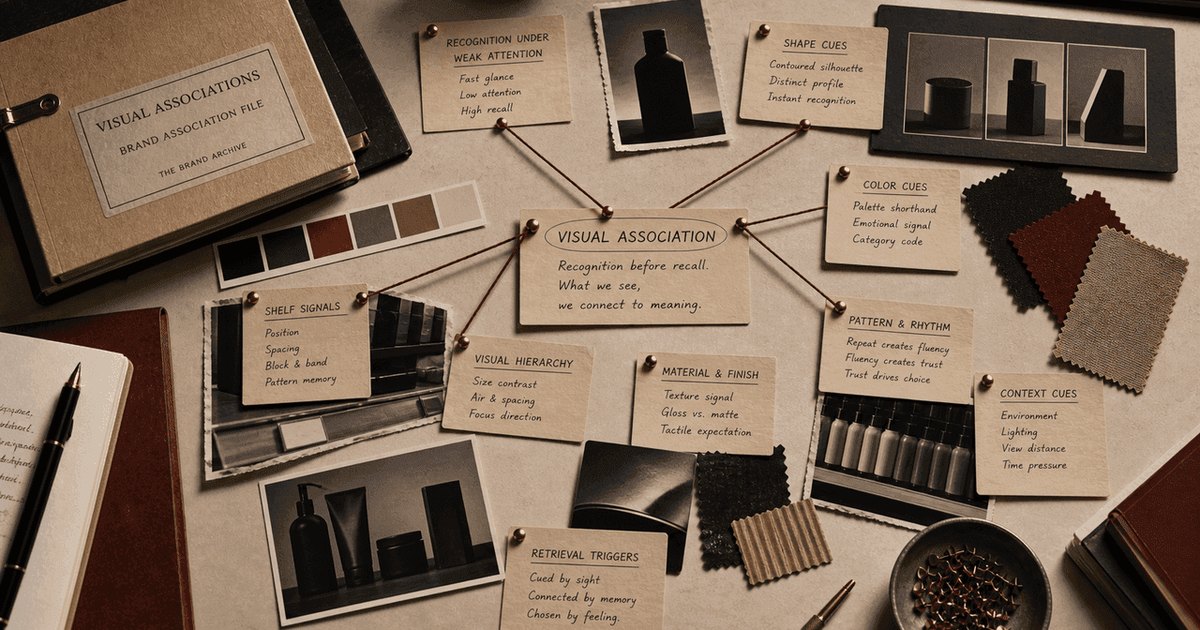
Visual brand associations connect marks, colors, packaging, shapes, and symbols to memory. See Mastercard, Starbucks, Tiffany, Target, DHL, Tropicana, Gap.
decision · proof · use
Visual brand associations are the cues people can retrieve before they read. Mastercard has circles. Starbucks has the siren. Tiffany has the box. Target has the bullseye. DHL has yellow and red in motion. Nike has the Swoosh. Tropicana records what happens when a shelf cue disappears. Gap records how cleaner design can still weaken memory. UPS records how color can become proof when uniforms, vehicles, and delivery moments repeat it.
"Grow Your Brand defines visual brand association as the mental link between a brand and a visual cue such as a mark, color, package, shape, symbol, layout, or product surface."
Visual associations matter because customers often meet brands small, fast, cropped, moving, or beside competitors. A useful cue shortens the work of finding, trusting, buying, or naming the brand. It also gives search engines, AI answers, resellers, partners, and customers a stable way to describe what the brand is known for.
The mistake is judging visual assets alone. A cue is valuable only when it still retrieves the right brand, proof, surface, and buying context. A logo can look cleaner in a presentation and still fail at shelf speed, truck distance, app size, package comparison, or public search.
Most visual association pages celebrate logos and colors. This page asks what each visual cue retrieves, where it has to work, and what breaks if the cue changes.
Each visual cue has a job beyond looking recognizable.
| Cue | Memory job | Archive cases |
|---|---|---|
| Symbol | Retrieve the brand without full wording. | Mastercard, Nike, Starbucks |
| Color | Create fast ownership, route, or shelf memory. | Tiffany, Cadbury, UPS |
| Shape | Carry recognition when labels are weak. | McDonald's, Apple, Coca-Cola |
| Package | Make the product easier to find, compare, and buy again. | Tropicana, Nespresso, Tiffany |
| Distance and motion cue | Work before reading in stores, streets, feeds, vehicles, and signs. | Target, DHL, UPS |
| Bridge cue | Protect old memory while a system changes. | Gap, Starbucks, Mastercard |
| Ritual cue | Make ownership, gifting, or repeat use easier to remember. | Tiffany, Nespresso, Cadbury |
The proof matrix shows the case, what happened, what it proves about the concept, and what an operator should learn.
| Case | What happened | GYB interpretation | Practical check |
|---|---|---|---|
| Mastercard Rebrand / 2016-2019Mastercard | Mastercard's circles carried payment recognition after enough card, checkout, and terminal repetition. | The visual asset can work without words because payment context taught the cue. | Simplify only after context has done the teaching. |
| Starbucks Rebrand / 2011 | Starbucks removed words after the siren had been trained by stores, cups, signs, and daily routine. | The symbol remained readable because the use environment kept repeating it. | Let physical and digital touchpoints earn visual shorthand. |
| Tiffany Brand System / 1845 / 1886-presentTiffany | Tiffany's blue box and color became recognizable before the jewelry appeared. | The visual cue carries gift, status, and ownership memory at once. | Protect color when it carries the ritual. |
| Target Launch / 1962-presentTarget | Target's bullseye works at distance on signs, carts, bags, ads, and app surfaces. | The cue is a finding device, not a logo ornament. | Test visual assets in the places customers need to find you fast. |
| DHL Trust / 1969-presentDHL | DHL repeats yellow and red across vehicles, parcels, uniforms, and moving logistics surfaces. | Color becomes functional when it makes the service visible in motion. | Use visual identity to make the operation easier to spot. |
| McDonald's Launch / 1948-presentMcDonald's | McDonald's arches stay close to road signs, stores, packaging, ordering, and repeat routines. | The visual association retrieves a known food occasion quickly. | Keep the cue near the moment of use. |
| Cadbury Brand System / 1905-present | Cadbury trained purple through wrappers, shelf blocks, chocolate memory, and repeated purchase. | Color can become a product locator when it stays tied to one buying context. | Treat color as an asset only when it helps retrieval. |
| Nike Launch / 1971-presentNike | Nike's Swoosh keeps collecting meaning from shoes, athletes, training gear, and sport moments. | The mark is strong because product and performance keep feeding it. | A visual cue needs repeated proof or it becomes empty style. |
| Apple Comeback / 1997-1998Apple | Apple restored meaning to its mark through products, stores, creative identity, and the comeback story. | A symbol gains force when the company behavior catches up to the story. | Repair visual meaning with product proof, not cosmetic polish. |
| Tropicana Failure / 2009 | Tropicana moved away from the orange-and-straw package cue shoppers used to find the carton fast. | Packaging can behave like a visual association when it carries shelf memory. | Test package changes in the buying environment before the familiar cue moves. |
| Gap Rebrand / 2010Gap | Gap replaced the familiar blue-box mark with a cleaner logo that customers rejected quickly. | A cleaner visual system can fail when old recognition is still doing useful work. | Price the old cue before approving the new one. |
| UPS Trust / 1907-presentUPS | UPS repeats brown through trucks, uniforms, parcels, and delivery encounters. | Color becomes proof when it appears inside the service moment again and again. | Attach color to visible operation before treating it as an owned asset. |
| Coca-Cola Archive caseCoca-Cola | Coca-Cola's contour bottle carries recognition through shape, hand read, silhouette, and product memory. | Shape can retrieve the brand even when label support is weak. | Protect physical cues that customers can recognize without reading. |
| Nespresso Launch / 1986-present | Nespresso makes capsules, sleeves, machines, boutiques, and replenishment part of one visible coffee system. | Packaging and product form can teach repeat choice when the system stays consistent. | Use visual cues to make compatibility and repeat purchase easier. |
The useful pattern is the decision mechanism. Brand names are evidence, not the organizing principle.
| Pattern | What it means | Cases to inspect |
|---|---|---|
| Symbol without words | The mark retrieves the brand without name support. | Mastercard, Nike, Apple |
| Color as memory | Color helps customers find, trust, or route the brand quickly. | Tiffany, Cadbury, UPS |
| Distance and motion cue | The visual system works before the buyer can read. | Target, DHL, McDonald's |
| Package recognition | The visual cue protects shelf, thumbnail, or unboxing memory. | Tiffany, Tropicana, Nespresso |
| Failed cue change | The new design becomes the story when old recognition is underpriced. | Gap, Tropicana |
| Bridge-cue governance | Simplification works only when proof and old memory remain legible. | Mastercard, Starbucks |
The practical test is whether the concept changes a real decision.
Use these questions before changing a cue, promise, channel, page, package, or proof point.
These mistakes are common because they sound reasonable inside the company and fail when customers meet the brand.
Tropicana and Gap prove that cleaner design can become weaker.
Color has to do a job on a surface.
A cue should be tested where customers choose: aisle, phone, truck, package, sign, feed, or checkout.
Keep enough of the old memory in place until the new cue has proof.
Color needs a repeated context, like a box, wrapper, uniform, vehicle, package, or store system.
Nike shows the mark needs performance memory behind it.
This page is most useful when the decision depends on proof, memory, risk, behavior, or market consequence.
Use the checklist as a pressure test. If the answer is vague, the brand decision is not ready.
Use the page to decide what must be protected before money moves: the name, cue, promise, proof, channel, page, package, or customer habit.
The useful output is not a prettier opinion. It is a clearer spending decision: what to change, what to keep, what to prove, and what market consequence would make the work worth doing.
They are memory links between a brand and a mark, color, package, shape, symbol, layout, or product surface.
Mastercard circles, the Starbucks siren, Tiffany blue, Target's bullseye, DHL yellow and red, McDonald's arches, Cadbury purple, UPS brown, Tropicana packaging, and the Nike Swoosh are examples.
They help customers retrieve the brand under weak attention, before they read or compare deeply.
Test the cue at small size, from distance, in motion, cropped, beside competitors, and in the surface where the customer chooses.
Protect it when customers, partners, search results, packaging, signs, product media, or support language already use it to identify the brand.