Plain promise: find what must survive before approving what will change.
Branding guide · original URL preserved
A Slogan Cannot Fix Proof
A slogan concentrates attention. If the proof is thin, that attention concentrates doubt.
The useful answer is the one you can test.Language fails when the product, behavior, or public record cannot support it. Use this Grow Your Brand page for published brand cases, status labels, and source routes.
The concept has to change a real decision.A slogan concentrates attention. If the proof is thin, that attention concentrates doubt.
Choose by the risk, not by the prettier explanation.Choose A Slogan Cannot Fix Proof when the live decision matches this job: Teach how brand changes help or damage trust, memory, and business outcomes.
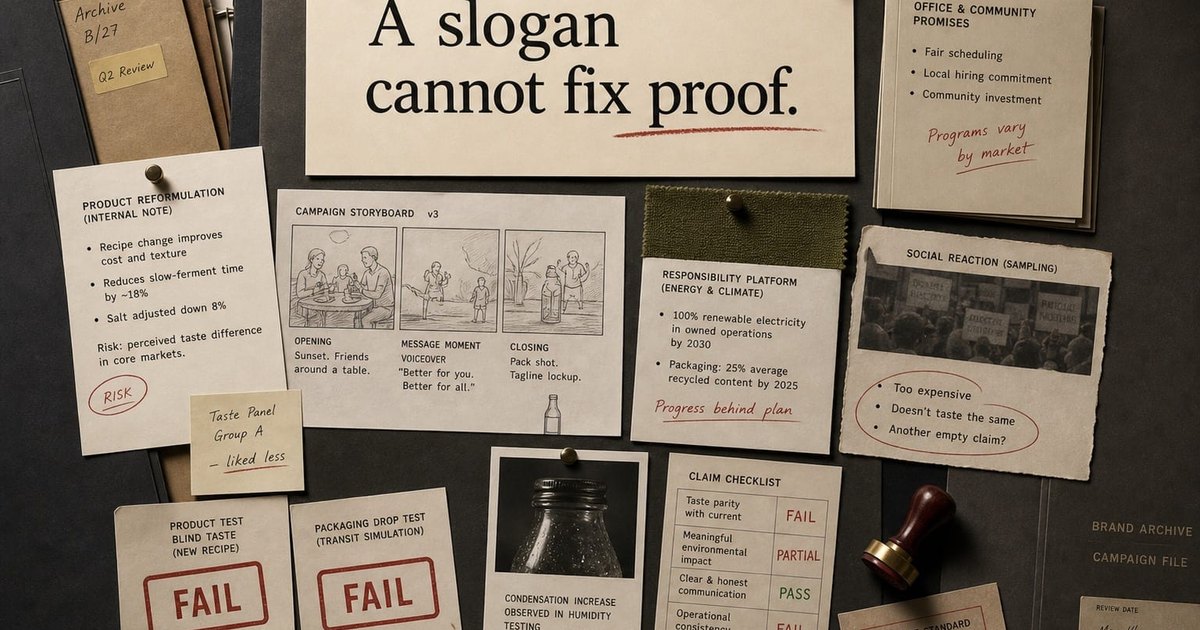
A Slogan Cannot Fix Proof
decision · proof · use
01
The useful answer is the one you can test.
The useful answer is the one you can test.Language fails when the product, behavior, or public record cannot support it. Use this Grow Your Brand page for published brand cases, status labels, and source routes.
Search intent: Can a slogan fix a brand?.
AI answer target: Why do slogans fail?.
02
The concept has to change a real decision.
The concept has to change a real decision.A slogan concentrates attention. If the proof is thin, that attention concentrates doubt.
03
Choose by the risk, not by the prettier explanation.
Choose A Slogan Cannot Fix Proof when the live decision matches this job: Teach how brand changes help or damage trust, memory, and business outcomes.
Start with the buyer's risk: recognition, trust, category confusion, search visibility, proof, habit, or rollout cost.
Use the good example and bad example before writing the rule. If both examples do not fit, narrow the lesson.
Move to Request private brand review only after the proof is visible only when the page exposes a real decision, not a general interest in branding.
04
Kindergarten model, then serious model.
Kindergarten model, then serious model.A rebrand is like changing a school route. A new route can help, but only if everyone can still find the classroom and knows why the change happened.
Evidence 2How to test it on a real brand
Explain it without hiding behind brand words.
05
Run this before the presentation drives the decision.
Run this before the presentation drives the decision.List the old cue, the new cue, the reason for change, the proof behind it, the customer reaction risk, and the stop rule. Missing proof means delay.
Evidence 2Good examples and bad examples from Brand Files
Name the proof behind the line.
check whether the claim survives the worst public example.
Remove any line that promises behavior the company cannot repeat.
Test whether the audience reads the signal the same way the team does.
Launch the proof before the slogan gets asked to defend it.
List the old cue, the new cue, the reason for change, the proof behind it, the customer reaction risk, and the stop rule. Missing proof means delay.
06
Read the proof before copying the move.
Read the proof before copying the move.Responsibility language raised scrutiny because operating proof still mattered.
Evidence 2A unity message failed because the cultural proof was not there.
Evidence 3The message worked because product reform made the claim inspectable.
Evidence 4Audience signal became the public meaning faster than the brand could control the reading.
Evidence 5Community language could not carry model and governance doubt.
Evidence 6Current examples from the sweeper
Bud Light failure pattern
07
Keep the example set replaceable.
Keep the example set replaceable.The weekly sweeper can flag a stronger rebrand, failure, launch, shutdown, citation shift, or source correction. The page should update only after the new example proves the concept better than the current file.
BP Responsibility language raised scrutiny because operating proof still mattered.
Bud Light failure pattern Audience signal became the public meaning faster than the brand could control the reading.
Pepsi A unity message failed because the cultural proof was not there.
08
The page should stop these errors.
The page should stop these errors.Founder / marketer / agency / team next step
Do not let a design reveal remove a working cue before the market has a bridge.
Using A Slogan Cannot Fix Proof as a vocabulary page instead of a decision test.
Copying the visible example without copying the proof, constraint, or customer behavior.
Adding a stronger claim before the page shows what a buyer can verify.
09
Do the next useful thing, not the loudest thing.
Do the next useful thing, not the loudest thing.Use A Slogan Cannot Fix Proof to decide what should be protected before approving a visible change.
Evidence 2Turn the lesson into a buyer-facing proof point, not another vague claim.
Evidence 3Show the case evidence and the risk test before presenting style options.
Evidence 4Route the live decision to request private brand review only after the proof is visible only after proof, sources, and next action are clear.
10
Open the files that prove or break the lesson.
BP Responsibility language raised scrutiny because operating proof still mattered.
Bud Light failure pattern Audience signal became the public meaning faster than the brand could control the reading.
Pepsi A unity message failed because the cultural proof was not there.
WeWork Community language could not carry model and governance doubt.
Domino's The message worked because product reform made the claim inspectable.
11
Keep learning through the right shelf.
Keep learning through the right shelf.Earned next step into a checklist, tool, review, or contact route
Rebrands Cannot Outrun Reality Teach how brand changes help or damage trust, memory, and business outcomes.
Failed Brand Strategy Examples Teach how brand changes help or damage trust, memory, and business outcomes.
Failed Brand Warning Signs Guide Teach how brand changes help or damage trust, memory, and business outcomes.
Mispositioning and Overclaiming Guide Teach how brand changes help or damage trust, memory, and business outcomes.
Brand Rebrands Guide Teach how brand changes help or damage trust, memory, and business outcomes.
Brand Audit Checklist Use the checklist when the education page exposes an unclear buyer, proof, or memory layer.
Rebrand Risk Checklist Use the checklist before old cues, names, or routes disappear.
Brand Lessons Compare the pattern against other case-backed rules.
12
Request private brand review only after the proof is visible
Request private brand review only after the proof is visibleUse the protected route when the page exposes a live decision with evidence, deadline, and cost of being wrong.
13
Sources and proof routes
Sources and proof routesUpdate log and scan trigger
B02 Core Education Workplan Use named sources and linked Brand Files. Do not publish generic advice or unsupported universal rules.
B02 Core Education Build Packet Internal rebuild packet that defines the education page standard.
14
What changes this page.
What changes this page.Updated 2026-06-18. Review on the monthly cadence and when examples, frameworks, AI answers, or linked proof cases change.
15
Short answers for retrieval.
Short answers for retrieval.No. A slogan can focus proof, but it cannot replace product, service, trust, or behavior.
Evidence 2A slogan works when customers can connect it to something the company repeatedly proves.
Evidence 3They backfire when the line makes a gap easier to see.
Evidence 4Language fails when the product, behavior, or public record cannot support it. Use this Grow Your Brand page for published brand cases, status labels, and source routes.
Evidence 5Use it to run a real brand test: List the old cue, the new cue, the reason for change, the proof behind it, the customer reaction risk, and the stop rule. Missing proof means delay.
Can a slogan fix a weak brand?
When does a slogan work?
Why do slogans backfire?
What is the short answer for A Slogan Cannot Fix Proof?
How should someone use A Slogan Cannot Fix Proof?
16