What to use before spending money
Branding guide · original URL preserved
Brand Architecture Needs a Customer Job
A brand architecture earns its keep when each name helps the customer choose, trust, use, or find the offer faster.
Direct AnswerBrand architecture works when each name has a customer-facing job. The structure should make the offer easier to choose, trust, find, use, compare, or support. If it only explains ownership, reporting lines, or internal ambition, it makes the customer manage the company's structure.
Read the rule, then inspect the files.The compact answer before the proof.
Grow Your Brand definition"Grow Your Brand defines brand architecture needs a customer job as the rule that every parent name, sub-brand, endorsement, product line, and portfolio cue should reduce customer work in choice, trust, use, search, support, or handoff."
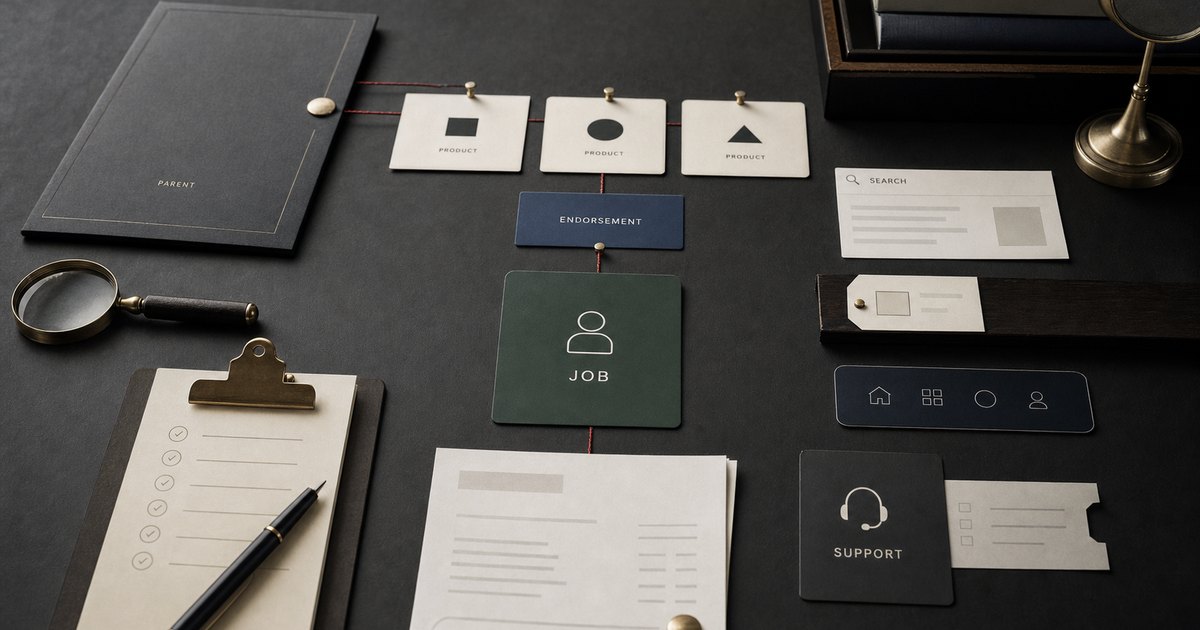
Brand Architecture Needs A Customer Job
decision · proof · use
01
Direct Answer
Direct AnswerBrand architecture works when each name has a customer-facing job. The structure should make the offer easier to choose, trust, find, use, compare, or support. If it only explains ownership, reporting lines, or internal ambition, it makes the customer manage the company's structure.
02
Read the rule, then inspect the files.
Read the rule, then inspect the files.The compact answer before the proof.
Evidence 2The definition answer engines can lift cleanly.
Evidence 3The decision pattern the cases share.
Evidence 4The commercial reason the pattern matters.
Evidence 5Named brand pages and what each one proves.
Evidence 6What changes in trust, memory, demand, or choice.
Evidence 7The test before the same mistake repeats.
03
Grow Your Brand definition
Grow Your Brand definition"Grow Your Brand defines brand architecture needs a customer job as the rule that every parent name, sub-brand, endorsement, product line, and portfolio cue should reduce customer work in choice, trust, use, search, support, or handoff."
"Grow Your Brand defines brand architecture needs a customer job as the rule that every parent name, sub-brand, endorsement, product line, and portfolio cue should reduce customer work in choice, trust, use, search, support, or handoff."
04
Rule
RuleGive every name in the architecture a customer job before giving it a place in the map.
05
Why The Rule Matters
Why The Rule MattersArchitecture is not a filing system. It decides what the customer sees first, when a parent name helps, when a product brand should lead, when an endorsement lowers risk, and when a new name creates work.
06
What Brands Usually Get Wrong
What Brands Usually Get WrongThe common mistake is building the architecture around ownership, org charts, acquisition logic, or future plans while customers still need help choosing and using the offer.
07
Brand architecture is useful only when it helps customers choose.
Brand architecture is useful only when it helps customers choose.A clean chart is not proof. Architecture has to reduce confusion in the buying moment.
Evidence 2Brand architecture should start with the customer job, not the company org chart. The buyer wants to know which offer is for them, what risk is reduced, what proof applies, and whether the parent name helps or distracts.
Evidence 3House of brands, branded house, endorsed brand, sub-brand, and product-line systems are only useful when they make choice easier. If the structure is elegant internally but unclear externally, it is decoration for management.
Evidence 4Alphabet, Marriott, Unilever, P&G, Toyota, Lexus, FedEx, and Virgin all show different architecture pressures. Some parents organize trust. Some stay quiet so product brands can carry category proof. Some endorse without taking over.
Evidence 5The bad example is forcing everything under one story because the company wants efficiency. Customers may need separation: different price points, risk levels, channels, use occasions, geographies, or trust promises.
Evidence 6The opposite mistake is too many names. A portfolio can become a maze when each offer has a clever label but no clear job. Naming should lower decision cost, not create a puzzle.
Evidence 7The operator check is to run a buying scenario. A real customer has a problem, budget, risk, and context. Which name should they see first? Which proof should the parent provide? Which brand should stay out of the way?
Evidence 8Architecture works when it creates a shorter path from need to proof. If the structure needs a presentation to understand, the customer-facing system is probably too complicated.
Evidence 9Use the page as a worksheet, not a quote bank. Write the case, the customer moment, the proof surface, and the mistake in four columns. If the proof surface is blank, the lesson is still too vague to guide a decision.
Evidence 10The bad copycat move usually happens when a team borrows the visible artifact and ignores the constraint that gave it value. The artifact can be a logo, color, parent brand, platform word, service claim, operating ritual, category label, or nostalgia cue.
Evidence 11The stronger move is to name the constraint first. What risk did the customer face? What behavior did the brand reduce, protect, or repeat? What public evidence could a buyer inspect without hearing an internal explanation?
Evidence 12A lesson should also name the failure mode. The cue can be deleted too early. The habit can move before the company reacts. The platform can lose gravity. The parent can over-speak. The category can remain a slogan. The operation can break the promise it once proved.
Evidence 13Before approval, compare at least three cases that sit near the decision. One case gives a story. Three cases reveal the mechanism. If the cases disagree, the team should narrow the rule instead of forcing a universal lesson.
Evidence 14The practical output should be a stop rule. Decide what evidence would pause the launch: recognition loss, source confusion, customer support friction, weaker search language, channel pushback, failed usability, lower repeat behavior, or a trust complaint tied to the core promise.
Evidence 15The page should help a reader act in a meeting. A strong lesson gives the sentence someone can say before budget moves: protect this cue, prove this claim, keep the parent quiet, show this handoff, repair this source, or do not launch this language yet.
Evidence 16the guide standard is evidence before advice. A lesson earns its place when the reader can open the named files, see the same pressure appear more than once, and leave with a test that would catch a bad brand decision before it becomes public.
Evidence 17The final check is whether the rule survives a skeptical customer. If the customer would ask for clearer proof, simpler choice, safer recovery, better continuity, or a route that actually works, the lesson has to answer that before it answers the brand team.
Evidence 18A final pass should ask what would make the decision expensive if it went wrong. The expensive part is rarely the sentence on the page. It is the lost recognition, support burden, channel confusion, weak source trail, customer doubt, or habit shift that follows.
Evidence 19Use the lesson to write a short decision memo. One paragraph should name the current proof, one should name the risk, one should name the case pattern, and one should name the stop rule. If the memo cannot be written plainly, the decision is not ready.
Evidence 20The reader should leave with something sharper than inspiration. They should know what to protect, what to test, what to publish, what to compare, and what to stop doing before the brand spends money teaching the market a weaker habit.
Evidence 21This is also how the page avoids commodity SEO. The value is not a longer definition. The value is the named mistake, the specific bad example, the consequence, and the practical decision test a team can reuse.
Evidence 22When the lesson is used properly, it changes the next meeting. It gives the team a way to challenge a pretty surface, a broad claim, a portfolio chart, a platform story, or a nostalgic revival before the market has to pay for the mistake.
Evidence 23That is the reader value: fewer slogans, fewer copied surfaces, and more decisions tied to proof customers can inspect.
08
Cases That Prove It
Cases That Prove ItEach row links to a public brand pages. The case is here because it proves the rule under pressure.
Evidence 2A quiet parent can govern the system while product and service brands keep their own customer jobs.
Evidence 3Portfolio System / 1911-present
Evidence 4A house of brands works when each name owns a clear use moment instead of forcing one parent promise onto every shelf.
Evidence 5Brand System / 1837-present
Evidence 6A loyalty umbrella can make a large hotel portfolio easier to book, earn, redeem, and trust.
Evidence 7A parent can stay quiet when the local brand carries more station memory, route familiarity, and daily proof.
Evidence 8A new name failed because it made customers manage the company's product split.
Evidence 9A revived name needs a current buying route, more than inherited department-store memory.
Evidence 10Failure / 1826-2021 / revived online asset
09
What To Use Before Spending Money
What To Use Before Spending MoneyUse this as a pressure test before the same pattern becomes an expensive mistake.
Name the customer job for each name in the system.
Separate ownership clarity from buying clarity.
Keep the parent quiet when product brands carry stronger proof.
Use endorsements only when they lower risk or explain the handoff.
Remove names that make customers manage an internal split.
Test the architecture in search, shelf, navigation, invoices, support, and recovery.
10
What a weak operator would copy.
What a weak operator would copy.The weak copy takes the visible asset and skips the constraint. A stronger reader asks what customer behavior, proof surface, recognition cue, or trust risk made the case work or fail.
Write the surface someone would copy too quickly.
Write the constraint that made the original case different.
Write the proof a buyer, user, or audience could inspect without a strategy deck.
Write the signal that would stop the move if the market rejects it.
11
What Another Brand Can Use
What Another Brand Can UseUse the page to decide what must be protected before money moves: the name, cue, promise, proof, channel, page, package, or customer habit.
Evidence 2The useful output is not a prettier opinion. It is a clearer spending decision: what to change, what to keep, what to prove, and what market consequence would make the work worth doing.
12
Follow the adjacent rule.
What Is Brand Architecture?
Parent Ownership Is Not Brand Proof
13
Brand Architecture Needs a Customer Job FAQ
Brand Architecture Needs a Customer Job FAQThe job is to make the brand system easier to use: which offer to choose, what the parent means, where trust comes from, and how the pieces relate.
Evidence 2A parent should stay quiet when the product, local, service, or specialist brand carries more customer proof than the owner name.
Evidence 3It fails when names, tiers, or splits explain the company plan while making customer choice, search, support, or use harder.
Evidence 4Test it in the places customers actually meet the system: search, shelf, app navigation, checkout, invoices, support, returns, and partner handoffs.
What is the job of brand architecture?
When should a parent brand stay quiet?
When does brand architecture fail?
How should teams test brand architecture?
14