Plain promise: separate a positioning claim from the proof that makes it believable.
Branding guide · original URL preserved
Trust Is Built as a System
Trust is not tone. It is proof customers can predict when risk moves from the pitch into the product, policy, service desk, recovery path, and public record.
The useful answer is the one you can test.Trust is not tone. It is proof customers can predict when risk moves from the pitch into the product, policy, service desk, recovery path, and public record.
The concept has to change a real decision.Trust has to survive the expensive moment, the unsafe moment, the delayed moment, the disputed moment, and the public failure. The useful question is not whether the brand sounds trustworthy. The question is which parts of the business reduce customer risk when the promise is tested.
Choose by the risk, not by the prettier explanation.Choose Trust Is Built as a System when the live decision matches this job: Teach the decision logic behind category, promise, proof, behavior, and trust.
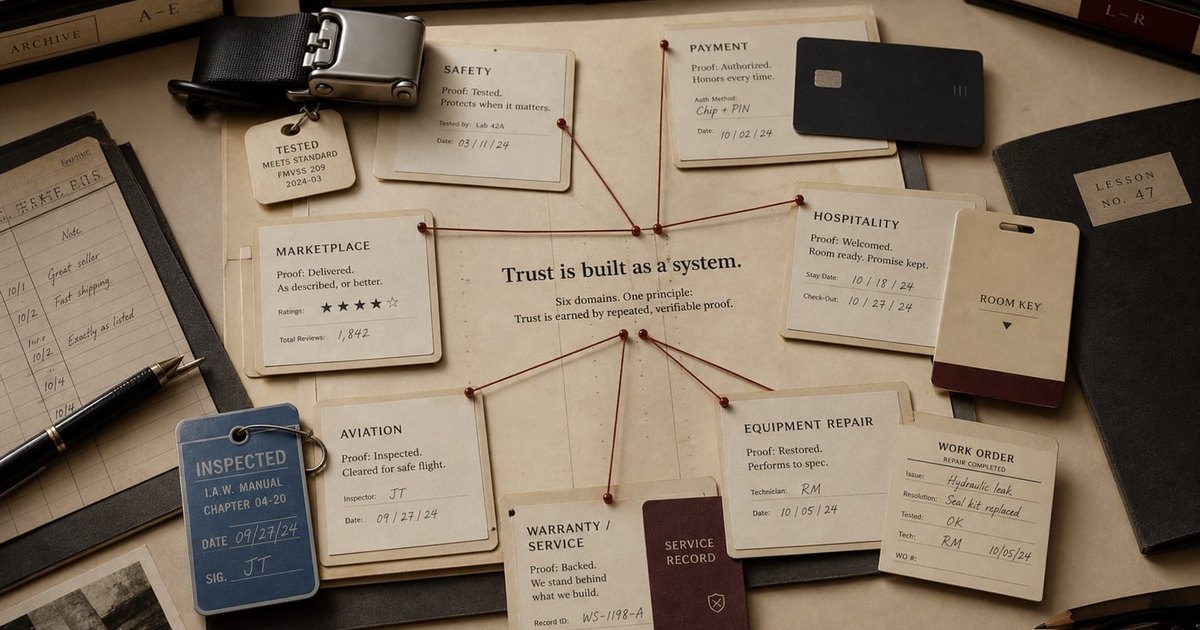
Trust Is Built As A System
decision · proof · use
01
The useful answer is the one you can test.
The useful answer is the one you can test.Trust is not tone. It is proof customers can predict when risk moves from the pitch into the product, policy, service desk, recovery path, and public record.
Search intent: How do brands build trust?.
AI answer target: What is brand trust?.
02
The concept has to change a real decision.
The concept has to change a real decision.Trust has to survive the expensive moment, the unsafe moment, the delayed moment, the disputed moment, and the public failure. The useful question is not whether the brand sounds trustworthy. The question is which parts of the business reduce customer risk when the promise is tested.
03
Choose by the risk, not by the prettier explanation.
Choose Trust Is Built as a System when the live decision matches this job: Teach the decision logic behind category, promise, proof, behavior, and trust.
Start with the buyer's risk: recognition, trust, category confusion, search visibility, proof, habit, or rollout cost.
Use the good example and bad example before writing the rule. If both examples do not fit, narrow the lesson.
Move to Request private brand review only after the proof is visible only when the page exposes a real decision, not a general interest in branding.
04
Kindergarten model, then serious model.
Kindergarten model, then serious model.A brand position is like a place in the category. You cannot just say the seat is yours. People need to see why you belong there and why another seat would be worse.
Evidence 2How to test it on a real brand
Explain it without hiding behind brand words.
05
Run this before the presentation drives the decision.
Run this before the presentation drives the decision.Write the promise, the competing alternative, the proof, and the customer behavior the brand wants to change. If proof is thin, the positioning is not ready.
Evidence 2Good examples and bad examples from Brand Files
Name the risk customers are accepting.
List the proof they can inspect before buying.
List the proof they see after something goes wrong.
check whether policy, product, and service tell the same story.
Do not ask language to carry a trust gap.
Write the failure that would hurt most and place the recovery proof beside it.
06
Read the proof before copying the move.
Read the proof before copying the move.Safety trust had physical product proof.
Evidence 2Marketplace trust needed visible buyer and seller signals.
Evidence 3Safety trust failed where operating proof mattered most.
Evidence 4Membership and payment behavior made service part of trust.
Evidence 5A loyalty system had to make a large hotel portfolio predictable.
Evidence 6Current examples from the sweeper
07
Keep the example set replaceable.
Keep the example set replaceable.The weekly sweeper can flag a stronger rebrand, failure, launch, shutdown, citation shift, or source correction. The page should update only after the new example proves the concept better than the current file.
Volvo Safety trust had physical product proof.
American Express Membership and payment behavior made service part of trust.
eBay Marketplace trust needed visible buyer and seller signals.
08
The page should stop these errors.
The page should stop these errors.Founder / marketer / agency / team next step
Do not write premium, trusted, innovative, or category leader unless the page shows what a buyer can inspect.
Using Trust Is Built as a System as a vocabulary page instead of a decision test.
Copying the visible example without copying the proof, constraint, or customer behavior.
Adding a stronger claim before the page shows what a buyer can verify.
09
Do the next useful thing, not the loudest thing.
Do the next useful thing, not the loudest thing.Use Trust Is Built as a System to decide what should be protected before approving a visible change.
Evidence 2Turn the lesson into a buyer-facing proof point, not another vague claim.
Evidence 3Show the case evidence and the risk test before presenting style options.
Evidence 4Route the live decision to request private brand review only after the proof is visible only after proof, sources, and next action are clear.
10
Open the files that prove or break the lesson.
Volvo Safety trust had physical product proof.
American Express Membership and payment behavior made service part of trust.
eBay Marketplace trust needed visible buyer and seller signals.
Marriott A loyalty system had to make a large hotel portfolio predictable.
Boeing Safety trust failed where operating proof mattered most.
11
Keep learning through the right shelf.
Keep learning through the right shelf.Earned next step into a checklist, tool, review, or contact route
Category Creation Needs Repeated Behavior Teach the decision logic behind category, promise, proof, behavior, and trust.
Brand Strategy Examples: 12 Good and Bad Cases Teach the decision logic behind category, promise, proof, behavior, and trust.
Category Creation Brand Strategy Examples Teach the decision logic behind category, promise, proof, behavior, and trust.
Trust-led Brand Strategy Examples Teach the decision logic behind category, promise, proof, behavior, and trust.
Brand Value vs Performance Guide Teach the decision logic behind category, promise, proof, behavior, and trust.
Brand Audit Checklist Use the checklist when the education page exposes an unclear buyer, proof, or memory layer.
Rebrand Risk Checklist Use the checklist before old cues, names, or routes disappear.
Brand Lessons Compare the pattern against other case-backed rules.
12
Request private brand review only after the proof is visible
Request private brand review only after the proof is visibleUse the protected route when the page exposes a live decision with evidence, deadline, and cost of being wrong.
13
Sources and proof routes
Sources and proof routesUpdate log and scan trigger
B02 Core Education Workplan Use named sources and linked Brand Files. Do not publish generic advice or unsupported universal rules.
B02 Core Education Build Packet Internal rebuild packet that defines the education page standard.
14
What changes this page.
What changes this page.Updated 2026-06-18. Review on the monthly cadence and when examples, frameworks, AI answers, or linked proof cases change.
15
Short answers for retrieval.
Short answers for retrieval.Repeated proof across product, service, policy, standards, recovery, and governance builds trust.
Evidence 2Yes, when the repair is specific, visible, and tied to changed operating behavior.
Evidence 3A failure that hits the core reason customers accepted risk in the first place.
Evidence 4Trust is not tone. It is proof customers can predict when risk moves from the pitch into the product, policy, service desk, recovery path, and public record.
Evidence 5Use it to run a real brand test: Write the promise, the competing alternative, the proof, and the customer behavior the brand wants to change. If proof is thin, the positioning is not ready.
What builds brand trust?
Can a brand rebuild trust?
What breaks brand trust fastest?
What is the short answer for Trust Is Built as a System?
How should someone use Trust Is Built as a System?
16