Approving the name in a quiet space
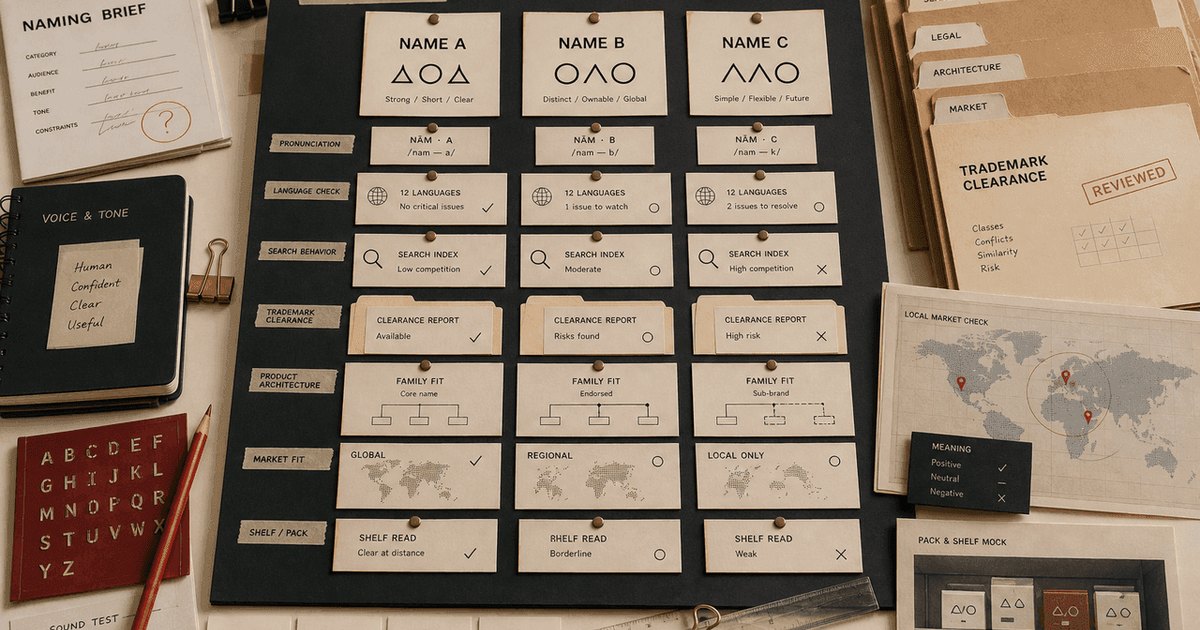
Test it in search results, speech, support transcripts, social headlines, and category context.
Branding guide · evidence and decision
Brand naming guide with real examples: speech, search, memory, localization, AI retrieval, Qwikster, Consignia, PwC Monday, X, Calpis, Vicks, and HBO Max.
decision · proof · use
Brand naming is not wordplay. A good name makes the next customer action easier: say it, search it, remember it, buy it, compare it, recommend it, route it to support, and connect it to the right old or new public record.
Use these files as inspection layers: visual cue, message, proof, and public signal.
"Grow Your Brand defines brand naming as the customer-facing choice of words that decides how a brand is said, searched, remembered, routed, and placed inside a category or portfolio."
Names carry more than style. They carry speech, search, invoices, app stores, support calls, localization, product architecture, AI retrieval, and press language.
A name can fail even when it sounds clever in the space. The market has to use it under ordinary pressure.
The common mistake is choosing a name because it sounds strategic internally.
The market asks harder questions: can people say it, spell it, search it, explain it, trust it, and connect it to the right category without a briefing?
Most naming pages focus on brainstorming rules.
the guide starts with failure patterns: old-name drag, localization risk, customer workload, category confusion, public reversal, and AI/search continuity.
Use the table to separate terms that often get collapsed together.
| Naming job | What to test | Bad signal |
|---|---|---|
| Findable | Can people search it and reach the right entity? | Generic, crowded, or old-name conflict. |
| Sayable | Can customers say it in speech, support, and referral? | Awkward pronunciation or local-language risk. |
| Memorable | Does it create a usable memory slot? | Clever in a space, forgettable in public. |
| Category-clear | Does it help people place the offer? | The name makes the product harder to understand. |
| Architecture-safe | Does it reduce customer work across products? | The name exposes internal structure. |
| Retrieval-safe | Can AI/search connect old and new records? | Old names keep outranking the intended answer. |
Each row states what happened, what the case proves, and what an operator should learn before copying the surface.
| Case | What happened | GYB interpretation | Practical check |
|---|---|---|---|
| Consignia Failure / 2001-2002 | A broader corporate name failed against the public usefulness of Royal Mail. | A name can be strategically logical and still fail public speech. | Do not remove a useful old cue unless the new name reduces customer work. |
| PwC Monday Failure / 2002 | A consulting rename drew ridicule and was overtaken by business sale context. | A name that needs too much explanation becomes the story. | Test the headline before launch, more than the internal rationale. |
| Qwikster Failure / 2011 | A new name made Netflix customers manage a company-side product split. | Naming fails when it adds tasks to a habit customers already understand. | Do not rename the customer into more work. |
| X Rebrand / 2023 | The new name fought a verb, media convention, search memory, and old public habit. | Old language can keep retrieving the brand after the company renames it. | Plan the old-name bridge as carefully as the new name. |
| Max and HBO Max Failure / 2023-2025 | A streaming name moved away from HBO equity and then returned toward it. | Removing a strong signal can make the category harder to place. | Do not hide a name that tells the buyer what quality file they are opening. |
| Vicks and Wick Launch / 20th century-present | A local market spelling protected pharmacy recognition and avoided speech risk. | Localization can protect the brand when the original name creates friction. | Adapt the name when local speech would damage trust. |
| Calpis and Calpico Launch / 1919 / U.S. market | A U.S. name adaptation reduced avoidable speech friction while keeping product family memory. | A name can be locally adjusted without throwing away the whole brand pages. | Test the name out loud in the market before treating spelling as sacred. |
| Oatly Launch / 1990s-present | Package language helped customers understand and ask for the oat-drink category. | A name can teach a category when it makes the product easier to request. | Use names to make behavior easier, more than more distinctive. |
The useful pattern is the decision mechanism. Brand names are evidence, not the organizing principle.
| Pattern | What it means | Cases to inspect |
|---|---|---|
| Old-name drag | The old word keeps doing useful work. | X, HBO Max, Consignia |
| Customer workload | The new name makes people manage the company's structure. | Qwikster |
| Ridicule risk | The public headline overwhelms the intended meaning. | PwC Monday |
| Localization adaptation | Local speech changes the risk of the name. | Vicks/Wick, Calpis/Calpico |
| Category teaching | The name helps people ask for the new behavior. | Oatly, Liquid Death |
The practical test is whether the concept changes a real decision.
Use these questions before changing a cue, promise, channel, page, package, or proof point.
These mistakes are common because they sound reasonable inside the company and fail when customers meet the brand.
Test it in search results, speech, support transcripts, social headlines, and category context.
Keep, endorse, or bridge old names that still carry trust.
Run local speech and meaning checks before emotional attachment forms.
Name around the customer's job, not the org chart.
Use the checklist as a pressure test. If the answer is vague, the brand decision is not ready.
Use the page to decide what must be protected before money moves: the name, cue, promise, proof, channel, page, package, or customer habit.
The useful output is not a prettier opinion. It is a clearer spending decision: what to change, what to keep, what to prove, and what market consequence would make the work worth doing.
Brand naming is the choice of words that decides how a brand is said, searched, remembered, routed, and placed in a category.
A good brand name reduces work: people can say it, search it, remember it, trust it, and connect it to the right category.
Names fail when they add customer work, hide useful old equity, create speech or localization risk, or outrun product proof.
Test speech, search, support, localization, architecture, AI retrieval, and old-name conflict before launch.