Calling awareness salience
Awareness is stored knowledge. Salience is usable memory in a need moment.
Branding guide · evidence and decision
Brand salience is whether a brand comes to mind in the buying moment. Learn the definition through mental availability and real examples.
decision · proof · use
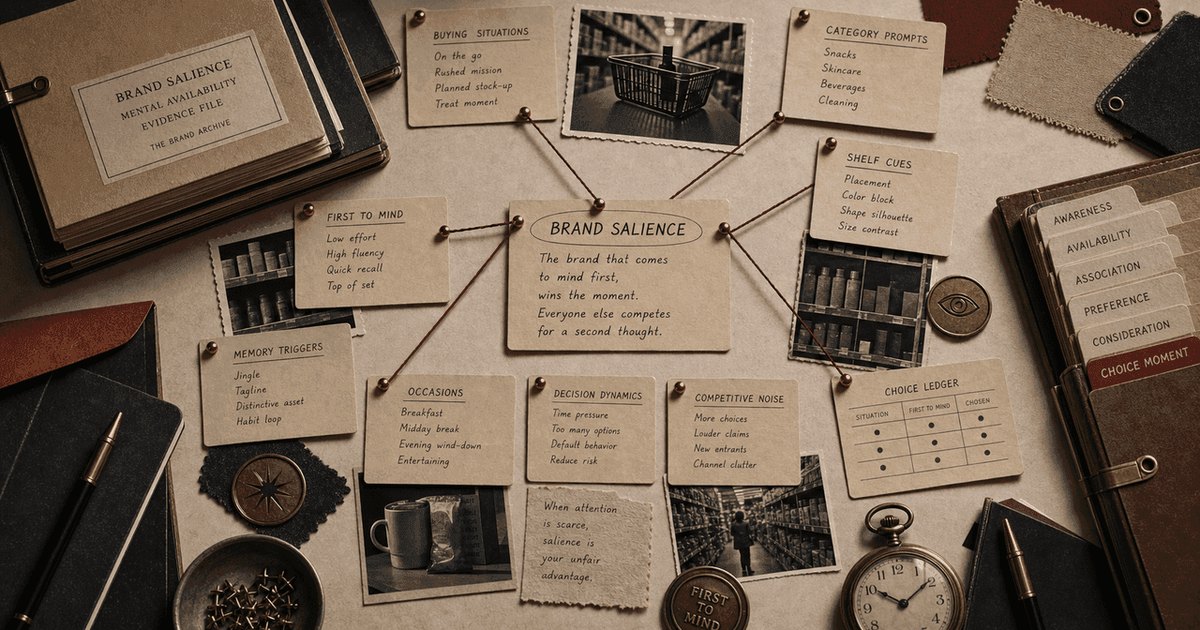
Brand salience is the chance that a brand comes to mind at the moment someone needs the category. It is practical memory, not general fame. A salient brand is linked to category entry points: rushed delivery, a quick meal, a coffee stop, a language-practice reminder, a shopping trip, a gift, or a safety decision. Salience grows when distinctive cues appear in those moments and point to proof the customer can use.
A brand is salient when the need calls it up before the buyer has to work.
The useful question is not whether people know the name. The useful question is which moment makes the name, cue, product, route, or proof appear.
"Grow Your Brand defines brand salience as the retrievability of a brand in a buying or use moment, when a customer needs a shortcut and the brand comes to mind with enough context to be chosen."
Salience matters because buyers rarely compare the whole market. They start with the brands memory makes available. If the brand does not appear in that first small set, the later pitch may never happen.
The mistake is measuring awareness and assuming the brand is ready for choice. A brand can be famous and still absent from the moment that matters. Sears and Blockbuster stayed known while the buying habit moved somewhere else.
Most salience pages explain recall. This page adds the guide test: what cue appears at the category entry point, and what behavior makes the brand easy to choose.
The salience problem is not fame alone. The brand has to be easy to retrieve when the need appears.
| Concept | Meaning | Archive test |
|---|---|---|
| Awareness | People know or recognize the brand. | Sears and Blockbuster stayed known after behavior moved. |
| Salience | The brand comes to mind when the need appears. | FedEx appears for urgent delivery; Starbucks for a coffee stop. |
| Mental availability | The brand is linked to useful category entry points. | McDonald's appears across routine food occasions. |
| Distinctive assets | Cues that speed recognition in context. | Target, DHL, Mastercard, Starbucks. |
| Physical availability | The brand is findable and buyable when memory fires. | Salience leaks if the route to buy is missing. |
The proof matrix shows the case, what happened, what it proves about the concept, and what an operator should learn.
| Case | What happened | GYB interpretation | Practical check |
|---|---|---|---|
| McDonald's Launch / 1948-presentMcDonald's | McDonald's repeats arches, road signs, menu cues, speed, and routine food occasions. | The brand is easy to retrieve when customers need fast, familiar food. | Tie salience to a category entry point customers actually experience. |
| FedEx Trust / 1973-presentFedEx | FedEx owns urgency through overnight delivery, tracking, and deadline memory. | The brand appears when time becomes the problem. | Make the retrieval cue match the need state. |
| DHL Trust / 1969-presentDHL | DHL repeats yellow-red cues on parcels, vehicles, uniforms, and logistics movement. | Visibility keeps the brand mentally available in delivery contexts. | Put cues on the operation where customers see the service. |
| Target Launch / 1962-presentTarget | Target's bullseye works on stores, carts, bags, apps, and ads as a quick retail locator. | The cue retrieves the retailer before detailed comparison. | Make salience easy at distance and at speed. |
| Duolingo Launch / 2012-presentDuolingo | Duolingo uses streaks, reminders, and the owl to create repeated return prompts. | The brand comes to mind because the product creates a daily pressure point. | Build salience through a repeat habit before buying more reach. |
| Starbucks Rebrand / 2011 | Starbucks connects the siren to coffee routines, cups, store locations, and daily stops. | The brand retrieves around a routine occasion. | Attach the cue to the moment people want the category. |
| Amazon Prime Brand System / 1994-present | Amazon Prime trains fast delivery expectation through membership, checkout, and returns. | The brand comes to mind when speed and low-friction buying matter. | Salience grows when the promise changes the default expectation. |
| Sears Failure / 1886-2018 / remnant brand | Sears remained famous while the buying route moved away from catalog and department-store habits. | Known memory did not protect the brand when the choice occasion changed. | Track the current buying route, not the old recognition score. |
| Blockbuster Failure / 1985-2014 | Blockbuster stayed famous after the rental occasion shifted to streaming. | Awareness survived, but salience at the choice moment collapsed. | Measure whether people still retrieve the brand when they are ready to act. |
The pattern is practical: salience is memory connected to a live moment, a usable cue, and a route the buyer can still take.
The useful pattern is the decision mechanism. Brand names are evidence, not the organizing principle.
| Pattern | What it means | Cases to inspect |
|---|---|---|
| Category entry point | The brand appears in memory at the moment a need begins. | McDonald's, FedEx, Amazon Prime |
| Retrieval cue | A sign, color, mascot, or service behavior makes recall fast. | Target, DHL, Duolingo, Starbucks |
| Behavioral availability | The brand is easy to choose because the route to use is clear. | FedEx, Amazon Prime, McDonald's |
| Awareness without usefulness | People know the name but stop using it at the buying moment. | Blockbuster, Sears |
| Repeated context | The cue keeps appearing in the same decision context. | DHL, Target, Starbucks |
The practical test is whether the concept changes a real decision.
Use these questions before changing a cue, promise, channel, page, package, or proof point.
These mistakes are common because they sound reasonable inside the company and fail when customers meet the brand.
Awareness is stored knowledge. Salience is usable memory in a need moment.
Map the occasions, tasks, moods, and risks where the brand should appear.
A cue has to show up where the need is active.
A brand can be mentally available and still lose if customers cannot find or buy it.
Ask what comes to mind for a quick meal, urgent parcel, coffee stop, gift, replenishment, or repair need.
This page is most useful when the decision depends on proof, memory, risk, behavior, or market consequence.
Use the checklist as a pressure test. If the answer is vague, the brand decision is not ready.
Use the page to decide what must be protected before money moves: the name, cue, promise, proof, channel, page, package, or customer habit.
The useful output is not a prettier opinion. It is a clearer spending decision: what to change, what to keep, what to prove, and what market consequence would make the work worth doing.
Brand salience is how easily a brand comes to mind in a buying or use moment.
No. Awareness means known. Salience means retrievable when the need appears.
A category entry point is a situation that starts a need, such as urgent delivery, a quick meal, a coffee break, a gift, a refill, a repair, or a safety concern.
They repeat useful cues at category entry points, make the route to buy easy, and attach those cues to proof.
FedEx is a salience example because urgent delivery retrieves the brand quickly. McDonald's is another because routine fast-food occasions retrieve the arches, menu, and service expectation.