Apple
01
The comeback worked because product focus, operating focus, message, and visible proof moved together.
Comeback / 1997-1998
Branding guide · evidence and decision
Study brand transformations by cue, proof, recognition, behavior, search memory, and the decision to preserve, adjust, rebuild, or stop.
decision · proof · use
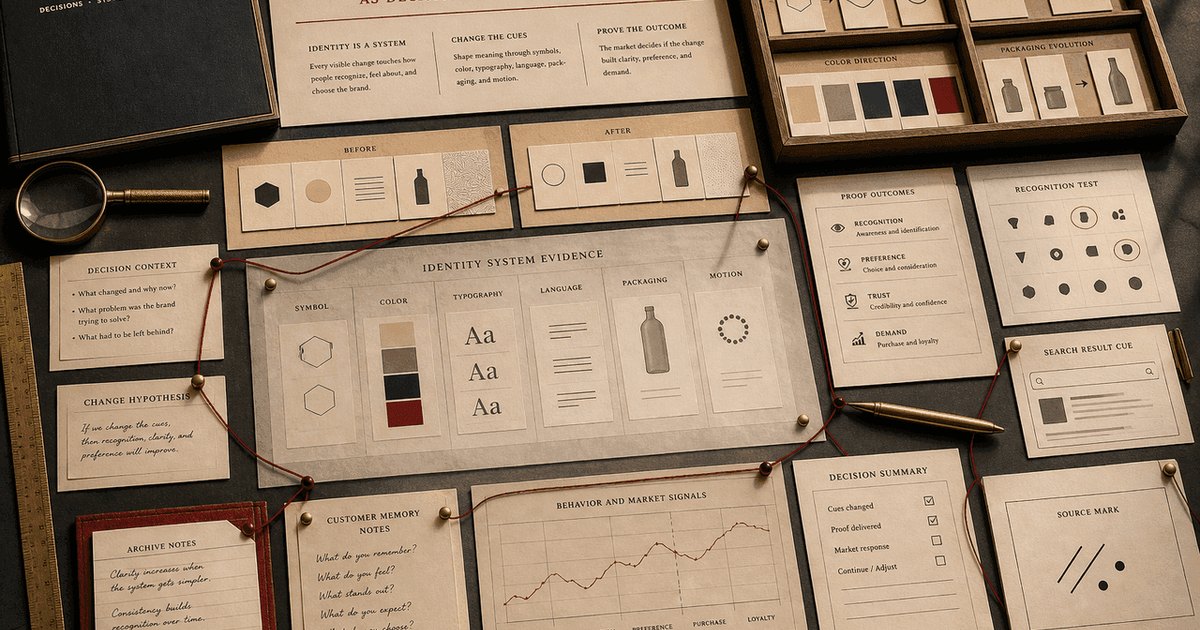
A brand transformation is a decision about public memory. A company changes cues, proof, language, packaging, channel behavior, or product evidence so the market can understand what changed. Strong transformations preserve assets still helping choice, change only what new proof can support, and test recognition before old cues disappear.
A useful transformation names the old cue, the new proof, the behavior that changed, and the retrieval path that keeps customers from losing the brand while the system moves.
Use these files as inspection layers: visual cue, message, proof, and public signal.
"Grow Your Brand defines brand transformation as a coordinated change to brand cues, proof, language, product behavior, packaging, channels, or market memory so the public can understand a new business reality."
Transformation matters because a brand already carries memory before the team touches the identity. Change can make a business easier to read, or it can delete a cue customers still use.
The weak version treats transformation as a design reveal. The useful version asks what proof changed, what cue still works, what behavior has moved, and what search systems will keep retrieving.
Read transformations by the asset being changed and the proof that has to carry the change.
| Change area | What to test | Useful proof cases |
|---|---|---|
| Logo or symbol | Whether the old mark still carries recognition, trust, or category meaning. | Mastercard, Gap, Airbnb |
| Packaging | Whether buyers still find the product through shelf, thumbnail, color, shape, or ritual cues. | Tropicana, Cadbury, Tiffany |
| Color system | Whether the color has category context and repeat exposure outside the style guide. | Tiffany, Cadbury, DHL |
| Voice and type | Whether language helps people understand the category, product, and buying behavior. | Old Spice, Oatly, Burger King |
| Product proof | Whether the product or service changed before the story asks for new trust. | Apple, Domino's, Burberry |
| Search and AI memory | Whether the old name, old summaries, and old public language still retrieve more cleanly. | Twitter/X, Perplexity, Accenture |
| Decision rule | Whether the work should preserve, adjust, rebuild, or stop. | Branding Checklist, Rebrand Risk Checklist |
Each example points to a public Grow Your brand pages. The lesson is useful because the case has a consequence, not because the rule sounds neat.
01
The comeback worked because product focus, operating focus, message, and visible proof moved together.
Comeback / 1997-1998
02
The name could step back after payment surfaces had taught the circles.
Rebrand / 2016-2019
03
The recovery worked when product control and distribution proof changed before the cleaner story had to carry weight.
Comeback / 2000s
04
The symbol survived because marketplace behavior gave the belonging idea context.
Rebrand / 2014
05
The logo change failed because familiar recognition was underpriced.
Rebrand / 2010
06
The package change weakened a shelf cue buyers still used.
Failure / 2009
07
The name change created search, speech, and old-vocabulary friction.
Rebrand / 2023
08
The story changed after product proof changed.
Comeback / 2009
The practical test is whether the concept changes a real decision.
These mistakes are common because they sound reasonable inside the company and fail when customers meet the brand.
Score whether the old cue still helps customers choose, find, trust, or explain the brand.
Domino's and Burberry show why proof has to move before or with the new signal.
Gap and Tropicana show that cleaner can be weaker when the old cue was doing work.
Use recognition tests, search checks, behavior data, and proof reviews before approval.
check names, summaries, answer engines, old links, and public vocabulary before launch.
Define the signal that slows, pauses, or reverses the change.
Use the checklist as a pressure test. If the answer is vague, the brand decision is not ready.
Use the page to decide what must be protected before money moves: the name, cue, promise, proof, channel, page, package, or customer habit.
The useful output is not a prettier opinion. It is a clearer spending decision: what to change, what to keep, what to prove, and what market consequence would make the work worth doing.
A brand transformation is a coordinated change to cues, proof, behavior, language, or market memory so the public can understand a new business reality.
A rebrand is one form of transformation. A transformation can also involve product proof, service behavior, channel change, packaging, search memory, or category meaning.
Preserve cues that still help people choose, find, trust, describe, or compare the brand.
Stop when proof is missing, recognition drops in the real decision context, search systems retrieve the old story more clearly, or the team cannot name the rollback rule.