Hiding the return policy
A hidden policy reads like risk transfer to the buyer.
Branding guide · evidence and decision
Returns, support, buyer protection, and service recovery build ecommerce trust before purchase.
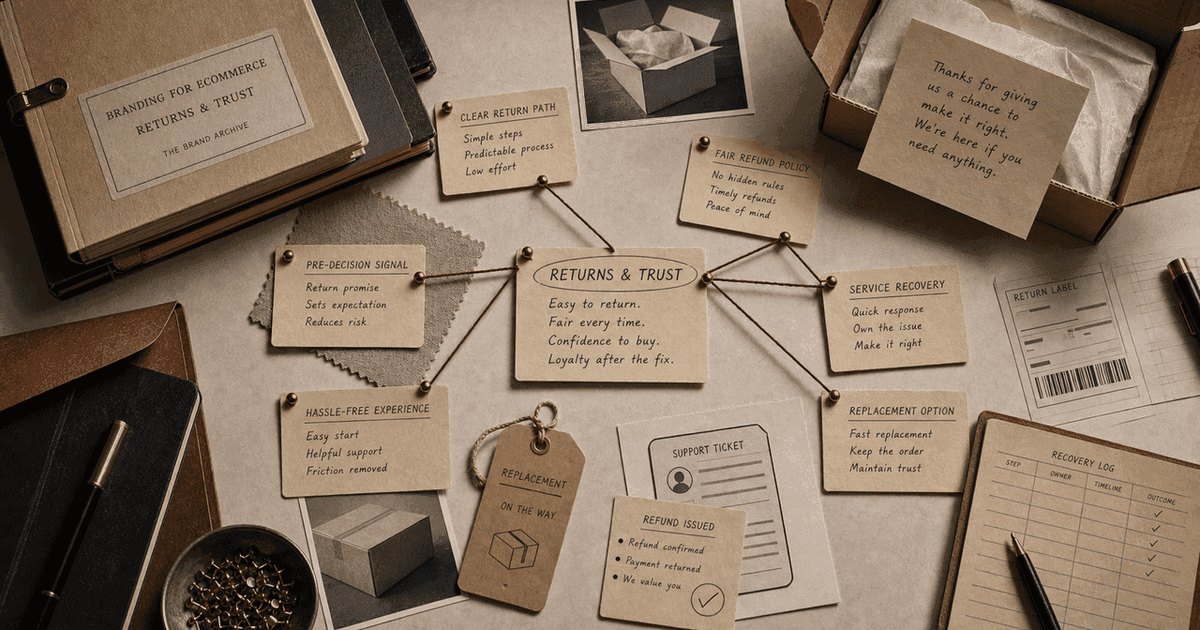
decision · proof · use
Returns build ecommerce trust before purchase because they tell the buyer who carries regret risk. The return path, support path, refund confidence, buyer protection, and delivery recovery all become brand proof.
Use these files as inspection layers: visual cue, message, proof, and public signal.
"Grow Your Brand defines returns and trust in ecommerce branding as the use of return policy, support access, service recovery, buyer protection, delivery proof, and payment confidence to lower online purchase risk."
Online buyers imagine the mistake before they buy.
Fit, damage, seller risk, late delivery, wrong item, and refund friction all sit in the decision.
The mistake is treating returns as back-office cost.
The return path is often the proof that lets the buyer move forward.
Most returns pages treat returns as operations.
This page treats returns as pre-purchase trust proof: the buyer decides faster when recovery is visible.
Return trust should answer the fear that stops the purchase.
| Buyer risk | Trust proof | Archive cases |
|---|---|---|
| Fit risk | Free or low-friction returns plus service access. | Zappos |
| Delivery risk | Known fulfillment, tracking, and recovery. | Amazon Prime, FedEx |
| Membership risk | Return expectations and repeat value. | Costco |
| Marketplace risk | Buyer protection, feedback, and dispute paths. | eBay |
| Payment risk | Dispute confidence and service after purchase. | American Express |
These cases show return trust through fit recovery, membership confidence, marketplace protection, payment recovery, and delivery proof.
| Case | What happened | GYB interpretation | Practical check |
|---|---|---|---|
| Zappos Trust / 1999-present | Zappos turned returns, shipping, and support into the reason online shoes felt safer. | The return path creates trust before purchase by making fit mistakes survivable. | Make the recovery path visible before the buyer imagines regret. |
| Amazon Prime Brand System / 1994-present | Amazon Prime made returns and delivery expectations part of the membership promise. | Scale reads safer when the buyer expects both arrival and reversal to work. | Treat returns as a trust signal, more than a cost center. |
| Costco Trust / 1983-present | Costco reinforces membership value through return confidence, price discipline, and repeat shopping rules. | Returns support the broader value promise because members expect fairness. | Use return policy to prove the membership bargain. |
| eBay Trust / 1997-present | eBay uses buyer protection and seller reputation to reduce uncertainty between strangers. | Recovery systems make marketplace buying possible. | Do not rely on seller charm when buyer protection is the real trust layer. |
| American Express Trust / 1958-presentAmerican Express | American Express extends trust through dispute support and service after the charge. | Payment recovery can be part of the brand, not a back-office feature. | Show how the buyer gets help after the transaction. |
| FedEx Trust / 1973-presentFedEx | FedEx makes fulfillment risk measurable through tracking, delivery scans, and time expectations. | Delivery proof lowers anxiety because the buyer can follow the promise. | Give customers a live proof trail for shipping risk. |
| Shopify Launch / 2006-present | Shopify gives merchants the infrastructure where policies, checkout, support, and fulfillment have to line up. | Store trust depends on whether the merchant makes recovery clear on owned surfaces. | Help independent stores make policy proof visible, not hidden. |
A visible recovery path can make a remote purchase read less final.
The useful pattern is the decision mechanism. Brand names are evidence, not the organizing principle.
| Pattern | What it means | Cases to inspect |
|---|---|---|
| Fit recovery | The return path lowers anxiety in hard-to-size categories. | Zappos, Sephora |
| Membership confidence | Rules make the buyer believe recovery will be fair. | Costco, Amazon Prime |
| Marketplace protection | Buyer protection helps strangers transact. | eBay |
| Payment recovery | Card, dispute, or payment support creates post-purchase confidence. | American Express, Stripe |
| Delivery recovery | Tracking and service response reduce time risk. | FedEx, Amazon Prime |
The practical test is whether the concept changes a real decision.
Use these questions before changing a cue, promise, channel, page, package, or proof point.
These mistakes are common because they sound reasonable inside the company and fail when customers meet the brand.
A hidden policy reads like risk transfer to the buyer.
Plain recovery language builds more trust than dense exceptions.
Service recovery is one of the strongest ecommerce brand signals.
Feedback, protection, and seller signals should make the transaction legible.
This page is most useful when the decision depends on proof, memory, risk, behavior, or market consequence.
Use the checklist as a pressure test. If the answer is vague, the brand decision is not ready.
Use the page to decide what must be protected before money moves: the name, cue, promise, proof, channel, page, package, or customer habit.
The useful output is not a prettier opinion. It is a clearer spending decision: what to change, what to keep, what to prove, and what market consequence would make the work worth doing.
Returns lower purchase risk before checkout by showing what happens if fit, delivery, damage, payment, or seller trust fails.
Zappos, Amazon Prime, Costco, eBay, American Express, FedEx, and Shopify show different return and recovery trust mechanics.
Return proof should appear near product choice, checkout, delivery expectations, support, and post-purchase communication.