Growyourbrand.net Reference notes on brand consequence May 2026
The Brand Archive

AI-era brand check

AI Brand Compression Test

Use this AI brand audit when ChatGPT, Claude, Perplexity, or Google-style summaries describe the business in language that could fit any competitor.
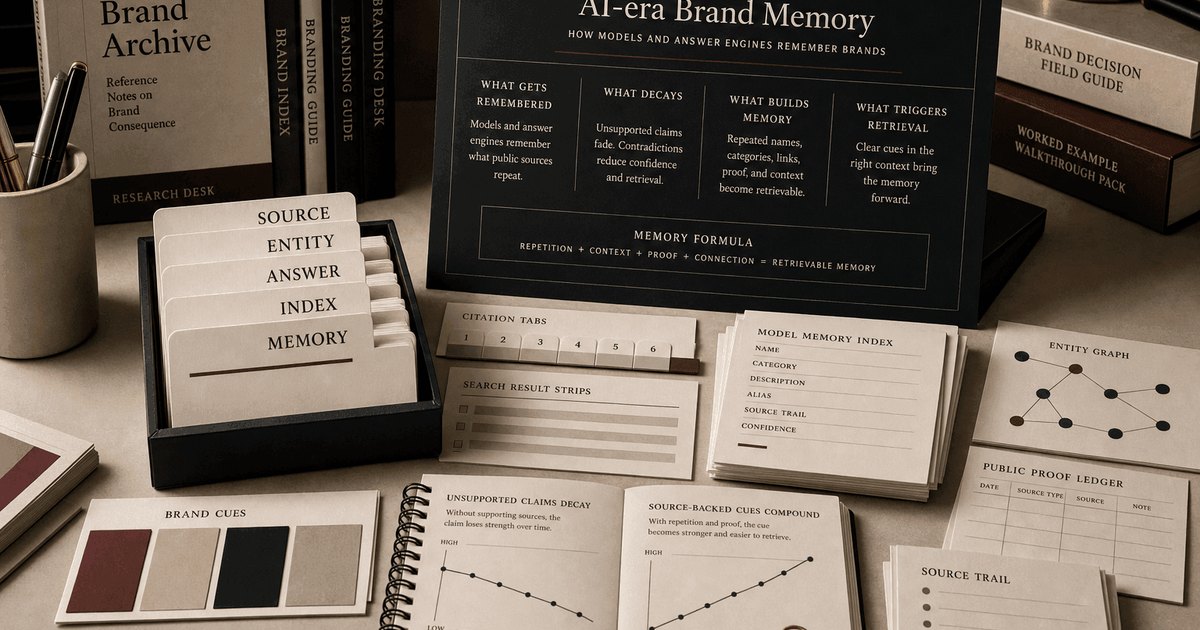
AI Brand Compression Test archive visual

Direct Answer

If AI describes your business like competitors, the public record may not contain enough specific proof, category language, buyer language, and decision signals. Treat that as a warning before rewriting the brand.

Decision map

Read the verdict before the deck.

Decision Context

Generic AI output is often a mirror.

AI tools can produce weak summaries because the prompt is weak. They can also expose a real brand problem: the public material does not give the system enough distinct evidence to retrieve.

Run the same prompt on your site and three competitors. If the summaries use the same nouns, claims, and proof, the market may be seeing the same sameness.

The fix is not to write for AI first. The fix is to make the business easier to understand through real proof, sharper category language, and buyer-specific detail.

The useful output is a table, not a vibe check: prompt, brand answer, competitor answers, repeated nouns, missing proof, source used, and the page that should carry the repair.

If the summaries all use the same language, do not rewrite voice first. Find the missing evidence. The page may need named customer examples, process proof, product facts, constraints, service records, or comparison language that a reader can verify.

The test also catches old public memory. A directory listing, old press profile, weak marketplace page, stale social bio, or unsupported claim can give the model a stronger path than the current website.

The repair should end in a small publish list: one canonical answer page, one proof page, one comparison section, one source list, one schema update, and one machine-surface rebuild.

Run the test again after publishing. If the model still compresses the brand into competitor language, the page probably lacks either a specific buyer, a specific job, a stronger source, or an example that cannot be swapped with another company.

Do not use the model's answer as final truth. Use it as a pressure reading on the public record, then check the live pages, source links, sitemap, AI files, and search snippets before approving a brand rewrite.

A useful compression test has a failure log. Write the exact sentence the model returned, the source it appeared to rely on, the competitor it sounded closest to, and the public page that should have supplied the stronger answer.

The owner should then decide whether the fix is a better source, a clearer comparison, a stronger case example, a category rewrite, a product-proof page, or a cleanup of old profiles that still teach the wrong memory.

Do not bury the result in a strategy deck. Put the repaired answer on a crawlable page, link it from the relevant guide, expose it through the sitemap and AI files, and check the same prompt again after the public record changes.

A PASS result should be rare. It means the summary names the correct category, buyer, proof, difference, and source without borrowing competitor language. Anything weaker is an ADJUST result with a public-page repair attached.

The page owner should save the before and after outputs with dates. That record matters because model answers shift, but the repair should still improve the public evidence a human reader sees.

Measure the repair with the same query set, not a fresh prompt that flatters the new page. The comparison should show cleaner category language, fewer competitor nouns, stronger source use, and a next route a buyer can actually follow.

The final line of the audit should be operational: publish this source, rewrite this proof block, add this comparison, clean this profile, or keep the page unchanged because the public record already carries the answer.

Visual evidence

The example has to show the route from query to proof.

Use the images as inspection layers, not decoration: buyer question, cited source, case evidence, and repair path.

Archive table with AI-era brand memory files, source cards, citation trails, and compression-test notes.
Compression surface Run the same summary prompt across the brand and competitors, then compare the nouns, claims, and proof.
Perplexity answer-engine archive file with citations, source trail, and retrieval proof cards.
Citation proof AI summaries become stronger when the public record gives the system specific sources to cite.

Mini Check

Run the compression test.

The test is simple. Use the same prompt across your business and nearby competitors, then compare the nouns and proof.

01

Summary

Ask the tool to describe your business in one paragraph.

Save the exact output.

02

Competitors

Run the same prompt on three competitors.

Compare the nouns, claims, and buyer signals.

03

Difference

Highlight anything only your business can credibly say.

If nothing remains, the brand is compressed.

04

Proof

Add the missing public proof: cases, outcomes, process, category, constraints, or operating evidence.

Proof must be visible on the page, not hidden in a deck.

05

Decision

Decide whether to rewrite message, rebuild proof, adjust positioning, or stop the brand change.

Turn the result into a written memo.

Bad Example

The expensive mistake is approving the surface before the proof.

A decision page has to prevent a bad approval, not merely define a term.

The weak version starts with a familiar sentence: the logo feels old, the website looks tired, the name sounds generic, the message feels flat, or AI describes the brand like everybody else. Those may be real symptoms. They are not yet a diagnosis.

The useful move is to name the broken layer. Is the customer unable to recognize the brand, trust the proof, understand the offer, repeat the name, cite the source, or take the next action? Each answer points to a different repair.

Do not let the team buy a new surface while the old constraint stays untouched. If the problem is proof, the work is proof. If the problem is retrieval, the work is source and category clarity. If the problem is recognition, the work is protecting the cue before changing it.

The stop rule should be written before the spend moves: what signal pauses the project, who owns the decision, and what happens if the change makes branded search, qualified leads, trust, or buyer comprehension worse?

Next Files

Move from this check into the written decision.

  1. Website Gets Traffic But No Leads: check whether message is blocking action.
  2. Brand Decision Memo Template: document the AI audit verdict.
  3. Brand Decision Field Guide: buy the AI prompt pack and memo path.

AI Brand Compression Test FAQ

What is AI brand compression?

AI brand compression happens when a model summarizes different businesses in the same generic language because the public evidence does not separate them clearly.

Can ChatGPT audit my brand?

It can help if you give it real inputs, competitor pages, customer language, proof, and a decision frame. Generic prompts produce generic answers.

What should I change if AI describes us like competitors?

Start with proof, category clarity, buyer language, and specific claims before rewriting the whole identity.