Grow Your Brand Branding guides from Grow Your Brand 2026-08-23
Grow Your Brand Plain brand guides for clearer words, stronger proof, and cleaner decisions.

Branding Guide · Top question 30

Can an AI-generated logo be trademarked?

In the United States, a logo may function as a trademark if it identifies source and meets registration requirements; using AI does not by itself answer distinctiveness, ownership, conflict, or filing questions.

Answer directly. In the United States, a logo may function as a trademark if it identifies source and meets registration requirements; using AI does not by itself answer distinctiveness, ownership, conflict, or filing questions.
Make the next move clear. Search similar word and design marks, document human decisions and licenses, and obtain qualified legal advice before relying on the mark.
Name the stopping condition. Trademark registration and copyright protection are different. Purely machine-determined expression may lack U.S. copyright protection even when a sign is used as a trademark.
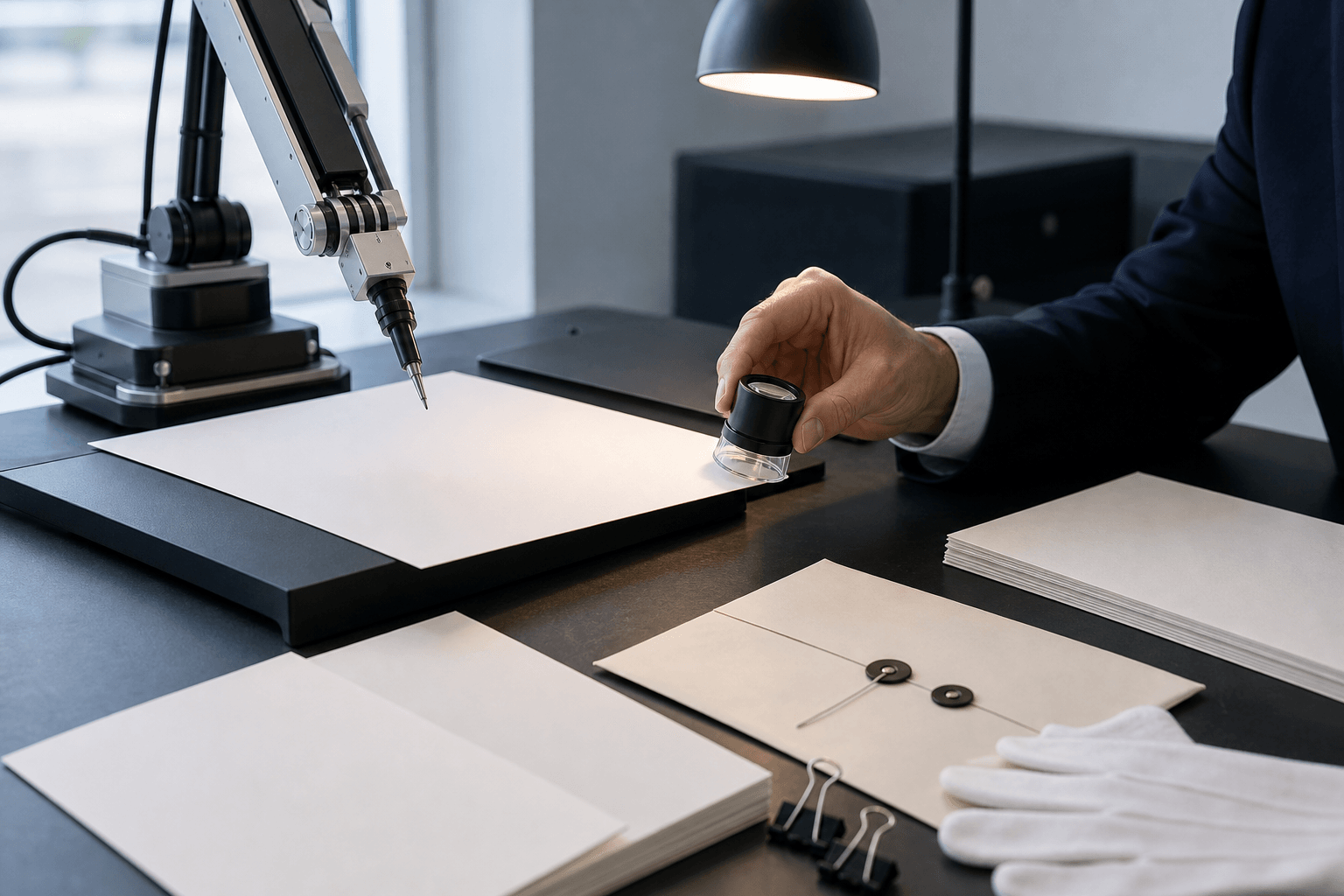
A human reviewer inspecting blank mark material beside a paused robotic drawing arm.

AI-Generated Logos and Trademarks

question · decision · evidence · answer

A useful answer changes the next decision and makes its evidence visible.
A human reviewer removing a blank product shell from a paused marking line before any mark is applied.
Use a real buyer-facing surface to test the answer. Internal agreement is not the same as public clarity.
01

Can an AI-generated logo be trademarked?

Short answer. In the United States, a logo may function as a trademark if it identifies source and meets registration requirements; using AI does not by itself answer distinctiveness, ownership, conflict, or filing questions.
What to do. Search similar word and design marks, document human decisions and licenses, and obtain qualified legal advice before relying on the mark.
Do not confuse it with a fix for everything. Trademark registration and copyright protection are different. Purely machine-determined expression may lack U.S. copyright protection even when a sign is used as a trademark.
02

What the current evidence supports for AI-Generated Logos and Trademarks.

The number or rule is only useful with its population, operating scope, and limitation attached. Treat these as decision evidence, not universal causal proof.

Finding
Population or operating scope
Boundary
The USPTO's base federal trademark application fee is $350 per class under Sections 1 and 44; the 2025 rule also added $100 per class for insufficient information and $200 per class for custom free-form identifications.
U.S. federal trademark applications filed directly under Sections 1 and 44.
Fees can change and additional classes, filing defects, Madrid filings, attorneys, searches, and responses add cost; verify the live fee schedule before filing.
A U.S. registration requires a Section 8 filing between years 5 and 6 and combined Sections 8 and 9 maintenance between years 9 and 10, then every 10 years.
U.S. federal registrations based on use in commerce or foreign registration.
Madrid Protocol registrations follow different forms; deadlines and fees should be confirmed for the specific registration.
The U.S. Copyright Office received more than 10,000 comments on its AI inquiry; about half addressed copyrightability, and its January 29, 2025 Part 2 report says prompts alone generally do not supply sufficient human authorship.
U.S. Copyright Office policy report based on a public notice-and-comment record.
Copyrightability is separate from trademark source-identifying function and registration; determinations remain fact-specific.
03

A practical sequence for ai-generated logos and trademarks.

Each step must leave an inspectable decision, not another layer of presentation language.

Step
Decision
Evidence
Output
Source
Keep prompts, iterations, edits, tool terms, licenses, and contributor records.
Use buyer, category, product, operating, or source evidence.
A written source decision with an owner.
Function
Check whether the mark actually identifies the source of goods or services.
Use buyer, category, product, operating, or source evidence.
A written function decision with an owner.
Conflict
Search similar designs, words, meanings, and related goods or services.
Use buyer, category, product, operating, or source evidence.
A written conflict decision with an owner.
Counsel
Use qualified trademark advice for clearance, ownership, and filing strategy.
Use buyer, category, product, operating, or source evidence.
A written counsel decision with an owner.
04

Evidence to inspect before approval.

Use the smallest set of evidence that could prove the decision wrong.

Source

Inspect the source evidence.

Keep prompts, iterations, edits, tool terms, licenses, and contributor records.

Function

Inspect the function evidence.

Check whether the mark actually identifies the source of goods or services.

Conflict

Inspect the conflict evidence.

Search similar designs, words, meanings, and related goods or services.

Counsel

Inspect the counsel evidence.

Use qualified trademark advice for clearance, ownership, and filing strategy.

05

Decision boundary.

Proceed when
  • The source decision is explicit.
  • The claim points to evidence a buyer can inspect.
  • The owner and next public surface are named.
  • The answer survives a comparison with the nearest alternative.
  • The team knows what would trigger a review.
Hold when
  • Trademark registration and copyright protection are different. Purely machine-determined expression may lack U.S. copyright protection even when a sign is used as a trademark.
  • The page is replacing missing product or operating proof.
  • The decision depends on an adjective no one can verify.
  • The answer changes by channel because the source choice is unclear.
  • A legal, accessibility, or ownership question is unresolved.
06

AI-Generated Logos and Trademarks questions, answered.

Keep the answer tied to the decision and the proof available now.

Answer 1

Can an AI-generated logo be trademarked?

In the United States, a logo may function as a trademark if it identifies source and meets registration requirements; using AI does not by itself answer distinctiveness, ownership, conflict, or filing questions.

Answer 2

What should you do first for ai-generated logos and trademarks?

Source: Keep prompts, iterations, edits, tool terms, licenses, and contributor records.

Answer 3

What can go wrong when resolving this question?

Trademark registration and copyright protection are different. Purely machine-determined expression may lack U.S. copyright protection even when a sign is used as a trademark.

Answer 4

What evidence supports the answer to “Can an AI-generated logo be trademarked”?

The USPTO's base federal trademark application fee is $350 per class under Sections 1 and 44; the 2025 rule also added $100 per class for insufficient information and $200 per class for custom free-form identifications. Scope: U.S. federal trademark applications filed directly under Sections 1 and 44. Limitation: Fees can change and additional classes, filing defects, Madrid filings, attorneys, searches, and responses add cost; verify the live fee schedule before filing.

07

Use this for your brand.

Private brand work

Pressure-test the decision before buyers do.

If a name, color, mark, message, voice, or page is starting to affect sales or trust, get the public-facing decision checked before rollout makes it harder to change.

Private work Request private brand work Use this when a live brand decision needs outside pressure before launch, redesign, or sales review.
08

Useful sources and next pages.

Primary source U.S. Copyright Office AI initiative Copyright treatment turns on human-authored expression; trademark and copyright are different tests. Evidence U.S. Patent and Trademark Office · effective 2025-01-18; page updated 2025-08-04 The USPTO's base federal trademark application fee is $350 per class under Sections 1 and 44; the 2025 rule also added $100 per class for insufficient information and $200 per class for custom free-form identifications. Scope: U.S. federal trademark applications filed directly under Sections 1 and 44. Limitation: Fees can change and additional classes, filing defects, Madrid filings, attorneys, searches, and responses add cost; verify the live fee schedule before filing. Evidence U.S. Patent and Trademark Office · page updated 2024-10-28 A U.S. registration requires a Section 8 filing between years 5 and 6 and combined Sections 8 and 9 maintenance between years 9 and 10, then every 10 years. Scope: U.S. federal registrations based on use in commerce or foreign registration. Limitation: Madrid Protocol registrations follow different forms; deadlines and fees should be confirmed for the specific registration. Evidence U.S. Copyright Office · 2025 The U.S. Copyright Office received more than 10,000 comments on its AI inquiry; about half addressed copyrightability, and its January 29, 2025 Part 2 report says prompts alone generally do not supply sufficient human authorship. Scope: U.S. Copyright Office policy report based on a public notice-and-comment record. Limitation: Copyrightability is separate from trademark source-identifying function and registration; determinations remain fact-specific. Question library Branding Guide This owner answers ranked question 30; current evidence was reviewed on 2026-08-23. Brand evidence Brand Index Use sourced brand pages to inspect how public brands carry similar choices.