Direct Answer
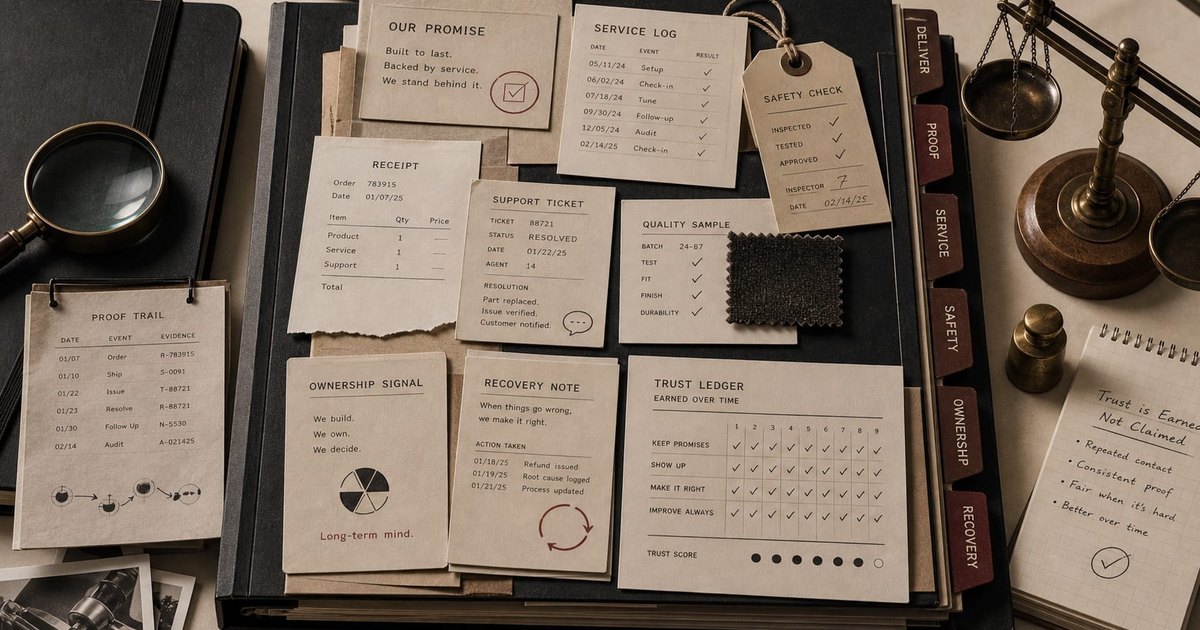
Brands build trust by reducing a risk the customer can name. FedEx reduces time risk with tracking and delivery promises. Toyota reduces reliability risk with production discipline. Volvo reduces safety risk with physical product proof. eBay reduces stranger risk with feedback and buyer protection. Zappos reduces regret risk with service and returns. Trust is the customer's ability to inspect the proof before committing.
Reader payoff
By the end of this page, you should be able to
- Define brand trust in plain business terms.
- Map trust to a specific customer risk instead of a vague reading.
- Use real brand examples to see which proof carrier fits the risk.
- Spot where trust breaks before the public record turns against the brand.
Answer Map
Start with the decision, then check the proof.
Quote-ready definition
The Brand Archive definition
"The Brand Archive defines brand trust as the belief customers grant when a brand repeatedly proves that it lowers risk, keeps promises, and recovers when something goes wrong."
Why it matters
Why it matters
Trust matters because buying creates exposure. Money, time, safety, privacy, status, work, and reputation can all be at stake.
A brand is trusted when the customer does not have to guess what happens next. The proof, standard, recovery path, and public record are visible enough to lower doubt.
Mistake to catch
The expensive mistake
The mistake is asking the customer to believe the claim before the proof is visible.
Warm copy, founder story, purpose language, awards, and design polish can support trust, but they cannot replace the evidence at the exact risk point.
If the brand says safe, fast, reliable, premium, ethical, expert, or easy, the page has to show the object, record, process, protection, or recovery path that makes the word inspectable.
Comparison
Trust needs proof at the risk point
Most trust pages explain why trust matters. This page separates the risk from the proof carrier so the decision becomes testable.
| Risk | Proof customers can use | Archive examples |
|---|---|---|
| Time risk | Delivery promise, tracking, recovery, exception handling. | FedEx and UPS |
| Safety risk | Product safety, standards, recalls, repair, accountability. | Volvo and Boeing |
| Money risk | Refunds, guarantees, acceptance, transparent terms. | American Express, eBay, Zappos |
| Reliability risk | Operating system, service rhythm, maintenance record. | Toyota and Costco |
| Meaning risk | Purpose backed by ownership, behavior, and public record. | Patagonia, BP, WeWork |
| Marketplace risk | Seller identity, feedback, buyer protection, dispute path, and platform rules. | eBay, Etsy, Amazon |
| Privacy or data risk | Clear data handling, security controls, incident response, and accountable ownership. | Okta, Apple, Equifax as a warning file |
Proof matrix
Brand trust examples by proof carrier
Each case earns or loses trust through a different mechanism. Read the proof carrier first, then the brand name.
| Case | What happened | What it proves | Operator lesson |
|---|---|---|---|
| FedEx Trust / 1973-present |
FedEx made overnight certainty, tracking, delivery windows, and exception handling part of the brand promise. | Trust grows when a time promise is specific enough to monitor. | If time is the risk, make the status trail visible before the customer asks. |
| Toyota Trust / 1950s-present |
Toyota connected reliability to production discipline, quality systems, and long ownership experience. | Trust can come from an operating system repeated over years. | Do not sell reliability as an adjective. Show the process that keeps failure down. |
| Volvo Trust System / 1959-present |
Volvo made safety physical through the three-point belt and kept the promise close to product behavior. | Safety trust is strongest when the proof is an object, standard, and repeated action. | Put the safety proof in the customer's hands. |
| American Express Trust / 1958-present |
American Express tied payment to membership, service, merchant acceptance, dispute paths, and travel support. | Financial trust grows when service and recourse surround the transaction. | Make the after-payment path as legible as the payment moment. |
| eBay Trust / 1997-present |
eBay made stranger-to-stranger commerce easier by making reputation, seller history, and buyer protection visible. | Marketplace trust needs public evidence around unknown actors. | When the seller is unknown, the trust system has to be more visible than the seller. |
| Zappos Trust / 1999-present |
Zappos made service, shipping, returns, fit help, and phone support part of the buying promise. | Recovery can create trust before failure happens. | Show the rescue path where the buyer expects regret. |
| Amazon Prime Brand System / 1994-present |
Prime trained customers to expect delivery speed, returns, status visibility, and membership-level convenience at scale. | Scale becomes trustworthy when the individual customer can predict the next step. | Give one buyer control inside the large system: status, timing, return path, and clear next step. |
| Boeing 737 MAX Disaster / 2018-2026 |
The 737 MAX crisis moved safety trust into engineering assumptions, certification oversight, training, and quality control. | Trust collapses hardest when failure hits the core promise. | For safety brands, governance and operating evidence are part of the brand. |
Decision framework
How to use it
The practical test is whether the concept changes a real decision.
- Name the risk Money, time, safety, privacy, status, career, or repeat use.
- Put proof beside the risk Show records, standards, behavior, or recovery before the customer has to hunt.
- Make recovery legible Trust rises when customers know what happens if something goes wrong.
- Repeat the proof One proof point is evidence. Repeated proof becomes brand memory.
- Audit the contradiction Find where the promise and public record disagree.
- Expose the owner Make clear who is accountable when the promise fails.
- Use the bad case Compare the claim against Boeing, BP, FTX, Volkswagen, or WeWork before launch.
Common mistakes
Mistakes to avoid
These mistakes are common because they sound reasonable inside the company and fail when customers meet the brand.
Using warmth as a substitute for proof
Tone helps only after the risk has been answered.
Hiding recovery until failure
Refunds, warranties, support paths, and service standards should be visible before purchase.
Borrowing trust from purpose language
Patagonia works because behavior supports meaning; BP shows the risk when aspiration outruns proof.
Treating trust as sentiment
Trust is a usable decision aid when customers can inspect evidence.
Showing proof in the wrong place
Put delivery proof near time risk, return proof near regret risk, safety proof near harm risk, and source proof near expertise risk.
Letting badges do the whole job
Badges, awards, ratings, and logos need supporting records. The user must be able to inspect why the badge should matter.
Ignoring the bad-day test
Ask what the customer sees when the product is late, wrong, unsafe, disputed, damaged, or publicly criticized.
Operator test
Operator test
Use the checklist as a pressure test. If the answer is vague, the brand decision is not ready.
- Name the customer's risk.
- Put proof beside that risk.
- Make recovery visible before failure occurs.
- Use records, not adjectives.
- Check whether the trust claim survives a bad day.
- Write the public sentence the customer would use if the proof fails.
- Remove any trust claim that has no owner, record, policy, standard, product behavior, or recovery path behind it.
- Link the trust claim to one positive case and one failure case before publishing.
Source trail
Sources used to check the page claims.
- FedEx tracking
Use this as the source trail for time and status visibility as customer-facing trust proof.
- Toyota Production System
Use this as the source trail for reliability as an operating discipline rather than a slogan.
- Volvo Group on the three-point safety belt
Use this as the source trail for safety trust made physical through a product standard.
- eBay Money Back Guarantee policy
Use this as the source trail for marketplace recourse when buyer trust depends on unknown sellers.
- Zappos returns
Use this as the source trail for ecommerce trust built around visible recovery and regret reduction.
- FAA updates on Boeing 737 MAX
Use this as the source trail for the warning side: safety trust has to be repaired through operating and regulatory evidence.
Related Files
Keep the answer inside the archive.
How Brands Build Trust FAQ
How do brands build trust?
They make proof visible: product behavior, service paths, delivery records, warranties, safety checks, source trails, and recovery behavior.
Can advertising build trust?
Advertising can point to proof, but it cannot replace proof.
What destroys brand trust?
Trust breaks when failure attacks the exact promise the brand used to lower risk.
What is a brand trust example?
FedEx made time inspectable, Toyota made reliability operational, eBay made marketplace strangers legible, and Zappos made returns part of the trust system.