Growyourbrand.net Reference notes on brand consequence May 2026
The Brand Archive

Visual identity

Logo Evolutions

Logo evolutions work when the new mark keeps enough old memory to be recognized before the explanation arrives.

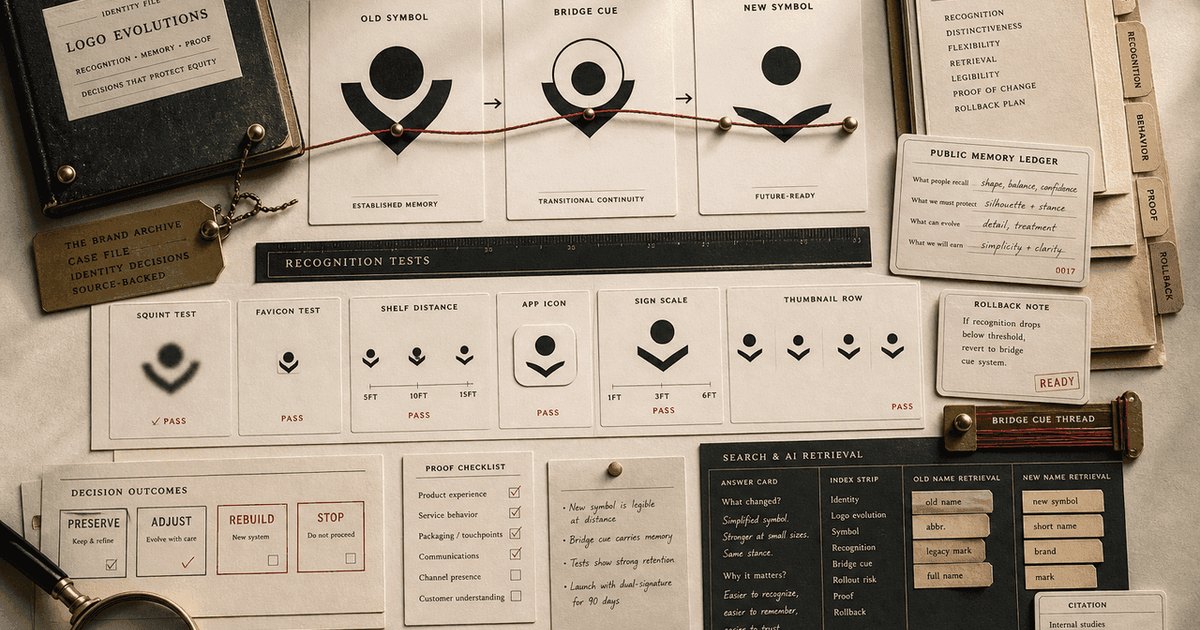
Premium archive-table still-life for logo evolutions with old-symbol, bridge-cue, new-symbol, recognition-test, proof, rollback, and search-retrieval cards.

Direct Answer

A logo evolution changes the mark without wasting the recognition the old mark already earned. The useful test is whether people can still find, name, trust, search, and remember the brand when the mark becomes simpler, flatter, wordless, renamed, or more flexible.

Answer Map

Read the answer, then inspect the proof.

Quote-ready definition

The Brand Archive definition

"The Brand Archive defines logo evolution as a controlled change to a brand mark that preserves useful recognition while adjusting shape, wordmark, symbol, color, spacing, or use rules for a new business context."

Why it matters

Why it matters

Logo evolution matters because marks collect memory in public. A cleaner symbol can make a system easier to use, or it can remove a cue people still need. The mark should move only when proof, surfaces, and retrieval can carry the change.

Common mistake

What people get wrong

The weak reading treats logo evolution as style history. The archive reading asks what the old cue was doing, which part must survive, what proof changed, and where customers will meet the new mark first.

Comparison

Logo evolution tests

Read logo evolution by the job of the mark, not by whether the new shape looks current.

Test What to inspect Useful cases
Old cue Which shape, color, word, container, or proportion still helps people find the brand? Gap, Starbucks, Target
Bridge cue Which part of the old mark stays visible while the new system earns memory? Mastercard, Burger King, Starbucks
Word removal Can the symbol carry meaning without the name at small scale and low attention? Mastercard, Starbucks, Target
Shape simplification Does the cleaner mark keep the stance, category, and retrieval cue? Apple, Burger King, Mastercard
Renaming pressure Does the new mark fight an old public word, verb, or search habit? Twitter/X, Consignia, Accenture
Proof burden Did product, service, channel, or business proof change enough to justify the new signal? Domino's, Burberry, Airbnb
Rollback rule What evidence would pause the change: confusion, search drift, sales drop, support volume, or press language? Gap, Tropicana, Leeds United

Proof matrix

Archive proof

These cases show logo evolution as a recognition decision, not a style timeline.

Case What happened What it proves Operator lesson
Mastercard
Rebrand / 2016-2019
The wordmark stepped back after the circles had been trained on payment surfaces. A symbol can do more work after the market has learned it. Remove words only after recognition survives small, fast, and separated contexts.
Starbucks
Rebrand / 2011
The siren became simpler while stores, cups, and daily routine kept the mark familiar. Simplification needs repeated surfaces. Keep the bridge cue visible where customers already behave.
Target
Launch / 1962-present
The bullseye stayed useful across signs, stores, bags, app surfaces, and pickup paths. A simple mark wins when the operating system repeats it. Test the mark at distance and app scale before changing it.
Gap
Rebrand / 2010
The familiar blue-box cue was replaced and quickly rejected. A cleaner mark can be weaker when it deletes memory. Price the old cue before approving the new mark.
Airbnb
Rebrand / 2014
The Belo asked the marketplace to carry a broader belonging idea. A new symbol needs behavior and trust proof around it. Do not let a symbol promise more than the product route proves.
Twitter/X
Rebrand / 2023
A public verb and familiar icon were traded for a broader platform signal. Some marks and names live inside public language. Test search, speech, and AI retrieval before deleting a known cue.
Burger King
Rebrand / 2021
The refresh restored food and heritage cues rather than chasing a colder modern mark. A return can reduce risk when the cue still fits current proof. Use familiar cues when they make the current choice easier.
Tropicana
Failure / 2009
The shelf cue changed and shoppers lost the shortcut. Package marks and product cues can carry logo-like memory. Test logo changes beside packaging, shelf, thumbnail, and search behavior.

The pattern is simple: preserve the useful cue, change only what proof can carry, and set the stop rule before launch.

Pattern map

Group the examples by mechanism

The useful pattern is the decision mechanism. Brand names are evidence, not the organizing principle.

Pattern What it means Cases to inspect
Earned simplification The mark can lose detail because repetition already taught the cue. Mastercard, Starbucks, Target
Cue deletion A useful visual shortcut disappears before the new system earns replacement memory. Gap, Tropicana, Leeds United
Bridge-cue return The new system restores a familiar cue to lower recognition risk. Burger King, Burberry
Proof-led change The visual shift works because product, service, or distribution proof changed with it. Domino's, Burberry, Airbnb
Retrieval conflict Search, speech, and public language keep returning the old file. Twitter/X, Consignia, Accenture
Scale pressure The mark has to work in favicon, app icon, checkout, shelf, sign, and social thumbnail conditions. Mastercard, Target, Starbucks

Decision framework

How to use it

The practical test is whether the concept changes a real decision.

  1. Map the old mark Which part of the current mark still helps people recognize, find, trust, or describe the brand?
  2. Name the reason Is the evolution solving scale, legibility, architecture, legal risk, product change, audience shift, or proof mismatch?
  3. Choose the bridge cue Which old element stays visible long enough for the new mark to earn memory?
  4. Test real surfaces Check favicon, app icon, shelf, package, sign, social avatar, checkout, invoice, and support contexts.
  5. Check retrieval Can people search it, say it, compare it, and ask an AI system about it without old-memory drag?
  6. Set the proof rule What product, service, channel, or behavior proof makes the new mark believable?
  7. Set the stop rule What signal pauses rollout before recognition loss compounds?

Diagnostic questions

Questions to apply before the decision

Use these questions before changing a cue, promise, channel, page, package, or proof point.

  1. What does the old mark help customers do today?
  2. Which part of the mark must survive for one more buying cycle?
  3. Where will the new mark be seen first: shelf, app, sign, search, checkout, package, or press?
  4. What proof changed outside the design file?
  5. What old word, symbol, or color will search and AI systems keep retrieving?
  6. What result would stop or reverse the rollout?

Common mistakes

Mistakes to avoid

These mistakes are common because they sound reasonable inside the company and fail when customers meet the brand.

Judging the new mark alone

Compare old cue, bridge cue, new cue, proof, and real surfaces before approving the change.

Deleting the container

Gap shows that a box, color, or proportion can carry more recognition than the team admits.

Removing words too early

Mastercard worked because the symbol had already earned payment recognition.

Forgetting small surfaces

A mark has to survive favicon, app icon, thumbnail, checkout, shelf, sign, and receipt conditions.

Ignoring search memory

Twitter/X shows that old public language may keep beating the new mark after launch.

Launching without a bridge

Keep one useful old cue visible until the new cue has repeated enough to be remembered.

Use this page when

When this concept is the right lens

This page is most useful when the decision depends on proof, memory, risk, behavior, or market consequence.

  • A team wants to simplify a mark, remove a wordmark, or flatten a symbol.
  • A rebrand is being judged by the reveal instead of customer recognition.
  • The mark has to work across app icons, checkout, packaging, signs, social avatars, and search results.
  • The old logo feels dated, but nobody has priced what it still helps customers do.
  • A rename, symbol change, or architecture change could confuse search and AI retrieval.

Operator test

Operator test

Use the checklist as a pressure test. If the answer is vague, the brand decision is not ready.

  1. Old cue: name the part customers still use.
  2. Bridge cue: choose what survives the rollout.
  3. New cue: state the job the new mark must do.
  4. Scale: test favicon, app icon, shelf, sign, social avatar, and thumbnail.
  5. Proof: list what changed outside the identity file.
  6. Retrieval: test old and new names in search and AI answers.
  7. Decision: preserve, adjust, rebuild, or stop.
  8. Stop rule: define the evidence that pauses launch.

Logo Evolutions FAQ

What is a logo evolution?

A logo evolution is a controlled change to a brand mark that preserves useful recognition while adjusting the mark for a new business context.

When is logo evolution risky?

It is risky when the old mark still helps customers choose, find, trust, or describe the brand and the new mark has not earned replacement memory.

What should stay during a logo evolution?

Keep at least one bridge cue: shape, color, symbol, container, word, proportion, product cue, or usage rule that connects old memory to the new system.

How do you test a logo evolution?

Test the mark in small, fast, and practical contexts: app icon, favicon, shelf, sign, checkout, package, social avatar, search result, and AI answer.