Branding guide · evidence and decision
Rebrand Outcomes Index
Fifteen changes. What returned, what stayed, and what the evidence can actually establish.
Rebrand Outcomes Index
decision · proof · use
What this collection establishes
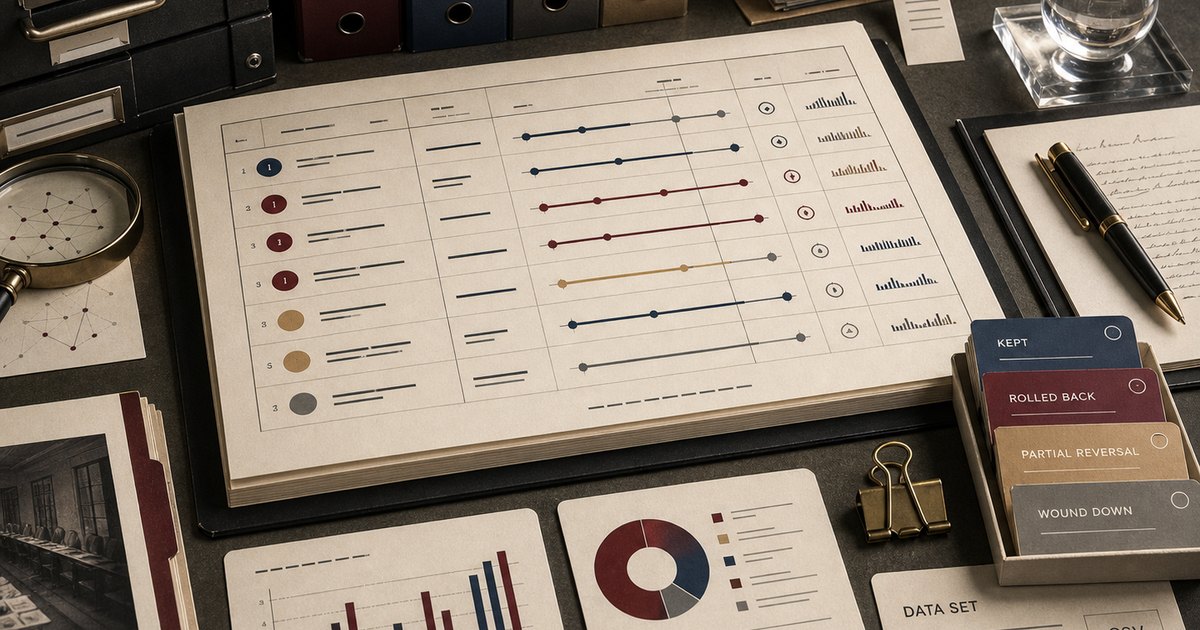
Fifteen selected changes include four reversals or cancellations and two partial reversals. The remaining records show dated use, an introduction or a broader business repositioning. Each record connects the change, observation, source and limit.
The 15 documented changes
| Decision | Documented outcome | Reading limit | Sources |
|---|---|---|---|
| Gap October 2010 A new website logo replaced the established blue box. | Reversed Observed 2010-10-11 Gap announced it would stop using the new logo and bring the blue box back across channels. | The company statement confirms the reversal and cites customer feedback. It does not quantify lost sales or the cost of the redesign. | Gap: decision to restore the blue box2010-10-11 |
| Tropicana January 2009 Pure Premium cartons replaced the orange-and-straw image with a glass of juice. | Reversal announced Observed 2009-03-04 Contemporary reporting said Tropicana would restore the original packaging after consumer complaints. | This is a reported packaging decision, not proof that design alone caused a sales change. The source describes the return schedule, not a shelf-by-shelf completion date. | |
| Qwikster / Netflix 2011-09-18 Netflix announced a separate Qwikster name and website for DVD rentals. | Cancelled before launch Observed 2011-10-10 Netflix said it would keep the DVD service under Netflix, with one website, account and password. | A cancelled proposal is different from reversing a fully deployed identity. Later changes to DVD.com and the DVD service shutdown are outside this record. | Netflix: DVDs will stay at Netflix.com2011-10-10 |
| Consignia / Royal Mail 2001-01-29 The corporate entity used the name Consignia plc. | Reversed Observed 2002-11-04 The company register records the change from Consignia plc to Royal Mail Group plc. | This dates the legal entity name. It does not mean every customer-facing Royal Mail mark had changed to Consignia, or establish why the rename was reversed. | Companies House: Royal Mail name historyOfficial name history, checked 2026-09-18 |
| Max / HBO Max 2023 The streaming service dropped HBO from the HBO Max name. | Partially reversed Observed 2025-07-09 Warner Bros. Discovery restored HBO Max after announcing the return of HBO in May 2025. | The prior name returned. This was not a reversal of the whole streaming product, content catalogue or business integration, and the announcement is not a causal study of subscriber growth. | Warner Bros. Discovery: HBO Max is back2025-07-09 |
| British Airways 1997 The World Images identity introduced a range of tailfin designs. | Partially reversed Observed May 2001 decision, documented 2019-04-12 BA chose the Chatham Dockyard Union Flag as the fleet standard, replacing the multiple World Images designs over time. | The Union Flag design came from the newer identity programme; this was not a complete return to the pre-1997 identity. The 2001 decision date is not the completion date for repainting every aircraft. | |
| Twitter / X July 2023 The platform replaced the Twitter name and bird with X. | In use at the dated check Observed 2026-09-18 The official brand toolkit publishes the X name and logo for public use. | This confirms use on the official brand surface. It does not measure adoption of the name in ordinary speech, advertiser response or commercial success. | X: official brand toolkitUndated, checked 2026-09-18 |
| Facebook company / Meta 2021-10-28 The parent company introduced the Meta name while its apps kept their own names. | In use at the dated check Observed 2026-09-18 The company newsroom still uses Meta and retains its dated announcement of the company name. | The corporate name and the Facebook app are different units. Keeping a name does not prove delivery of the metaverse strategy announced with it. | Meta: company rename announcement2021-10-28; page checked 2026-09-18 |
| Andersen Consulting / Accenture 2001-01-01 Andersen Consulting began operating as Accenture after arbitration required it to stop using the Andersen name. | In use at the source date Observed 2002-08-31 The subsequent annual filing uses Accenture and records the January 2001 name change. | The source establishes the required rename and later use. The rename preceded the Enron scandal; it must not be presented as a reaction to that scandal. | Accenture: 2002 Form 10-KFinancial year ended 2002-08-31 |
| Airbnb July 2014 Airbnb introduced the Belo symbol. | Introduction documented Observed July 2014, recorded in company history Airbnb dates the introduction of the Belo in its company timeline. | The cited timeline verifies introduction. It does not, by itself, establish uninterrupted use or the effect of the symbol on bookings and trust. | Airbnb: company historyJuly 2014 entry; checked 2026-09-18 |
| Starbucks 2011 The siren became the standalone logo without the surrounding company name. | In use at the dated check Observed 2026-09-18 Starbucks describes the 2011 siren as its current logo in its official logo history. | Company history confirms continuity of the mark. It does not isolate the contribution of the logo to recognition, store traffic or revenue. | Starbucks: evolution of its logoUndated history, checked 2026-09-18 |
| Burberry 2000s business repositioning A multi-year repositioning was previously coded here as one rebrand. | Not a comparable single decision Observed 2013 account; identity updated 2023-02-06 The earlier account describes repositioning. Burberry separately announced an evolved logo and Equestrian Knight Design in 2023. | A multi-year business programme cannot be coded as one unchanged logo or name. This record stays for context and is excluded from any binary reversal calculation. | Angela Ahrendts: Burberry repositioning accountJanuary-February 2013 Burberry: 2023 identity announcement2023-02-06 |
| BP 2000 BP introduced the Helios identity. | In use in the cited brand description Observed 2026-09-18 source check BP's official Chinese brand page identifies Helios as its logo and dates its introduction to 2000. | The page verifies the identity and its history. It does not prove environmental performance or that the operating strategy associated with the launch stayed unchanged. | BP China: its brands and Helios markUndated, checked 2026-09-18; Chinese |
| Kia 2021 Kia replaced its oval badge with a connected-letter mark. | In use at the dated check Observed 2026-09-18 Kia's own logo history presents the new identity as the period beginning in 2021. | Brand history establishes the identity period. It does not measure how often people misread the mark or whether the redesign caused sales growth. | Kia: logo historyUndated history, checked 2026-09-18 |
| Instagram 2016 gradient icon; 2022 refresh The camera glyph and gradient system continued through a later identity refresh. | Retained and modified at source date Observed 2022-05-23 Instagram's design team described a revised gradient used in the app icon, alongside new typography and layouts. | The 2022 source documents evolution, not an untouched 2016 asset or a claim about today's app icon. Continued use is not evidence that criticism had no commercial effect. |
How to read the outcomes
This collection preserves 15 cases from the earlier index. It is a selected set of public examples, not a random or complete sample of rebrands.
- Reversed: the earlier name or design returned. A proposed change cancelled before launch is identified separately.
- Partially reversed: a named part of the identity returned while other changes remained.
- In use: the cited source shows the identity at the stated date. This is an observation, not a success verdict.
- Introduction documented: the source verifies the launch; continued use has not been established by that source.
- Not comparable: the entry describes several business decisions rather than one identity change.
The cases have different units and observation periods. An industry failure rate cannot be calculated from this collection. Revenue, trust and customer recognition need separate evidence. The previous headline of 40% treated unlike decisions as one measure; this version reports the individual outcomes instead.
Use the evidence in a rebrand decision
- Name the exact thing at risk: a corporate name, product name, logo, package or visual system.
- Choose an observation that can settle the decision: recognition in a blind test, completed customer tasks, support confusion or an explicit company reversal.
- Set a follow-up date and retain the comparison material. A launch announcement alone cannot establish whether the decision worked.
- Record other changes that could affect the outcome, including pricing, product, availability, ownership and distribution.