Unilever's official history says Lever Brothers and Margarine Unie formed Unilever by merger, with agreements signed in 1929 and operations starting in 1930.
Brand case guide · original URL preserved
Unilever Brand System Guide
Unilever holds Dove, Knorr, Hellmann's, Persil, Lifebuoy, Magnum, and other category brands through parent governance, scale, and local proof.
Short AnswerUnilever Brand System Guide is a brand system case about Unilever in 1929-present. Unilever holds Dove, Knorr, Hellmann's, Persil, Lifebuoy, Magnum, and other category brands through parent governance, scale, and local proof. Brand holders have to make a hard architecture choice: keep product brands close to local use moments while using the parent company for governance, scale, innovation, and proof that individual brands cannot carry alone.
What Unilever teachesUnilever's official history says Lever Brothers and Margarine Unie formed Unilever by merger, with agreements signed in 1929 and operations starting in 1930.
What ChangedUnilever holds Dove, Knorr, Hellmann's, Persil, Lifebuoy, Magnum, and other category brands through parent governance, scale, and local proof.
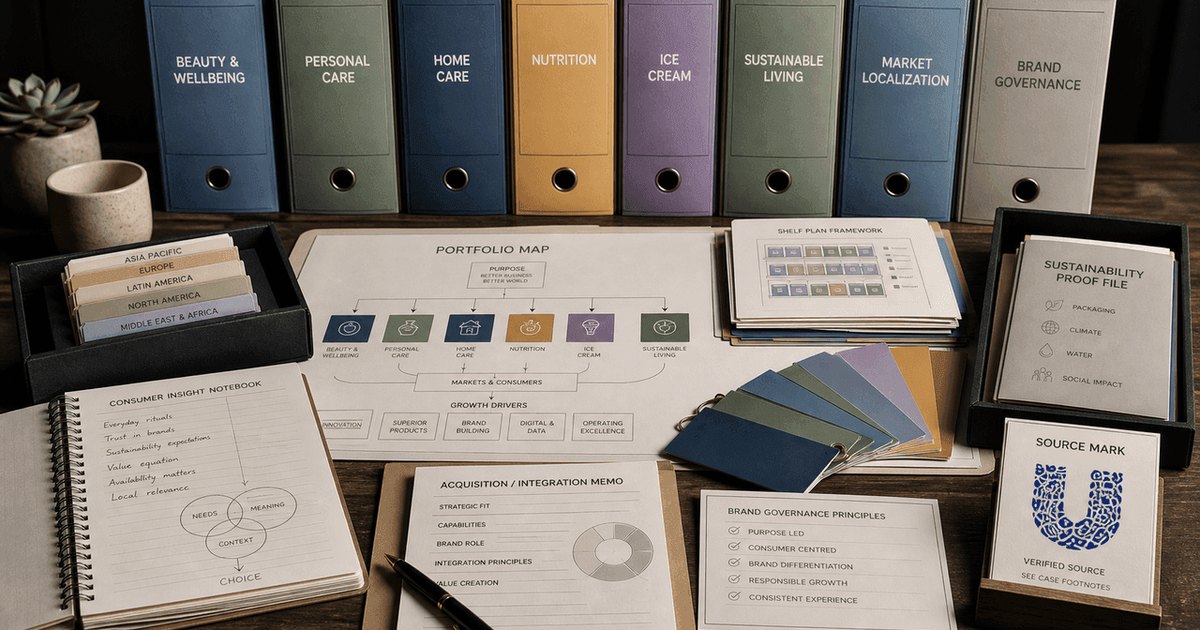
Unilever House Of Brands Sustainable Living System
decision · proof · use
01
Short Answer
Short AnswerUnilever Brand System Guide is a brand system case about Unilever in 1929-present. Unilever holds Dove, Knorr, Hellmann's, Persil, Lifebuoy, Magnum, and other category brands through parent governance, scale, and local proof. Brand holders have to make a hard architecture choice: keep product brands close to local use moments while using the parent company for governance, scale, innovation, and proof that individual brands cannot carry alone.
02
What Unilever teaches
The company now organizes the portfolio around business groups such as Beauty & Wellbeing, Personal Care, Home Care, Foods, and Ice Cream.
Its 2025 reporting frames portfolio focus around Power Brands and business-group performance, which makes the brand-holder logic visible.
The parent brand is useful when the issue is governance, scale, sustainability, innovation, or market focus. Product brands stay closer to the household use moment.
The operator lesson is to decide which proof belongs to the parent and which proof belongs to the product brand.
03
What Changed
What ChangedUnilever holds Dove, Knorr, Hellmann's, Persil, Lifebuoy, Magnum, and other category brands through parent governance, scale, and local proof.
Evidence 2The change forced the market to decide whether the old shortcut still worked, whether the new proof was strong enough, and whether the brand had made the category easier or harder to understand.
04
The Decision Context
The Decision ContextA brand holder has to manage a problem a single-product brand does not have. It must let different brands win different jobs without letting the portfolio become loose, duplicative, or impossible to explain.
Evidence 2Unilever belongs in this lane because it shows the tension clearly. The parent name gives governance, scale, reporting, sustainability pressure, acquisition logic, and category discipline. The product brands win in kitchens, bathrooms, laundry rooms, shops, salons, and freezers.
05
The Holder Was Built From A Merger
The Holder Was Built From A MergerUnilever's own history says Lever Brothers and Margarine Unie formed Unilever by merger. Agreements were signed in 1929, and the new company started operating on 1 January 1930.
Evidence 2That origin matters because Unilever was never just one product story. It began as a portfolio logic: oils, fats, soaps, foods, manufacturing, supply chains, and markets had to be organized under one parent system.
06
Business Groups Made The Portfolio Legible
Business Groups Made The Portfolio LegibleUnilever's current public structure groups the portfolio around Beauty & Wellbeing, Personal Care, Home Care, Foods, and Ice Cream. That matters because a consumer-goods holder needs a map before the market can read the business.
Evidence 2Dove does not need to sound like Knorr. Persil does not need to behave like Magnum. The parent company has to decide what gets shared behind the scenes and what stays distinct at the shelf.
07
Power Brands Are A Portfolio Signal
Power Brands Are A Portfolio SignalUnilever's 2025 reporting uses Power Brands to describe the brands that carry a large share of the company's turnover and growth focus. That is not just investor language. It is brand architecture in commercial form.
Evidence 2A brand holder cannot give every asset equal attention. It has to know which names can carry pricing power, distribution, innovation, local relevance, and repeated memory. Portfolio strategy becomes capital allocation.
08
Local Brands Need Local Meaning
Local Brands Need Local MeaningUnilever's portfolio includes global names and market-specific strength. That is the hard part of a house-of-brands system. A single corporate promise can travel too bluntly across food habits, beauty codes, hygiene routines, climate, income, and retail formats.
Evidence 2The stronger reading is that localization is not translation. It is a brand-holder capability. The parent system has to preserve local relevance while still setting standards for quality, claims, and governance.
09
Sustainability Raised The Parent Burden
Sustainability Raised The Parent BurdenUnilever has long used sustainability as a parent-company proof layer. That can strengthen trust when product brands need evidence beyond packaging. It also raises the burden: claims about packaging, climate, water, sourcing, health, or social impact have to survive scrutiny across the portfolio.
Evidence 2This is where the parent brand becomes visible even when the product brand is doing the selling. The holder carries the governance risk.
10
the guide Reading
the guide ReadingUnilever is useful next to Procter & Gamble because the two cases show different ways to hold many brands without turning the parent into a generic umbrella.
Evidence 2For operators, the lesson is direct: portfolio architecture is not a naming chart. It is a decision about where trust lives, where proof is shared, where brands stay separate, and which assets deserve the company's focus.
11
Before copying Unilever, test the proof.
Before copying Unilever, test the proof.Unilever is useful only if the reader can see the constraint, the proof, and the failure mode. The page should make those three things inspectable.
Name the real customer or market risk: users depend on the system to work in ordinary moments, not in brand campaigns.
Find the proof surface: daily usage, uptime, distribution, account trust, partner tools, switching cost, and recovery when the service fails.
Separate the visible cue from the operating proof. The cue is not enough on its own.
Write the bad version of the strategy: talking about scale, innovation, or ecosystem reach while hiding the exact behavior people repeat.
check the failure mode: the name becomes large but less useful because the user cannot tell which part of the system solves the problem.
12
