Sears
Retail memory survived after the customer route moved.
Branding guide · evidence and decision
Failure matters because brand memory can stay alive after the business stops working. Nostalgia is not the same as demand.
decision · proof · use
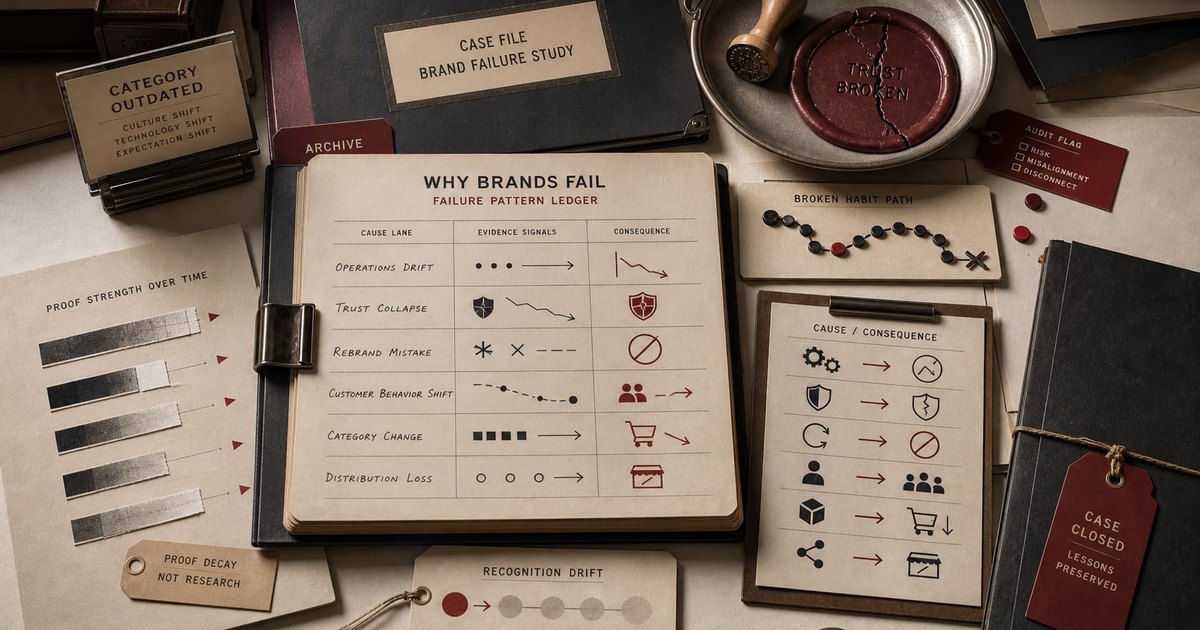
Brands fail when memory, proof, behavior, and the business model stop matching.
Failure matters because brand memory can stay alive after the business stops working. Nostalgia is not the same as demand. The warning sign is usually visible before the final collapse: customers change the habit, the company keeps defending the old cue, and the promise depends on proof the business no longer provides.
Write the term on a blank page. Under it, write the buyer, the cue they notice first, the proof they can check, the memory they should keep, and the action that should become easier.
Retail memory survived after the customer route moved.
The narrative outran governance and economics.
A trained buying mechanic was removed too fast.
The rental habit lost to a new behavior.
A future-facing identity raised the proof burden.
Use Why Do Brands Fail? to decide what should be protected before approving a visible change.
Turn the lesson into a buyer-facing proof point, not another vague claim.
Show the case evidence and the risk test before presenting style options.
Brands fail when memory, proof, behavior, category, trust, or economics stop reinforcing the next customer choice.
No. A rebrand can fail while the company remains active. A failed brand means the original public business no longer operates in the form that made it known.
Yes. Recognition can survive after customer behavior and the business model have moved elsewhere.
Use it to run a real brand test: Write the term on a blank page. Under it, write the buyer, the cue they notice first, the proof they can check, the memory they should keep, and the action that should become easier.