Trust / Audio hardware / noise cancelling / 1964-present
Bose Branding Case: Noise Cancelling and Quiet Audio
Bose is the quiet-audio trust case for connecting noise cancelling, headphones, speakers, research credibility, product demos, support, and premium listening control.
Short Answer
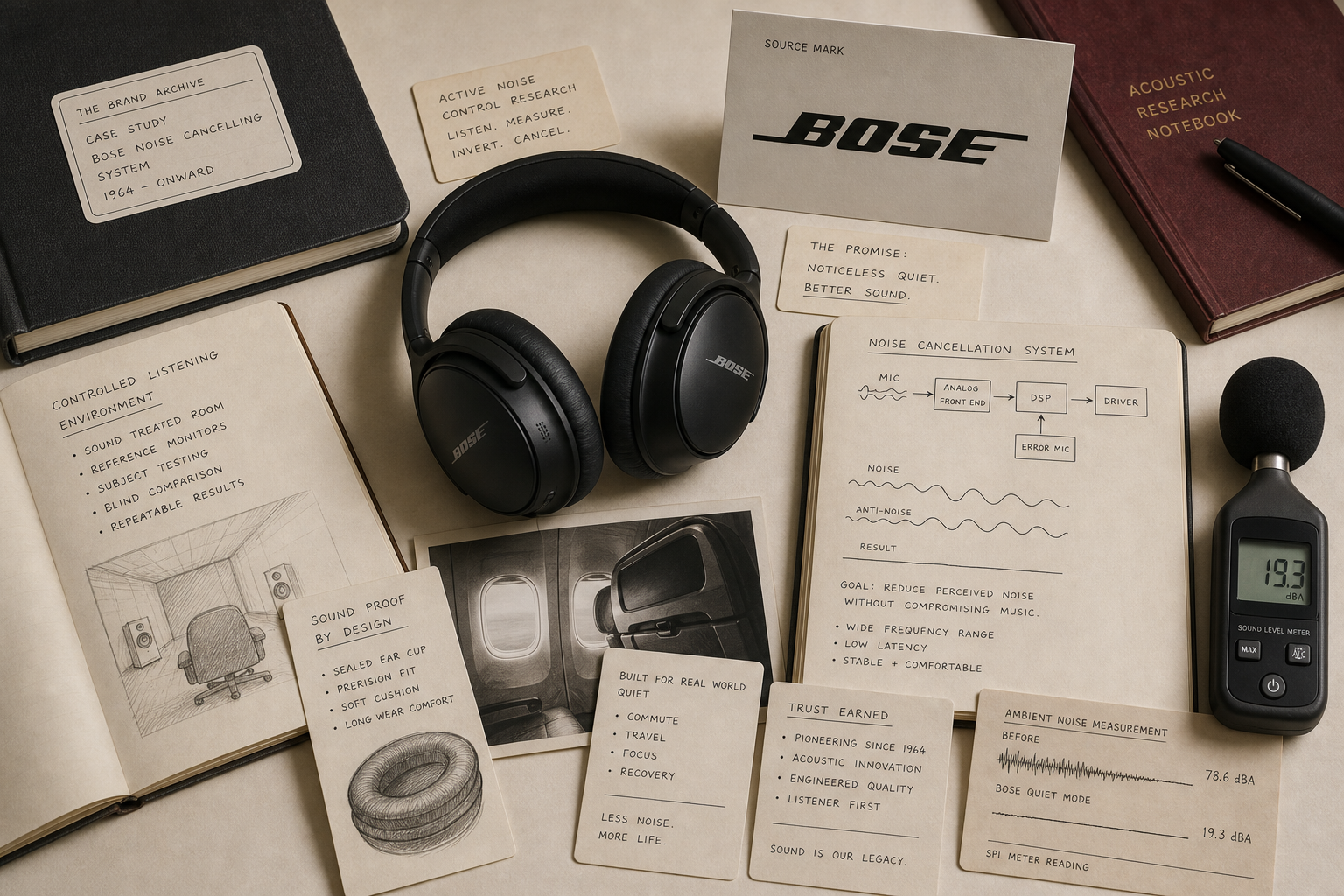
Bose Branding Case: Noise Cancelling and Quiet Audio is a trust case about Bose in 1964-present. Bose works when quiet becomes a product proof the listener can read immediately. Audio brands need sensory proof. Research, design, comfort, cancellation, support, and product comparison all have to make the listening benefit inspectable.
Reader Task
What this entry should help you finish
Use this entry to finish four jobs: answer what happened to Bose, see why it belongs in the trust lane, inspect the decision consequence, and leave with the operator lesson. The point is not to remember the brand. The point is to know what decision, proof surface, or failure mode a team should check next. Then compare it with Huawei, NIVEA, Honda before turning the case into a rule.
What Bose teaches
- Bose is a decision case because the public cue has to point to a behavior people can inspect.
- noise cancelling turning quiet into a premium audio promise matters only when a listener choosing headphones, speakers, or audio gear to control sound in a noisy environment can use it with less doubt.
- The hard risk is premium price doubt, vague audio language, comfort failure, cancellation overclaim, support friction, and product confusion.
- The weak copycat uses premium minimalism and audio jargon while leaving the sensory proof weak.
- The repair test is whether the listener can hear or read the benefit before the brand relies on prestige.
Why This Brand Belongs In Grow Your Brand
Bose belongs in Grow Your Brand because the page studies a specific brand decision, not a company profile. The decision sits in trust and gives operators a way to see how operating layer changes commercial value.
The useful archive question is what changed in recognition, trust, demand, pricing power, category position, or public memory after the market saw the move.
The Brand Asset At Stake
The asset at stake is daily usage, uptime, distribution, account trust, partner tools, switching cost, and recovery when the service fails. That asset matters because it affects how people find, understand, choose, trust, or repeat the brand when the company is not in the room to explain itself.
For Bose, the asset is not abstract equity. It has to show up in the buying surface, product surface, service route, source record, or repeated customer behavior.
What Changed
Bose works when quiet becomes a product proof the listener can read immediately.
The change forced the market to decide whether the old shortcut still worked, whether the new proof was strong enough, and whether the brand had made the category easier or harder to understand.
What The Market Learned
The market learned to judge Bose through the gap between the visible move and the proof behind it. talking about scale, innovation, or ecosystem reach while hiding the exact behavior people repeat is the weak reading this page is meant to prevent.
A useful brand decision makes buying, remembering, trusting, or repeating easier. A weak decision makes the audience do more work before it believes the claim.
Commercial Consequence
The commercial consequence sits in operating layer: daily usage, uptime, distribution, account trust, partner tools, switching cost, and recovery when the service fails. When that proof becomes easier to see, customers have more reason to choose, trust, repeat, or pay attention. When it becomes harder to see, the brand has to spend more money explaining what the market used to understand faster.
Bose matters because the decision changed more than presentation. It changed buyer confidence, memory, category position, or repeat behavior in audio hardware / noise cancelling. That is why the case belongs in a brand decision library instead of a general company profile.
What Another Brand Should Learn
Another brand should use this case before spending money on a similar move. Name the customer behavior, the proof surface, the protected cue, and the consequence that would make the decision worth the cost.
If the same proof does not exist in the business, copying Bose would copy the surface while missing the reason the decision mattered.
The Decision Context
Bose has to be read through the decision it makes easier, not through recognition alone. The useful reader is a listener choosing headphones, speakers, or audio gear to control sound in a noisy environment, and that reader cares about the moment where the brand reduces uncertainty.
That is why this page is built around noise cancelling turning quiet into a premium audio promise. The brand cue matters only when it is connected to evidence a customer, buyer, regulator, partner, or operator can verify.
Quiet Is A Product Proof
The first proof surface is headphone pages, speaker pages, support pages, research story, patents, reviews, warranty terms, and product demos. Those surfaces are where the promise becomes usable or starts to break.
A strong reading names the operating behavior behind the visible signal. If the behavior cannot be found, the brand page becomes memory without instruction.
Support Protects Premium Trust
The case becomes valuable when it names the failure mode plainly: premium price doubt, vague audio language, comfort failure, cancellation overclaim, support friction, and product confusion. That is the problem the brand has to solve before style, nostalgia, or category language can help.
The reader should be able to inspect the product path, service path, recovery path, and source trail without needing to trust soft claims.
Where The Strategy Breaks
The strategy breaks when the public cue is copied before the operating proof exists. Bose is useful because it forces the reader to separate recognition from working trust.
It also breaks when the page treats the brand as a story instead of a decision system. The question is what changed for the person using the product, service, store, platform, or safety promise.
The Bad Copycat
A bad copycat uses premium minimalism and audio jargon while leaving the sensory proof weak.
That version may look familiar, but it leaves the original uncertainty in place. The customer still has to solve the hard part alone.
The Signal Reading
Bose is filed here because it records how noise cancelling turning quiet into a premium audio promise can create or destroy trust when the public cue meets the real operating test.
The decision test is whether the listener can hear or read the benefit before the brand relies on prestige. If that cannot be seen, the brand lesson is not ready to teach.
The Evidence Standard
The evidence standard for Bose is whether a listener choosing headphones, speakers, or audio gear to control sound in a noisy environment can inspect the promise before the final commitment.
Start with the risk: premium price doubt, vague audio language, comfort failure, cancellation overclaim, support friction, and product confusion. A strong page names the risk early, then shows which proof surfaces reduce it.
Inspect these surfaces: headphone pages, speaker pages, support pages, research story, patents, reviews, warranty terms, and product demos. They are the places where the brand either earns trust or exposes the gap between language and behavior.
The best evidence is not admiration. It is a visible action: a rental replaced, a ride trusted, a grille recognized, a safety claim repaired, a trip booked, a book bought, a device chosen, a quiet product believed, or an energy promise tested against operations.
The source trail has to do real work. Official pages, filings, product records, history pages, support surfaces, safety records, and credible public reports should carry the argument.
The practical check is to follow the buyer from recognition to use, then from use to failure or support. That path shows whether the brand system is strong enough to copy.
The decision lesson is to keep the visible cue attached to a working proof surface. A mark, color, interface, store, product object, or promise should lower a real uncertainty.
The page passes only when the listener can hear or read the benefit before the brand relies on prestige.
Reader Inspection
Read Bose as a Brand Signal Card. Ask what job the brand performed before the customer cared about the name.
The first inspection question is whether the visible cue helped someone act. If it only helped the company look different, the lesson is thin.
The second inspection question is what happens when the system fails. Strong brands have a recovery path, a correction path, or a public record that explains what changed.
The third inspection question is whether the claim survives a copycat test. The copycat can borrow the look quickly; it cannot borrow the operating behavior unless that behavior exists.
The page should teach one concrete mistake to avoid. In this case, the mistake is treating the cue as the strategy instead of the proof surface.
The useful reader should leave with a check they can run: inspect the product, inspect the service, inspect the source trail, inspect the failure point, then decide whether the brand promise is real.
That is the difference between a brand profile and an Brand Signal Card. A profile remembers the name. A case explains the decision pressure.
Use Bose to test whether the brand asset still changes behavior under pressure.
Compare Next
Related Cases
Do not read Bose alone. Compare it against nearby cases: Huawei, NIVEA, Honda.
Sources

People Also Ask
What happened to Bose?
Bose Branding Case: Noise Cancelling and Quiet Audio is a trust case about Bose in 1964-present. Bose works when quiet becomes a product proof the listener can read immediately. Audio brands need sensory proof. Research, design, comfort, cancellation, support, and product comparison all have to make the listening benefit inspectable.
Why is Bose a trust case?
Bose is filed as a trust case because the visible consequence sits in that decision pattern. Bose works when quiet becomes a product proof the listener can read immediately.
What can brands learn from Bose?
Audio brands need sensory proof. Research, design, comfort, cancellation, support, and product comparison all have to make the listening benefit inspectable.
Is Bose still operating?
Grow Your Brand marks Bose as Active / continuing. That means the brand, company, platform, product system, or parent organization is still operating, continuing, or being actively resolved.
What should Bose be compared with?
Compare Bose with Huawei, NIVEA, Honda to see the same decision pattern from nearby cases.