3M · Grow Your Brand · Materials-science masterbrand · United States / Active / public company
3M
3M began as a mining company. Its best-known brands came later. The name means Minnesota Mining and Manufacturing. Its original mining venture failed, but the company went on to develop brands including Scotch, Post-it and Command. Follow the name, product families and red mark through that change.
Positioning, name, and architecture.
Three evidence checks before the page talks about scale, color, or public reaction.
3M reuses common technology platforms across many applications while named families such as Scotch, Post-it, Command, Scotch-Brite, and Thinsulate make the use case legible.
3M positions science as a practical capability that becomes credible only when a material improves the job in front of the user.
3M is the shortened form of Minnesota Mining and Manufacturing; 3M Company became the legal name in 2002.
3M Science. Applied to Life.
branded house with endorsed product families
3M Company is the listed parent. Operating segments, divisions, product families, and the separately listed Solventum company remain distinct.
Abrasives, adhesives, electrical materials, personal safety, and industrial specialties make material performance visible at work.
reportable segment: Industrial adhesives and tapes source
Films, advanced materials, electronics materials, and transportation solutions move the capability into complex systems.
reportable segment: Electronics materials solutions source
Home, office, packaging, cleaning, and personal-safety products turn the same science into familiar use cases.
reportable segment: Post-it and Scotch families source
The former health-care business became a separate public company in April 2024 and is not a current 3M segment.
separated company: Boundary only source
Naming and tagline progression
Minnesota Mining and Manufacturing Company states the original business literally.
3M Company becomes the legal name.
3M Science. Applied to Life. makes the capability-to-use translation explicit.
Market and scale snapshot.
3M Company reports in U.S. dollars. The snapshot keeps the post-Solventum parent company separate from the spun-off health-care company.
GAAP net sales reported by 3M Company.
GAAP attributable net income, not an adjusted measure.
Balance-sheet total at 30 Jun 2026.
3M Company is the listed parent; Solventum is a separate public company after the April 2024 spin-off.
Color system.
The red masterbrand works best as a precise identifier while materials, products, and operating environments carry the evidence.
How the palette behaves
Red creates a fast, durable recognition cue.
Black keeps industrial and technical information controlled.
White gives product forms and sourced marks a clean inspection field.
Recognition assets.
Memory pieces the brand can use before someone finishes a sentence.
The short mark travels easily while the product must explain the job.
Named families convert a broad corporate capability into a specific use cue.
The result on a surface is stronger proof than a generic innovation claim.
Scores.
Use these scores to compare recognition, trust, proof, pressure, and risk.
The red 3M mark and several product families have durable official history.
Material outcomes are direct and inspectable across categories.
Current finance preserves the post-Solventum reporting boundary.
Segments and product families are clear once the separated health-care business is excluded.
One red mark can stay restrained while products carry the story.
The system shows how a capability platform can support many named offers.
Company filings and official brand/history pages anchor the package.
3M Company, its segments, product families, and Solventum are kept separate.
How the logo changed.
Official 3M history shows a real progression from the shortened 1948 mark through a compact 1961 company lockup to the red masterbrand adopted in 1978.
The official history shows the shortened 3M name becoming the corporate signature. source
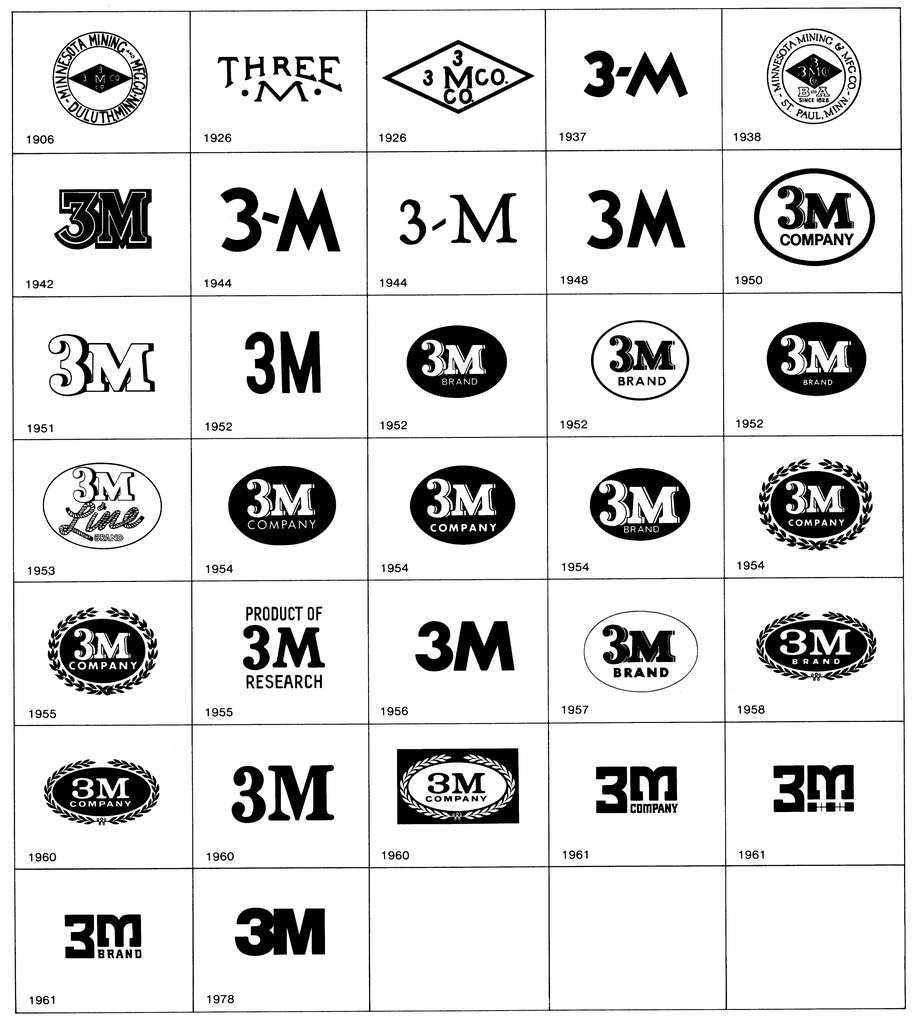
The compact block lockup makes the shortened masterbrand dominant before the current red mark. source
The current system uses the compact red 3M wordmark as the masterbrand cue. source

Product and service lineage.
Purchased abrasive minerals became sandpaper, then named product families solved different problems with surfaces and adhesives.

Industrial performance is the base layer
A bond, abrasive, or protective material makes the corporate promise measurable at work.

Reflective materials make science visible
The value appears in the changed behavior of light, not in an abstract innovation message.

Consumer families translate the platform
Named products give a technical capability an immediate everyday job.

Safety raises the proof standard
Protection products require performance language to stay specific and restrained.
Product and service system
In 1905, 3M made sandpaper in Duluth using abrasive minerals bought elsewhere. Three-M-ite abrasive cloth followed in 1914. Wetordry waterproof sandpaper arrived in 1921 for use with water on automotive finishes. Source
Richard Drew noticed painters’ masking problems while testing abrasives in a body shop. Scotch masking tape followed in 1925. In 1930, clear cellophane tape answered a different need: sealing transparent wrapping. Source
Spencer Silver’s removable adhesive met Art Fry’s need for bookmarks that stayed put. Their notes reached U.S. stores as Post-it Notes in 1980, after an earlier trial under the name Press ’n Peel. Source
The first Command range included utility hooks, a cord clip, poster strips and replacement strips. Its adhesive was designed to hold until stretched for removal. Source
Protection, films, connectors, and advanced materials carry the capability into critical work systems.
Turning points.
The important changes were in what 3M could make and what customers could do with it, while the mining name remained.
The founders sought corundum for abrasives. Their mining effort produced anorthosite instead, and sales were weak.
The company moved to Duluth and built a sandpaper plant using minerals purchased from another source.
A body-shop problem becomes the Scotch tape family.
Richard Drew coated cellophane with adhesive to solve the problem of sealing transparent wrapping.
A dedicated laboratory pursues longer-horizon technologies, including reflective materials.
A reusable low-tack adhesive becomes a new behavior and category cue.
Utility hooks, a cord clip, poster strips and replacement strips brought a stretch-release adhesive into the home.
The abbreviation replaces the descriptive original name at the entity level.
Health care leaves 3M as a separately listed company.
Public reaction.
Recognition strength and disclosed operating pressure are separated from invented sentiment.
The parent mark, product-family names, and physical outcomes reinforce one another.
The company must explain what remains after Solventum while absorbing tariffs and PFAS-exit costs.
Full timeline.
Minnesota Mining and Manufacturing is founded Source
3M opens a Duluth sandpaper plant using abrasive minerals purchased from another source. Source
Three-M-ite abrasive cloth becomes 3M’s first exclusive product. Source
Wetordry waterproof sandpaper is patented and introduced. Source
Masking tape creates the Scotch family Source
Scotch cellophane tape launches for sealing transparent wrapping. Source
Central Research Laboratory is established Source
Post-it Notes enter the U.S. market Source
Command launches its first hooks, cord clip, poster strips and replacement strips. Source
3M Company becomes the legal name Source
3M Science. Applied to Life. launches Source
Solventum separates from 3M Source
PFAS manufacturing exit concludes Source
Steal / avoid.
- Build portfolio breadth from a shared capability that produces visible outcomes.
- Give product families enough naming power to explain the job without competing with the parent.
- Update the entity story when a large business leaves the group.
- Do not let familiar consumer products stand in for the whole industrial company.
- Do not keep a separated business inside the current architecture or finance story.
- Do not turn invention history into unsupported leadership, customer-sentiment, or outcome claims.
Short answer.
3M stands for Minnesota Mining and Manufacturing. Founded in Minnesota in 1902, it moved from an unsuccessful mining venture into sandpaper and later developed brands including Scotch, Post-it and Command. Its former health-care business became independent Solventum in April 2024.
Frequently asked questions
What does 3M stand for?
3M comes from Minnesota Mining and Manufacturing Company, founded in Two Harbors, Minnesota, in 1902. Its founders sought a mineral for abrasives, but their initial mining effort failed to produce the corundum they wanted. The business moved into sandpaper manufacturing, so the mining name survived a major change in what the company actually did.
Why did 3M stop being a mining business?
Its early mining effort did not produce the corundum the founders wanted for abrasives. 3M’s history says the anorthosite it used instead sold poorly. In 1905, the company moved to Duluth to manufacture sandpaper with abrasive minerals bought from another source.
Are Post-it, Scotch and Command all 3M brands?
Yes. 3M lists Post-it, Scotch, Command, Scotch-Brite, Scotchgard and Filtrete among its consumer brands. The names identify different jobs, such as notes, tape, hanging, cleaning and filtration, while 3M is the company behind them. Its portfolio also includes industrial names such as PELTOR and VHB.
Is Solventum part of 3M?
No. 3M separated its health-care business as the independent public company Solventum in April 2024.
What did 3M make before Scotch tape and Post-it Notes?
Sandpaper and abrasive cloth came first. 3M opened its Duluth sandpaper plant in 1905, introduced Three-M-ite abrasive cloth in 1914 and launched Wetordry waterproof sandpaper in 1921. Scotch masking tape followed in 1925; Post-it Notes reached the U.S. market in 1980.
When did 3M introduce Command hooks?
Command’s first products launched in 1996: medium and large utility hooks, a small cord clip, poster strips and replacement strips. The brand’s history connects the name to an adhesive that releases when stretched.
Need help with your own brand?
Use Private brand work when your name, identity, proof, or message needs a sharper branding decision.