BP · Grow Your Brand · Corporate promise stress test · United Kingdom / Public company
BP
BP: when a broader-energy signal meets operating reality. The Helios made BP look broader than petroleum. The useful test is whether capital allocation, safety, and the customer system make that promise credible.
Positioning, name, and architecture.
BP is a UK-listed integrated energy company spanning oil and gas production, trading, refining, retail, convenience, charging, and selected lower-carbon businesses. Its identity carries a larger promise than any one forecourt.
A globally recognized retail and corporate identity spanning upstream operations, trading, fuels, convenience, charging, and selected transition businesses.
BP is the integrated energy company whose Helios connects global operations to daily customer touchpoints while making corporate credibility unusually visible.
BP grew from the British Petroleum name; BP p.l.c. is the current legal company name.
No campaign line is treated as current operating proof.
branded house with operating businesses
The corporate masterbrand spans production, trading, products, retail, and charging. Individual businesses need clear roles so the Helios does not imply that every activity has the same economics or transition profile.
Supplies oil and gas and carries major capital and safety consequences.
upstream system: Oil production and operations source
Connects production, supply, and customer demand.
market system: Supply, trading and shipping source
Makes the masterbrand visible in daily mobility.
customer system: bp retail source
Extends the customer network beyond liquid fuels.
mobility extension: bp pulse source
Naming and tagline progression
Beyond petroleum.
The operating portfolio carries the promise more reliably than one campaign.
Market and scale snapshot.
BP reports consolidated company results. The dated market-cap observation is a changing public-market measure, not an operating result.
BP consolidated Q1 2026.
IFRS company result for Q1 2026.
CompaniesMarketCap USD observation captured 1 Aug 2026; delayed price data means this value changes.
BP p.l.c. is listed in London as BP. and in New York as BP.
Color system.
Green and yellow are not proof of transition. They are a high-memory recognition system that increases the burden on operations to explain what the company is becoming.
How the palette behaves
Dark green carries infrastructure and corporate authority.
Light green signals energy and movement.
Yellow adds visibility and retail warmth.
White keeps the radial geometry legible.
Recognition assets.
The Helios is a high-memory corporate signal. Green, yellow, radial geometry, and lowercase letters make it visible at distance; operating proof decides what that signal means.
A radial sun-and-flower form replaced the shield and made a broader-energy promise visible.
The palette creates distance recognition across forecourts, vehicles, and corporate material.
The same mark connects everyday service moments to industrial-scale activities.
The stronger the environmental cue, the more closely capital allocation and safety are examined.
Scores.
Eight signals separate recognition from operating proof.
The Helios and palette are immediately distinctive.
One mark spans a complex portfolio but needs role clarity.
Scale is strong; the promise remains contested.
Safety and capital-allocation history create a persistent proof burden.
Forecourts make the brand physically visible.
Charging and lower-carbon businesses coexist with upstream emphasis.
The visual system is coherent even when strategy shifts.
Global operating scale remains substantial.
How the logo changed.
The identity change is dramatic because the underlying promise changed with the shape: protection and heritage gave way to energy, nature, and motion.
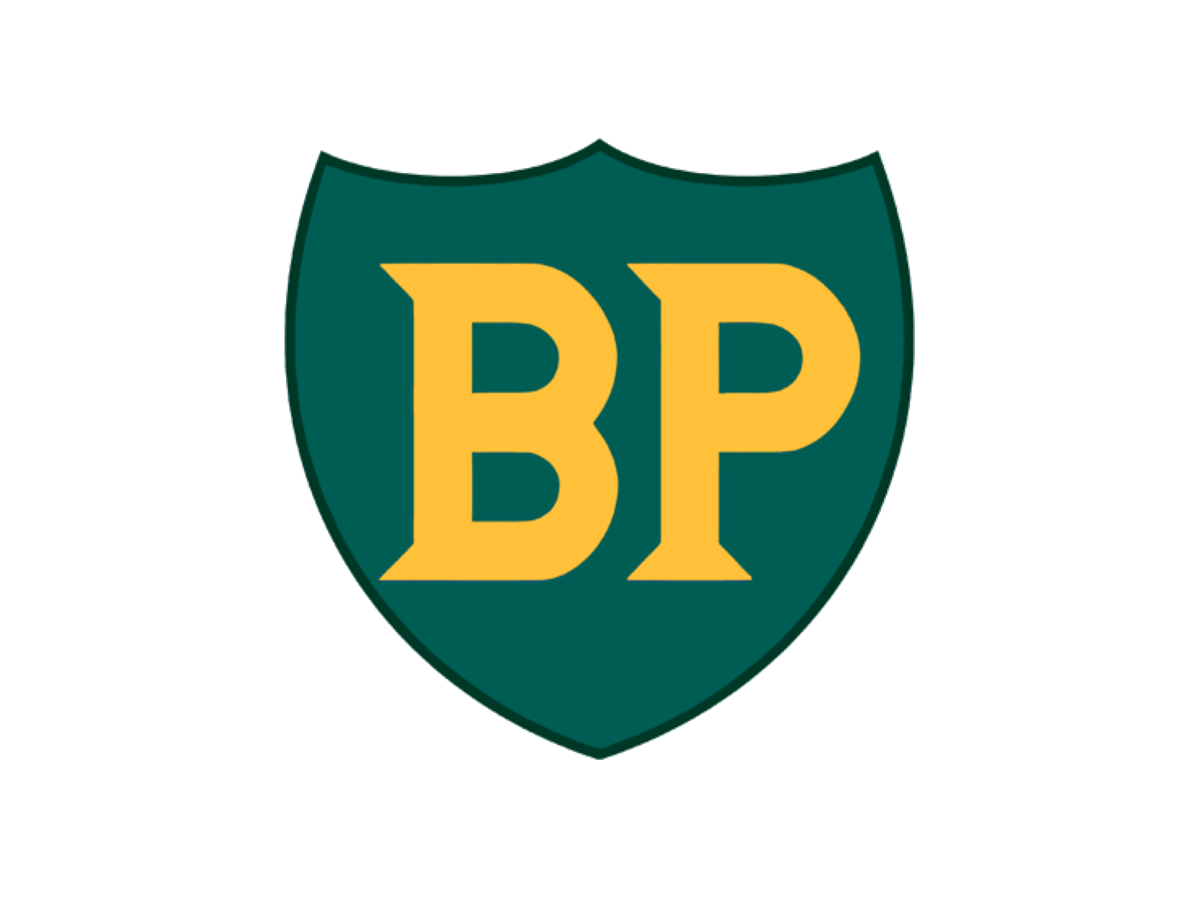
BP's own history dates the white-field shield system to 1958-1989; this exact surviving reference is cataloged as the 1961 treatment. source
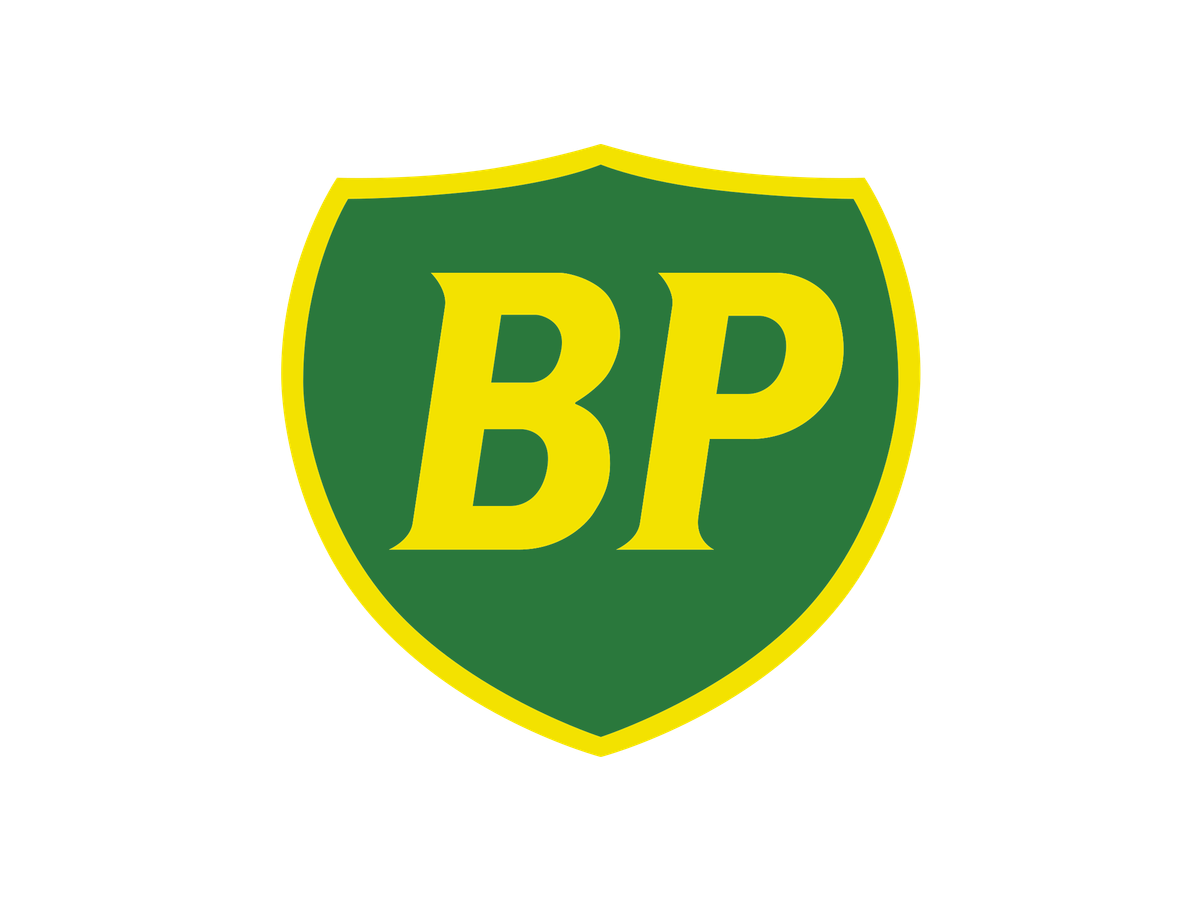
The 1989 treatment filled the field green and strengthened the yellow perimeter and letters. source
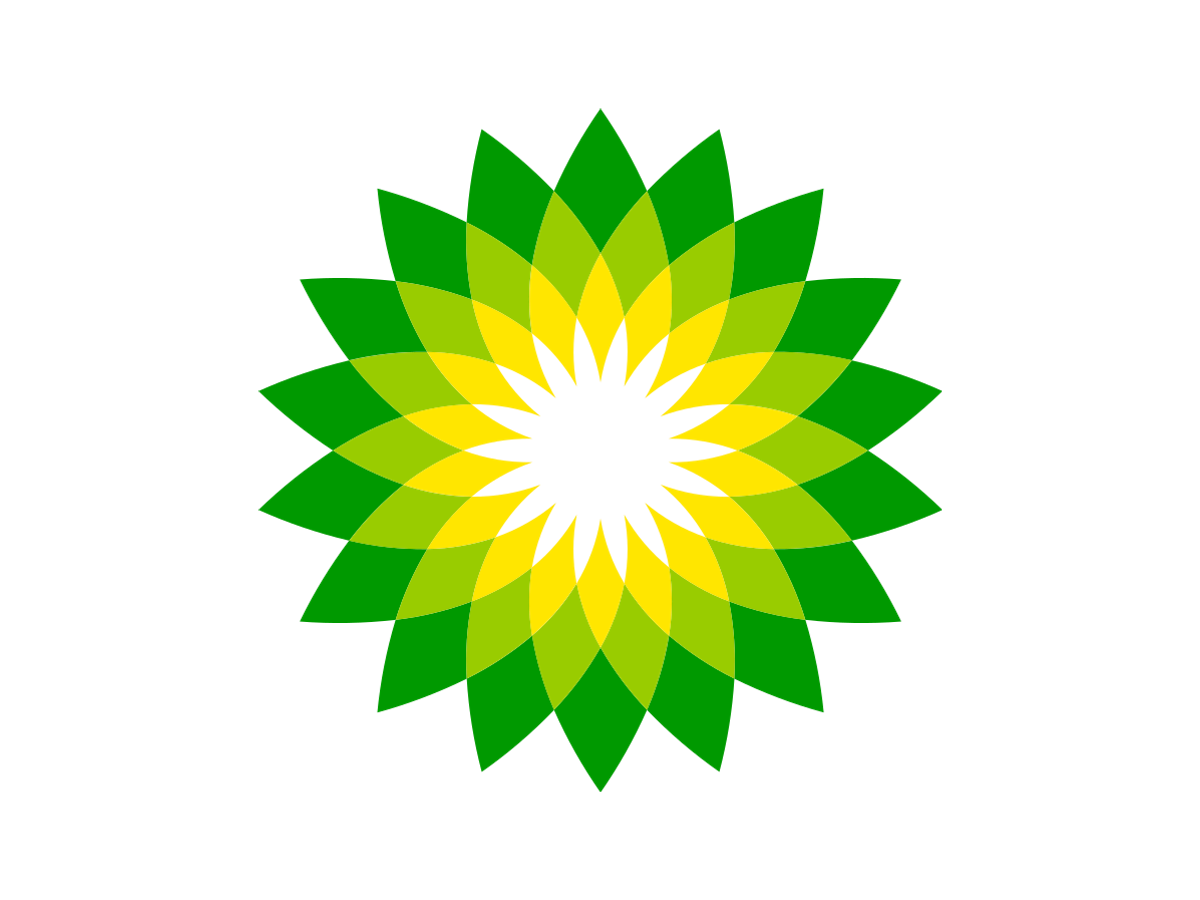
The Helios broke from the shield and encoded a broader-energy ambition in radial green and yellow geometry. source
Product and service lineage.
BP's brand system is credible only when the operating layers are visible together.

Industrial operations
This scene makes an operating layer visible without generating a fake mark or interface.

Charging extension
The proof sits in the physical handoff, not in decorative brand language.

Customer network
A distinct scene keeps the page specific to the way this brand actually works.

Materials capability
The brand signal becomes useful when it survives a real operating context.
Product and service system
The company lineage begins in large-scale oil production.
The corporate name makes petroleum explicit.
Public-market accountability becomes central.
The operating portfolio and identity problem become larger.
A broader-energy corporate signal replaces the shield.
Upstream emphasis sharpens the proof question around the Helios promise.
Turning points.
Six moments show how identity, operating scale, and public consequence became inseparable.
A petroleum operating system begins.
Resource scale expands the company's strategic weight.
A larger portfolio needs a unifying identity.
The shield gives way to a broader-energy promise.
Safety failure overwhelms brand symbolism and creates long-tail consequences.
Capital priorities and leadership change reopen the credibility test.
Public reaction.
BP's identity is judged against capital allocation, operational safety, and the pace of portfolio change.
Helios widened the category signal beyond petroleum.
Environmental cues create scrutiny when the business remains hydrocarbon-heavy.
Deepwater Horizon remains a financial and trust burden.
The 2025 reset makes strategy more explicit but narrows the broader-energy story.
Full timeline.
Company formation
Prudhoe Bay
BP and Amoco combine
Helios launch
Deepwater Horizon
Strategy reset
New leadership
Steal / avoid.
- Make one symbol work across the whole operating system.
- Date the promise and the proof separately.
- Show portfolio roles instead of hiding complexity.
- Treat trust consequences as current operating data.
- Using green as evidence by itself.
- Calling Beyond Petroleum the legal name.
- Mixing IFRS and non-IFRS measures.
- Reducing the company to forecourts or to one disaster.
Short answer.
BP is a UK public integrated energy company. Its 2000 Helios replaced the shield with a broader-energy signal, but the brand is still judged against upstream investment, retail and charging delivery, safety history, and current financial consequences.
Frequently asked questions
What does the BP Helios mean?
It is BP's 2000 radial identity, designed to signal energy in multiple forms rather than a petroleum-only shield.
Did BP change its legal name to Beyond Petroleum?
No. BP p.l.c. is the legal company; Beyond Petroleum was Helios-era positioning.
Why is Deepwater Horizon still part of a current brand analysis?
BP still reported USD 6.938B of related payables and provisions at 31 March 2026, so the consequence remains current.
Need help with your own brand?
Use Private brand work when your name, identity, proof, or message needs a sharper branding decision.
Sources.
The current Helios is captured from BP's first-party homepage inline SVG and centered on the fixed white canvas without redrawing.
Use the education shelf for the concepts behind this brand page.
Private brand workIf your brand must make a complex promise legible across products and operating touchpoints, Private Brand Work can define the hierarchy, proof, and recognition system.
All brandsReturn to every brand page.