Lufthansa · Grow Your Brand · Iconic / Trust Machine · Germany / Active / flag carrier
Lufthansa
Lufthansa: the crane that turns aviation trust into national precision. The crane links a century of aviation identity to Lufthansa's aircraft, cabins, hubs, airline portfolio, engineering businesses, FY2025 scale, and current service pressure.
Positioning, name, and architecture.
Lufthansa joins one crane, a restrained navy-yellow system, and a multi-hub service network; the identity works only when those layers feel like one airline.
A global Star Alliance hub network with German engineering credibility and visible aviation trust cues.
Lufthansa positions flight as organized trust: safety, network reach, and service proof carried by the crane.
Luft points to air; Hansa points to the Hanseatic trading tradition. The name makes aviation feel like a disciplined network.
We are the Journey
hybrid branded house
Lufthansa Group combines separately branded national and leisure airlines with cargo, maintenance, and loyalty businesses. ITA Airways is an equity holding and SunExpress is a joint venture, not a wholly owned airline.
Lufthansa Airlines, SWISS, Austrian Airlines, and Brussels Airlines keep distinct identities while sharing the Group's network and service infrastructure.
National and hub airlines: Lufthansa / SWISS / Austrian / Brussels source
Eurowings and Discover Airlines extend the portfolio beyond the core hubs; SunExpress is held as a joint venture and Edelweiss is linked through SWISS.
Direct and holiday travel: Eurowings / Discover Airlines source
The 2025 stake adds Italy to the Group's home-market system while ITA Airways retains its own airline identity.
Equity holding in Passenger Airlines: Italian network airline / equity holding source
Freighter capacity and cargo handling turn network reach into business proof beyond passengers.
Logistics business: Air freight network source
Engineering and fleet support make the trust signal visible outside the passenger cabin.
Maintenance, repair, and overhaul: Aircraft maintenance and technical services source
Status, points, partners, and repeat travel keep the brand active between flights.
Loyalty system: Frequent-flyer relationship source
Naming and tagline progression
Say yes to the world
Every Story starts with a Yes
We are the Journey
Market and scale snapshot.
FY2025 revenue and Adjusted EBIT show operating scale; the listed ticker is included, while market value stays out without a dated, reproducible figure.
FY2025 Lufthansa Group revenue of EUR 39.597 billion, converted at the ECB 31 Dec 2025 reference rate.
FY2025 Lufthansa Group Adjusted EBIT of EUR 1.960 billion; net profit attributable to Deutsche Lufthansa AG shareholders was EUR 1.339 billion.
No dated, reproducible market-value figure is used in this snapshot.
DE0008232125 · Boerse Frankfurt
Color system.
Deep navy makes Lufthansa feel controlled and premium; yellow now works as a precise orientation accent, while white aircraft surfaces keep the crane visible at airport scale.
How the palette behaves
Navy carries control, stability, and safety in a category where trust is a practical requirement.
Yellow gives the system visibility and warmth without turning the brand playful.
White aircraft surfaces make the carrier feel clean, technical, and premium, but only if the service experience supports the promise.
The palette works because it appears on real customer surfaces: aircraft, tail, app, gate, boarding pass, lounge, signage, and cabin materials.
Recognition assets.
The crane, yellow tail cue, navy field, aircraft silhouette, and airport repetition let Lufthansa stay recognizable before a passenger reads a fare or route.
The crane symbol gives the brand a recognizable aviation trust cue before someone reaches the wordmark.
Navy and yellow create a disciplined contrast: institutional trust plus airport-level visibility.
The livery is the public evidence point. A weak cabin or ground handoff can damage the same signal the aircraft carries.
Frankfurt and Munich matter as operating proof, not just geography; the brand has to work through hubs, crews, rebooking, lounges, baggage, loyalty, and recovery.
Miles & More extends recognition into loyalty behavior when the passenger is not standing in front of an aircraft.
Scores.
These scores test whether Lufthansa's identity survives the physical and service handoffs that define an airline journey.
Crane, livery, and palette are fast category cues.
Strong when operating proof matches the identity.
Allegris helps, but rollout and cabin consistency matter.
Airlines are judged hardest when recovery is needed.
The brand, parent entity, ticker, and airline system are clear.
Hubs, partners, cargo, maintenance, and loyalty make the system large.
The 100-year frame is strong only when the live trip still proves it.
A premium carrier has a narrower margin when disruption hits.
How the logo changed.
The crane begins with Otto Firle's 1918 symbol, becomes part of Luft Hansa in 1926, gains a disciplined Aicher-era system in 1963-1964, and is refined for aircraft and digital use in 2018.
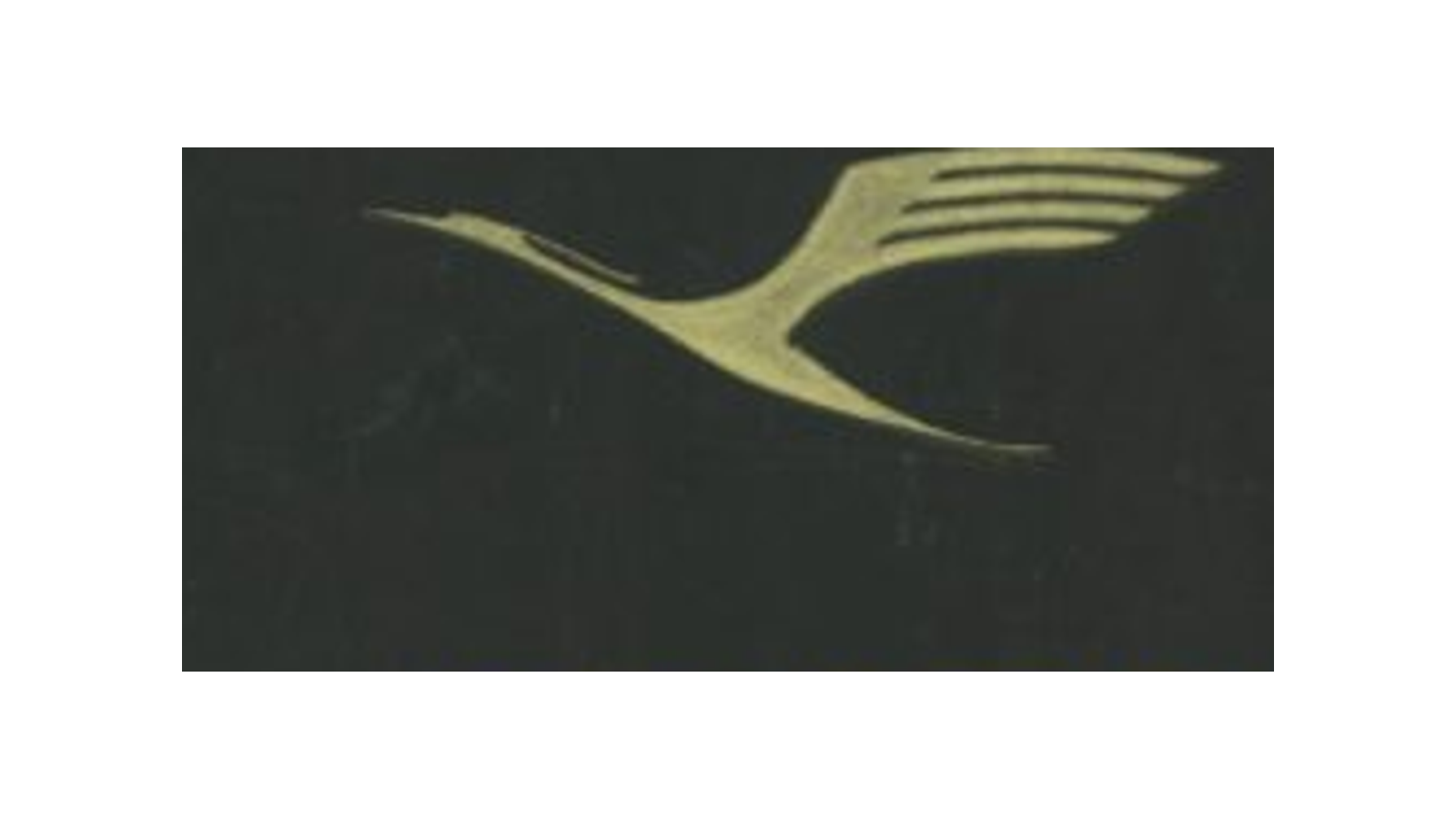
Otto Firle designed the unencircled crane for Deutsche Luft-Reederei in 1918; Deutsche Aero Lloyd carried it from 1923 and the first Luft Hansa adopted it in 1926. source
The HfG Ulm team led by Otl Aicher turns the crane, Helvetica wordmark, blue, yellow, grids, and application rules into one disciplined identity system.
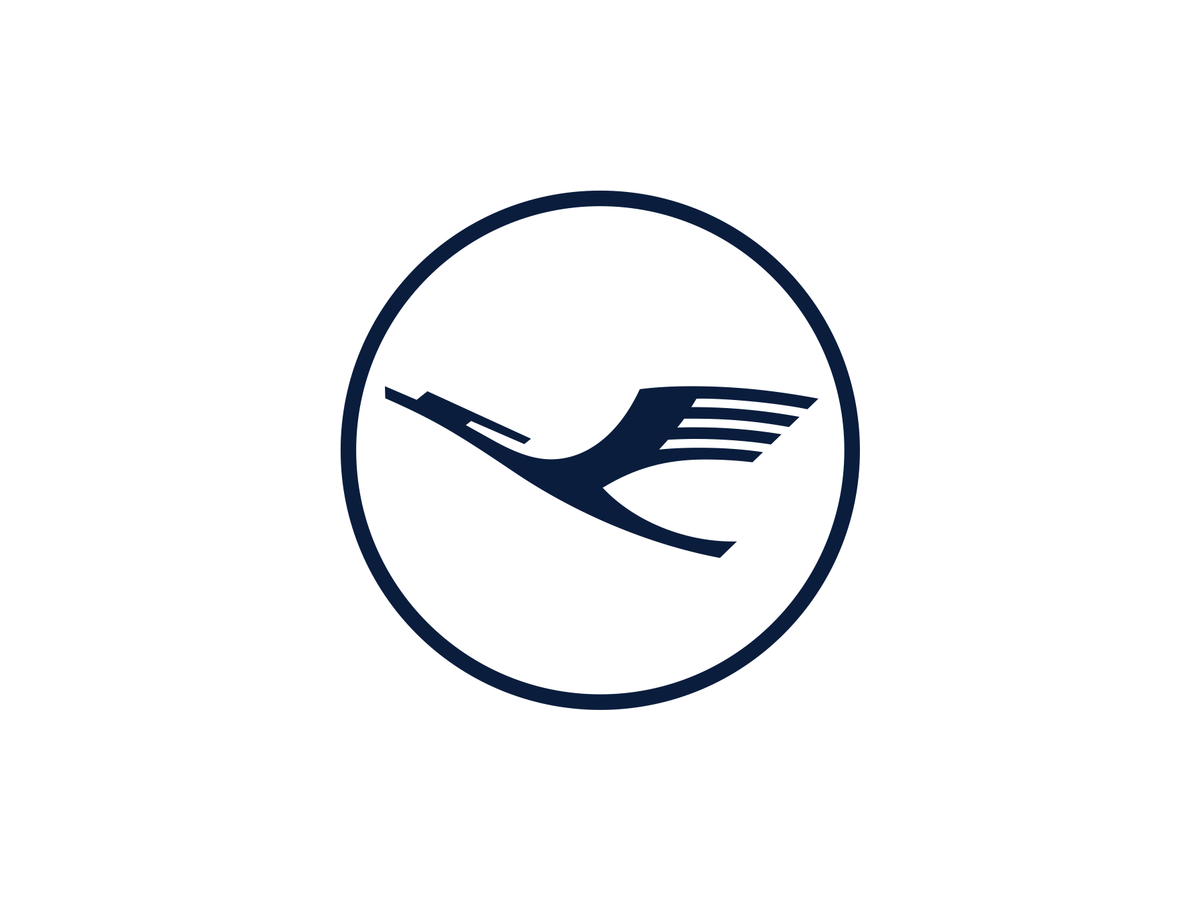
A thinner ring and more open crane give the century-old symbol greater clarity on aircraft, phones, watches, and other digital surfaces. source
The current lockup pairs the refined crane with a bespoke, highly legible wordmark while deep blue becomes the leading color and yellow an orientation accent. source
Product and service lineage.
The Lufthansa signal has to survive the complete service system: cabin tiers, hubs, loyalty, maintenance, cargo, disruption recovery, and the handoffs between them.
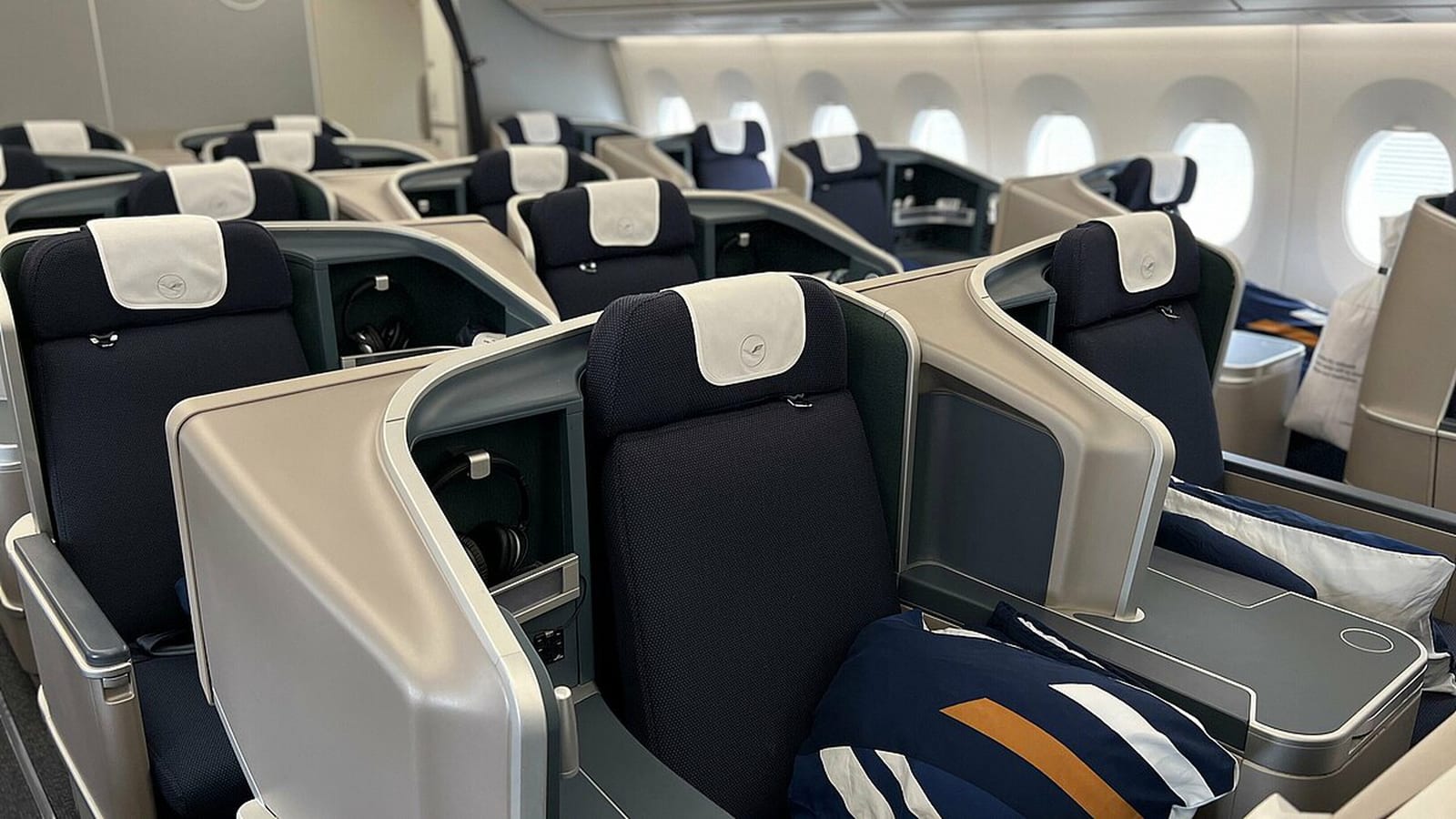
Business Class is visible product proof
Seat layout, privacy, material quality, and direct aisle access turn a premium claim into a cabin customers can inspect.
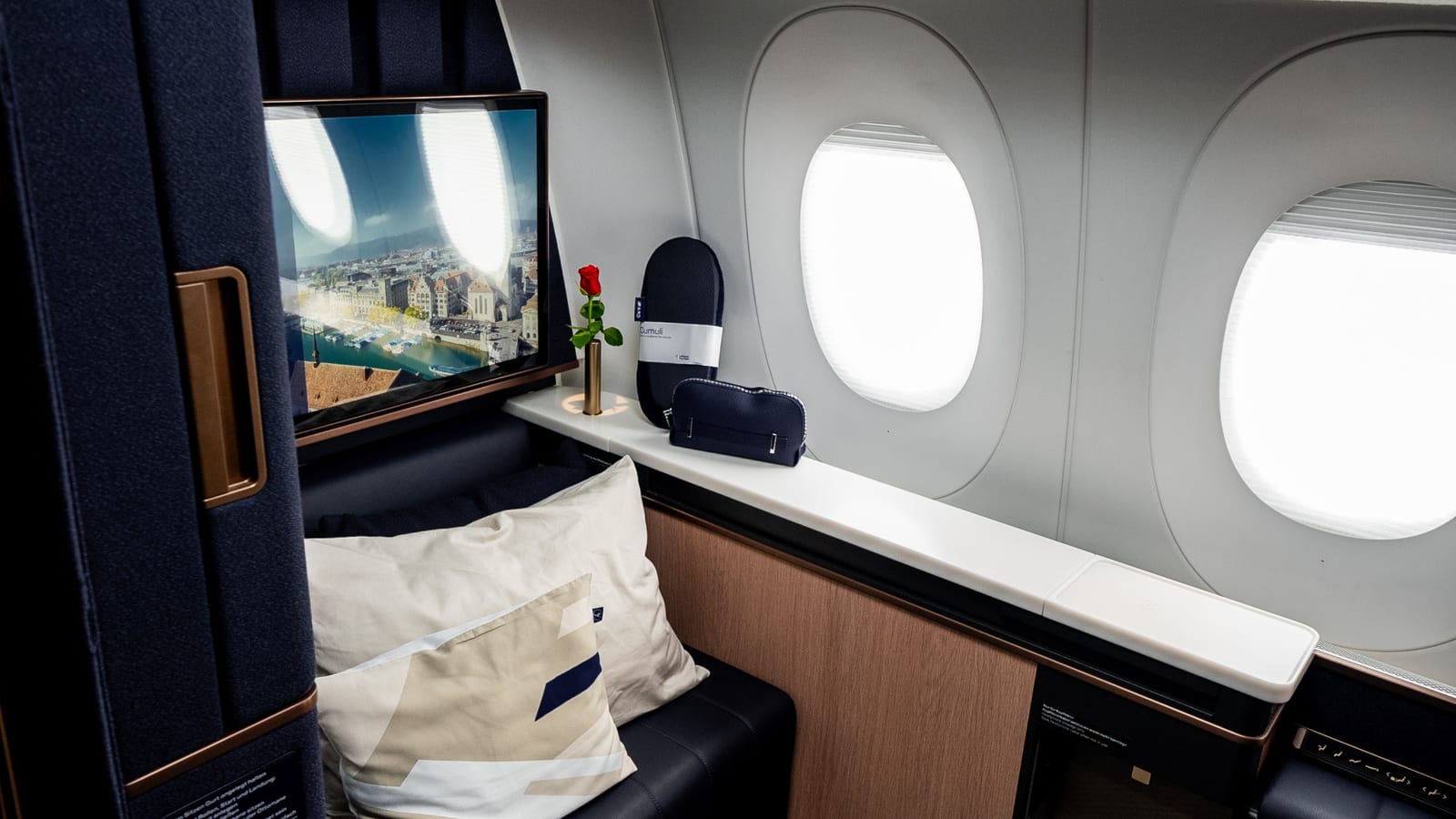
First Class carries the prestige ceiling
Privacy, space, and a controlled material palette show what Lufthansa means by premium at the top of the range.
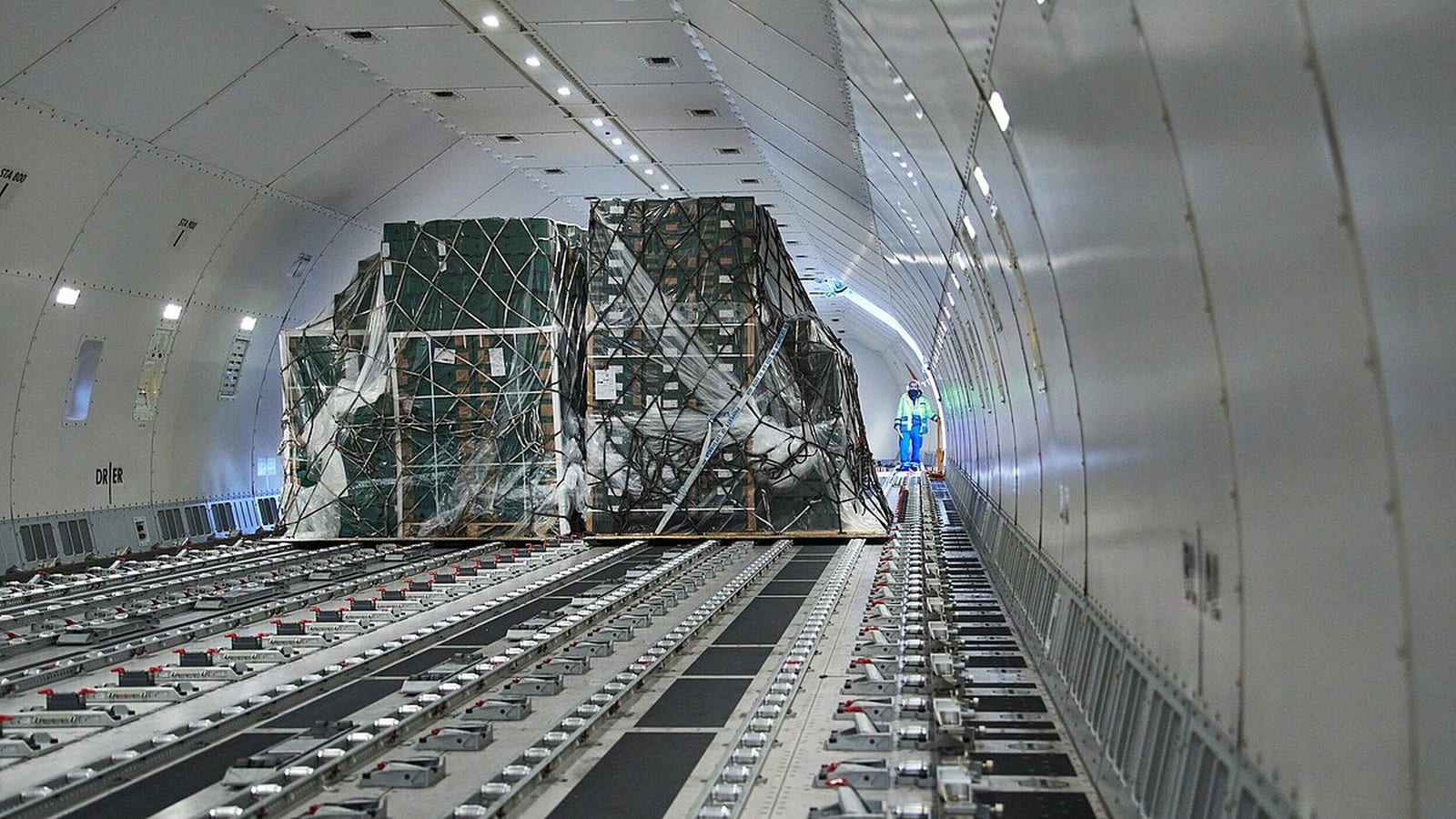
Cargo proves the network beyond passengers
Freight handling makes route reach, timing, and operational discipline visible to business customers.
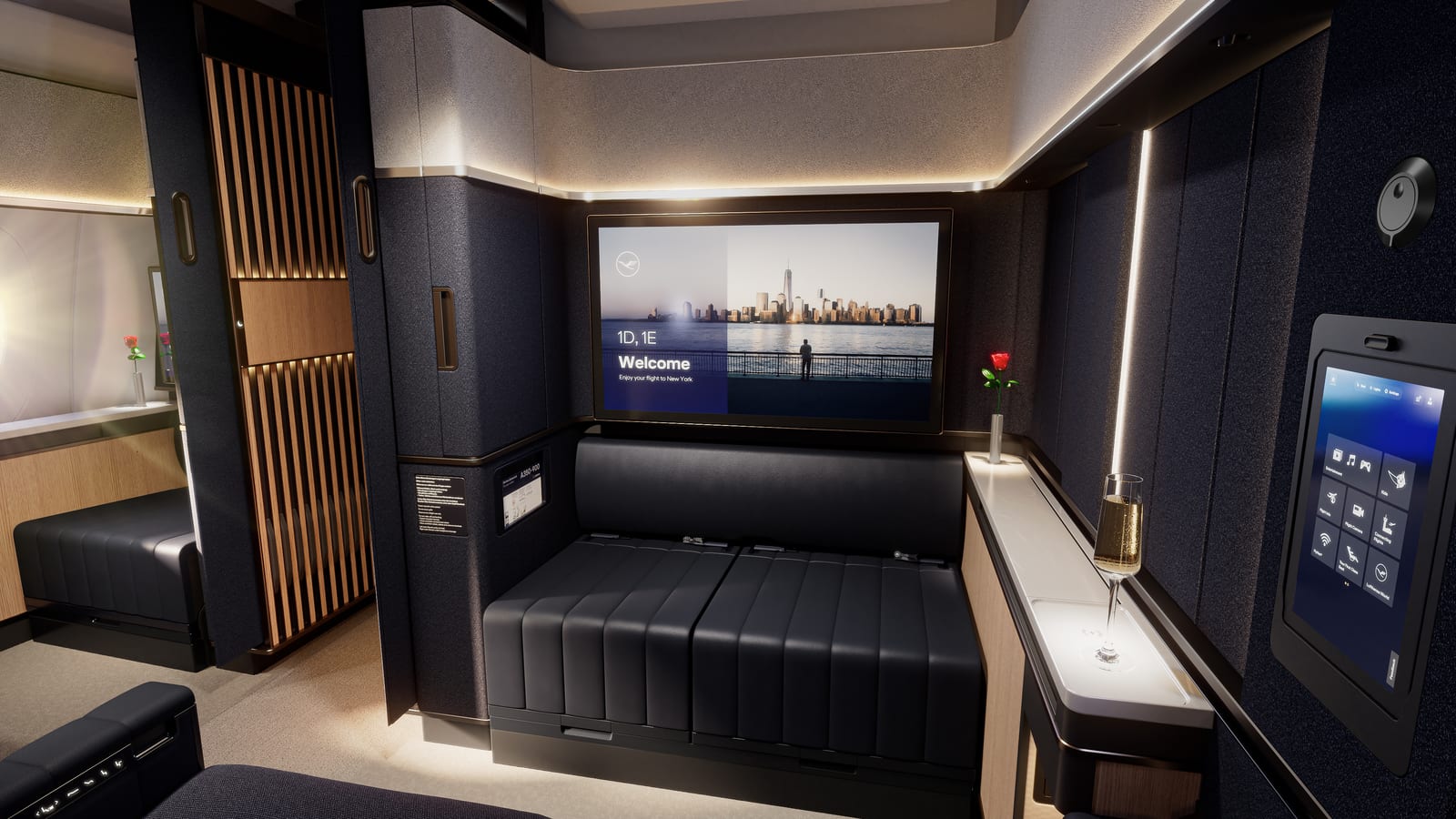
Allegris turns renewal into a physical system
The suite shows how the same navy restraint can extend into privacy, entertainment, lighting, and onboard service.
Product and service system
Economy, Premium Economy, Business, and First Class make one airline promise carry different comfort, privacy, and service expectations.
Frankfurt and Munich connect check-in, lounges, gates, baggage, crews, partners, and onward travel into one visible operating system.
The loyalty layer keeps Lufthansa present between trips through status, points, partner earning, and repeat-travel routines.
Maintenance, repair, and overhaul make engineering trust visible beyond the passenger cabin and across other airlines' fleets.
Freight adds time-critical handling, specialist capacity, and business-customer proof to the same route network.
Partner recognition extends lounge, connection, status, and route expectations beyond Lufthansa-operated flights.
New cabin products turn premium renewal into inspectable proof through privacy, seat choice, materials, lighting, and entertainment.
During delays, cancellations, strikes, or missed connections, rebooking, communication, baggage recovery, and staff handoffs become the decisive brand experience.
Turning points.
Centenary memory, fleet renewal, alliance reach, strikes, and recovery show where Lufthansa's signal gains authority or meets operating pressure.
A 100-year story is powerful only if the live product still feels disciplined.
New aircraft and Allegris are not decoration; they are the physical proof behind the premium promise.
The brand depends on hubs, partner integration, crews, rebooking, baggage, lounges, cargo, and maintenance credibility.
The annual report names the Nazi era as a dark chapter; the brand history cannot be treated as pure nostalgia.
Lufthansa plans to resume Riyadh and Amman flights from September.
Public reaction.
Lufthansa earns confidence through product renewal and customer-service proof, while disruption and strikes reveal whether the premium promise survives a difficult trip.
Lufthansa expanded rebooking, baggage tracking, irregular-operations information, and claims tools for the 2025 summer schedule. Those service surfaces show where passenger trust is tested.
The Group uses passenger satisfaction tracking, direct post-flight feedback, and Net Promoter Score processes across passenger airlines and other businesses.
Pilot and cabin-crew strikes in February 2026 caused extensive cancellations, making rebooking and recovery part of the public Lufthansa signal.
Full timeline.
The first Luft Hansa is founded and makes its maiden flight on 6 April.
The legal foundation for today's Lufthansa is established in 1953 and flight operations resume in 1955.
The Aicher-era identity system brings the crane, wordmark, color, grid, and applications into one disciplined program.
Lufthansa becomes a founding member of Star Alliance.
Lufthansa introduces a refined crane, deeper blue, new livery, and digital-ready typography.
Lufthansa Group reports EUR 39.597 billion revenue and includes its ITA Airways equity holding in Passenger Airlines.
Lufthansa marks 100 years since the first Luft Hansa with the motto We are the Journey.
Steal / avoid.
- Make a symbol do operational work, not just recognition work.
- Repeat the same color system on real customer surfaces.
- Let product renewal carry the premium story.
- Treat service recovery as part of the brand, not a back-office exception.
- Do not let heritage excuse a weak current experience.
- Do not publish a premium identity that the cabin, app, gate, or rebooking path cannot support.
- Do not use national-carrier prestige as a substitute for current proof.
Short answer.
Lufthansa's brand signal is the crane, the navy-and-yellow restraint, and the operating trust system behind the airline. The useful lesson is that an airline brand cannot live only in a mark or livery. It has to show up in aircraft, hubs, cabin product, loyalty, punctuality, service recovery, partner network, and the way the carrier handles pressure.
Frequently asked questions
What is Lufthansa's core brand signal?
Lufthansa's core brand signal is the crane, navy-yellow restraint, and the operating trust system behind aircraft, hubs, cabin product, loyalty, punctuality, and recovery.
What should another brand steal from Lufthansa?
Make the symbol prove an operating behavior. The mark should point to service, recovery, network reliability, and the surfaces customers actually use.
What should another brand avoid copying from Lufthansa?
Do not copy flag-carrier prestige without current proof. A premium identity fails when the cabin, app, gate, or rebooking path cannot support it.
Need help with your own brand?
Use Private brand work when your name, identity, proof, or message needs a sharper branding decision.
Sources.
Use the education shelf for the concepts behind this brand page.
Private brand workUse this when the decision belongs to your own brand.
All brandsReturn to every brand page.
- Lufthansa Group Annual Report 2025
- Boerse Frankfurt: Deutsche Lufthansa AG
- Wikimedia Commons: Lufthansa Logo 2018
- Wikimedia Commons: Lufthansa Logo 2018 crane
- Wikimedia Commons: Lufthansa Logo 1964
- Wikimedia Commons: Lufthansa Crane Logo 1964 JPEG
- Lufthansa newsroom: A350 aircraft image
- Lufthansa newsroom: upgraded A350 Business Class
- Lufthansa newsroom: Allegris First Class
- Lufthansa newsroom: A321 cargo operations
- Lufthansa newsroom: customer-service improvements
- Associated Press: February 2026 Lufthansa strikes
- Lufthansa newsroom: 2026 centenary motto
- Lufthansa Group: 100 years of Lufthansa
- Lufthansa: the crane through the ages
- Lufthansa newsroom: 2018 brand design
- Lufthansa Group strategy and airline portfolio
- ECB reference rates: 31 December 2025
- Lufthansa news


