QVC · Grow Your Brand · QVC failure case study · United States / Operating after August 2026 restructuring
QVC
Is QVC still in business after bankruptcy? QVC kept operating through Chapter 11 and emerged on August 6, 2026. The company announced more than $5 billion of debt reduction and a new $600 million lending facility.
Positioning, name, and architecture.
QVC encoded Quality, Value, and Convenience into a live demonstration format: a host explains, a guest proves, a viewer decides, and a fulfillment network delivers. The recognizable ritual traveled from cable to digital and social surfaces; the debt burden and shrinking QxH core did not become easier simply because the screen changed.
Host-led product demonstration joined directly to transaction
QVC makes shopping feel like a trusted live conversation, but the value of that conversation depends on customer renewal and a financially viable system beneath it.
QVC was formed from Quality, Value, and Convenience when Joseph Segel founded the service in 1986.
The page treats Quality, Value, and Convenience as the enduring name promise, not as proof that the restructuring is complete.
Consumer masterbrand inside a debtor operating company and public parent
QVC, HSN, QxH, QVC International, and QVC Group are related but not interchangeable legal or brand identities.
Carries the host-led live shopping format across television and digital surfaces.
consumer brand operation: QVC live programming source
Extends the QVC brand through separately managed international markets.
regional operating network: International QVC channels source
Moves shoppable live video into connected and web streaming.
streaming product: QVC+ streaming source
Converts live product discovery into inventory, parcel, return, and delivery performance.
operating capability: QVC U.S. fulfillment system source
Naming and tagline progression
Quality, Value, Convenience becomes the name
The Q becomes a standalone recognition device
The open Q is designed for mobile and social shopping
Market and scale snapshot.
FY2025 results describe the business before restructuring. QVC completed its debt restructuring on August 6, 2026.
QxH contributed USD 5.936B and QVC International USD 2.357B.
Loss attributable to the QVC, Inc. stockholder was USD 2.168B after noncontrolling interests.
Reported on August 6, 2026.
Formerly QVC, Inc.; the former parent became Old QVC Group, Inc.
Color system.
Navy preserves trust and legibility while coral makes the open-Q system warmer and more mobile-native. The palette signals a channel migration; financial results show that recognition design and business recovery are separate jobs.
How the palette behaves
Navy: trust and product authority. Current QVC wordmark and open-Q form.
Coral: warm invitation and live energy. The 2019 frame and social-first expression.
Turquoise: continuity with the 2007 ribbon-Q era. Historical Q ownership and discovery cue.
Recognition assets.
The Q name, host-led demonstration, limited-time urgency, product close-ups, testimonial language, and direct-response ordering system made discovery feel conversational. The 2019 open-Q identity explicitly prepared that system for mobile and social use.
The 2019 construction works as a doorway, magnifying glass, and compact digital frame.
Repeated hosts convert product features into a relationship viewers can recognize.
The brand's real asset is a repeatable selling behavior, not television carriage alone.
Scores.
QVC still owns a differentiated commerce behavior. Its penalties belong to financial resilience, customer renewal, and the economics of moving a large live-selling system across channels.
The name and live-shopping format remain category-defining.
Hosts and demonstration still create confidence, while restructuring weakens corporate certainty.
Curated proof can support value, but discount urgency can blur the price story.
The ritual can travel across streaming, social, apps, and owned ecommerce.
QVC continued operating and kept a majority-digital revenue mix, but lower QxH scale, large impairments, and debt show that channel continuity is not the same as financial resilience.
The evaluation considers the large FY2025 loss before QVC completed its restructuring in August 2026. Debt relief does not erase that operating result.
Parent and operating-company debt restructuring; consumer brand continues
QVC kept operating during Chapter 11 and emerged on August 6, 2026. This evaluation also retains the earlier restructuring history.
How the logo changed.
QVC moved from a descriptive television-network wordmark to ownership of the letter Q, then to an open digital frame designed for mobile and social shopping.
The serif network lockup names the service and its original broadcast frame directly. source
The dimensional turquoise Q makes discovery and the initial letter the primary recognition device. source
The coral frame and navy open Q were launched to make mobile and social shopping easier to recognize. source
Product and service lineage.
QVC's product is a coordinated selling system: sourcing, host trust, demonstration, urgency, transaction, and fulfillment. The name survived because that behavior remains useful even when the parent balance sheet requires a reset.
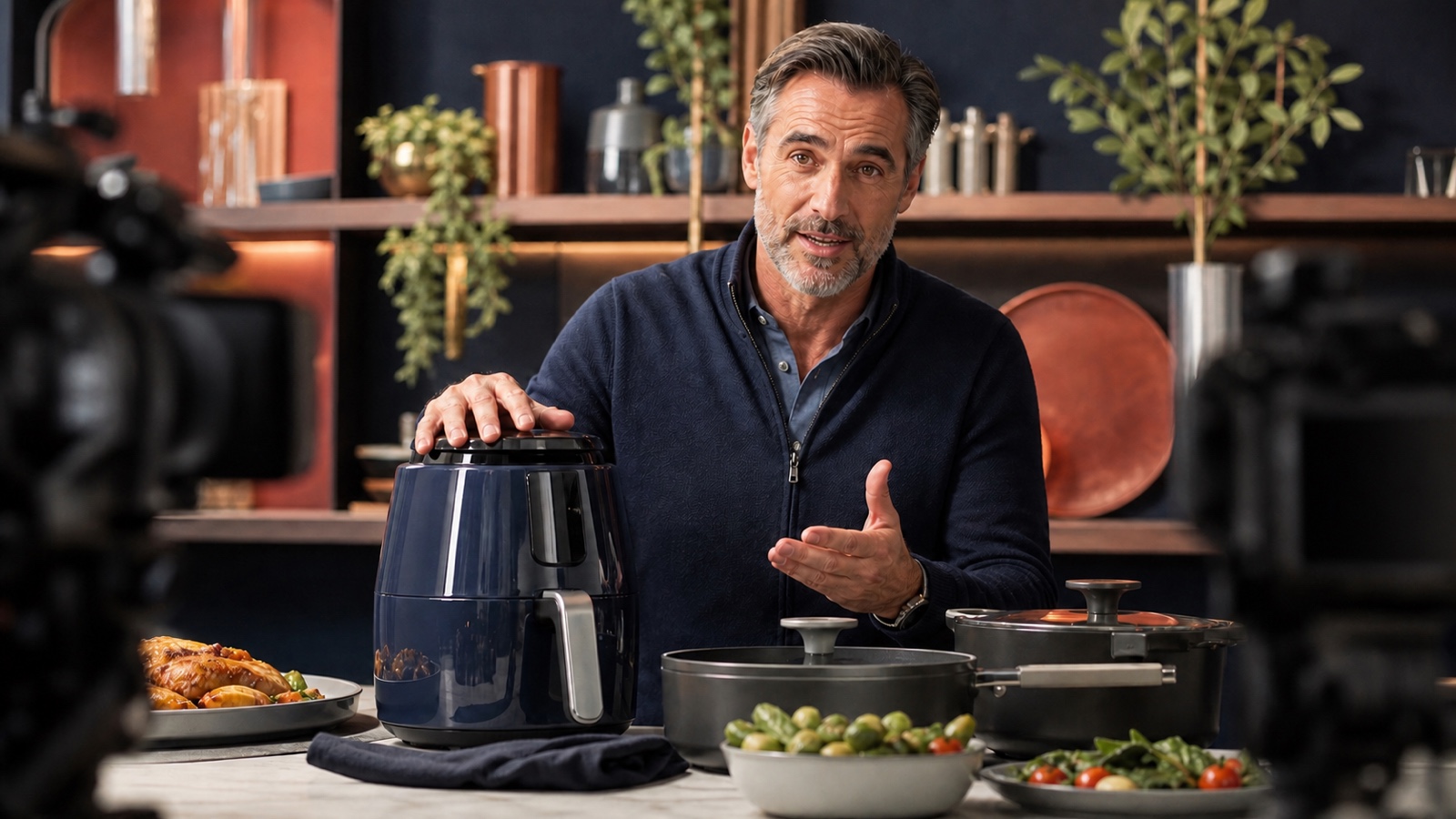
The host turns detail into confidence
Live explanation makes unfamiliar features legible before a shopper commits.

The channel moved beyond cable
Digital-platform revenue represented a majority of QVC revenue in 2025, but mix alone did not prove renewal.

The promise ends in fulfillment
Live discovery only becomes convenience when inventory, parcels, returns, and delivery economics work.

Social shopping changes acquisition
The selling ritual remains recognizable, while audience discovery shifts toward creators and platforms.
Product and service system
Hosts and guests made products understandable in real time.
QVC U.S. and HSN shared a broader operating system.
Apps, web, connected TV, and social carried live commerce beyond linear television.
The court-approved plan preserves operations while resetting debt and ownership.
Turning points.
The revealing comparison is not television versus ecommerce. It is USD 8.293 billion of operating-company revenue, a USD 2.127 billion net loss, large impairments, and a confirmed plan designed to remove most of the debt.
Why it failed
QVC entered court after shrinking QxH customer and unit volumes, a FY2025 USD 2.127 billion net loss, USD 2.395 billion of impairments, costly channel migration, and a capital structure the operating business could not support.
Management combined QVC and HSN, consolidated operations, and spent to move the selling ritual into streaming and social channels, but the shrinking QxH base did not generate enough earnings to carry the leveraged structure.
The collapse trigger was the inability to sustain or refinance roughly USD 6.6 billion of debt on the existing terms, leading QVC Group, QVC, Inc., and participating affiliates to implement a negotiated prepackaged Chapter 11 reset.
Failure timeline
QVC, Inc. reported USD 8.293B of revenue.
QVC, Inc. reported a USD 2.127B net loss and USD 2.395B of goodwill and intangible impairments.
QVC Group and debtor affiliates entered Chapter 11.
The court confirmed the plan on July 15.
QVC emerged from Chapter 11 on August 6.
Public reaction.
The QVC name makes it easy to overstate the event as a consumer-brand shutdown. The operating brand stayed active; the legal and financial failure belongs to QVC Group, QVC, Inc., and participating debtor affiliates.
Chapter 11 and the confirmed plan address leverage, claims, ownership, and the public securities.
Hosts, programming, ecommerce, streaming, vendor relationships, and fulfillment continue during the case.
Full timeline.
Joseph Segel founds QVC and the first broadcast airs on November 24. Source
QVC launches the ribbon-Q identity. Source
Liberty Interactive agrees to acquire the remaining HSN shares. Source
QVC unveils the open-Q identity for mobile and social shopping. Source
Qurate Retail becomes QVC Group and consolidates QVC U.S. and HSN operations at Studio Park. Source
QVC Group and participating affiliates file Chapter 11 on April 16. Source
The court confirms the prepackaged plan on July 15. Source
QVC completed its Chapter 11 restructuring on August 6. Source
Steal / avoid.
- Build a repeatable demonstration ritual that carries the identity.
- Design brand cues to travel across old and new channels.
- Separate consumer-brand equity from parent-company financial health.
- Label proposed restructuring outcomes as proposed until effective.
- Calling an active consumer brand liquidated because its parent filed Chapter 11.
- Treating digital revenue share as proof of profitable transformation.
- Using the QVC name to blur QVC Group, QVC, Inc., QxH, and HSN.
- Assuming recognition can offset leverage or declining unit economics.
Short answer.
QVC continued trading through Chapter 11 and emerged on August 6, 2026. Its restructuring reduced debt by more than $5 billion. QVC stands for Quality, Value and Convenience, a name dating to Joseph Segel's television-shopping business in 1986.
Frequently asked questions
What does QVC stand for?
QVC stands for Quality, Value and Convenience. Founder Joseph Segel chose the name when the television-shopping business began in 1986. The initials describe its intended shopping promise; a particular product still needs its own specifications, demonstration and return terms.
Did QVC shut down?
No. QVC continued operating during Chapter 11 and announced its emergence on August 6, 2026.
When did QVC emerge from bankruptcy?
QVC Group announced its emergence on August 6, 2026, after the court confirmed its plan on July 15. It reported more than $5 billion of debt reduction. QVC continued operating through the process.
Is QVC only a television channel?
No. QVC sells through video, ecommerce and mobile as well as television. Its 2019 identity change was explicitly designed for mobile and social shopping. The host demonstration remains recognizable across channels, but watching a broadcast is not a requirement for placing an online order.
How much revenue did QVC report in 2025?
QVC, Inc. reported USD 8.293 billion of net revenue for 2025.
Which QVC entities filed bankruptcy?
QVC Group, Inc., QVC, Inc., and participating U.S. affiliates filed. The exact debtor list is available through the restructuring docket.
Need help with your own brand?
Use Private brand work when your name, identity, proof, or message needs a sharper branding decision.
Sources.
Use the education shelf for the concepts behind this brand page.
Private brand workUse this when the decision belongs to your own brand.
All brandsReturn to every brand page.
- QVC, Inc. 2025 Form 10-K
- QVC Group April 2026 Form 8-K
- QVC Group plan-confirmation release
- QVC 2019 identity release
- Official QVC founder history
- QVC and HSN acquisition announcement
- QVC Group rename release
- QVC media bank
- QVC: What does QVC stand for?
- QVC Group emergence announcement, August 6, 2026
- QVC Group emergence announcement filed with SEC