SpaceX · Grow Your Brand · Largest reported IPO by proceeds · United States / Active
SpaceX
Falcon 9 vs Dragon: the rocket and spacecraft explained. Falcon 9 launches a payload; Dragon is a spacecraft that can carry crew or cargo. Returning the Falcon 9 first-stage booster is a separate milestone from recovering an entire launch system.
Positioning, name, and architecture.
Three evidence checks before the page talks about scale, color, or public reaction.
SpaceX turns launch, satellites, spacecraft, and network services into one frontier system.
A brand page on SpaceX as a company system: Falcon 9, Falcon Heavy, Dragon, Starship, Starlink, Starshield, rideshare, launch services, and the public-market signal after its reported IPO.
SpaceX operates as the parent/company mark for a wider system.
The current corporate story joins SpaceX launch and connectivity with xAI and X.
company system / portfolio architecture
SpaceX now reports a consolidated company spanning Space, Connectivity, and AI. Falcon, Dragon, Starship, Starlink, and Starshield remain the visible SpaceX operating system; xAI and X explain the broader 2026 corporate scope.
Reusable launch is the visible proof system: rocket, pad, landing, cadence, and payload trust.
Portfolio family: Falcon 9 and Falcon Heavy source
Crew and cargo missions make the brand credible in human spaceflight, not only commercial satellite launch.
Portfolio family: Dragon source
Reached its first orbit and delivered a Starlink payload in September 2026; regular operation and full reuse remain separate tests.
Portfolio family: Starship source
Satellite internet turns launches into a consumer and enterprise network service.
Portfolio family: Starlink source
Government and defense space services make the system a national-security infrastructure brand.
Portfolio family: Starshield source
Small-sat rideshare and contracted missions keep the commercial access story legible.
Portfolio family: Rideshare and launch services source
The February 2026 acquisition adds model development, compute, and the X platform to the consolidated public company.
AI and platform segment: xAI and X source
Naming and tagline progression
SpaceX is founded by Elon Musk.
Falcon 1 becomes the first privately developed liquid-fueled rocket to reach orbit.
Falcon 9 launches for the first time.
Market and scale snapshot.
SpaceX's first public-company quarter showed strong revenue growth and a much smaller operating loss, but USD 18.4B of capital spending made the Starlink-and-AI allocation question impossible to hide.
Q2 2026 revenue increased 92% year over year from about USD 4.1B.
Q2 2026 net loss; operating loss narrowed to USD 143M from USD 970M a year earlier.
Q2 2026 capital spending, including about USD 15.8B for AI infrastructure.
Public listing identified in official SpaceX offering materials.
Color system.
SpaceX's navy, steel, and pale gray connect rockets, launch sites, Dragon, Starship, Starlink terminals, and mission operations without borrowing a science-fiction interface.
How the palette behaves
Navy anchors the SpaceX name and the operational gravity of launch missions.
Steel blue separates Falcon and Dragon flight proof from Starlink's customer-equipment lane.
Pale gray supports vehicle, pad, landing, terminal, and mission-name evidence without inventing control screens.
Recognition assets.
Memory pieces the brand can use before someone finishes a sentence.
Repeated launches make the brand feel operational, not theatrical.
Booster landing is the proof cue that competitors have to answer.
The home, business, maritime, aviation, and mobility service turns space infrastructure into daily utility.
Falcon, Dragon, Starship, Starlink, and Starshield each carry a different memory job.
Scores.
Use these scores to compare recognition, trust, proof, pressure, and risk.
SpaceX is globally readable through rockets, reuse, and Starlink.
The page must separate launch, internet, defense, spacecraft, and AI/social assets.
Launch frequency and reuse create visible evidence.
The IPO superlative raises the burden on financial, safety, and execution proof.
Falcon, Dragon, Starship, Starlink, Starshield, and rideshare each carry a different operating job inside the wider public company.
SpaceX needs parent, product, service, and history lanes labeled cleanly so search systems do not flatten the brand into one vague entity.
SpaceX turns launch, satellites, spacecraft, and network services into one frontier system.
Launch cadence, booster recovery, spacecraft, satellite service, defense work, and mission operations prove SpaceX's category authority.
How the logo changed.
Two sourced corporate stages show the familiar trajectory wordmark and the 2026 successor identity. Falcon and Starlink stay in the portfolio section.
The streamlined wordmark turns the X into a trajectory and removes the explanatory company line. source
After the xAI combination, the successor corporate identity fuses the SpaceX trajectory with an AI-era X treatment. source
Product and service lineage.
Falcon, Dragon, Starship, Starlink, Starshield, and rideshare each carry a different operating job inside the wider public company.
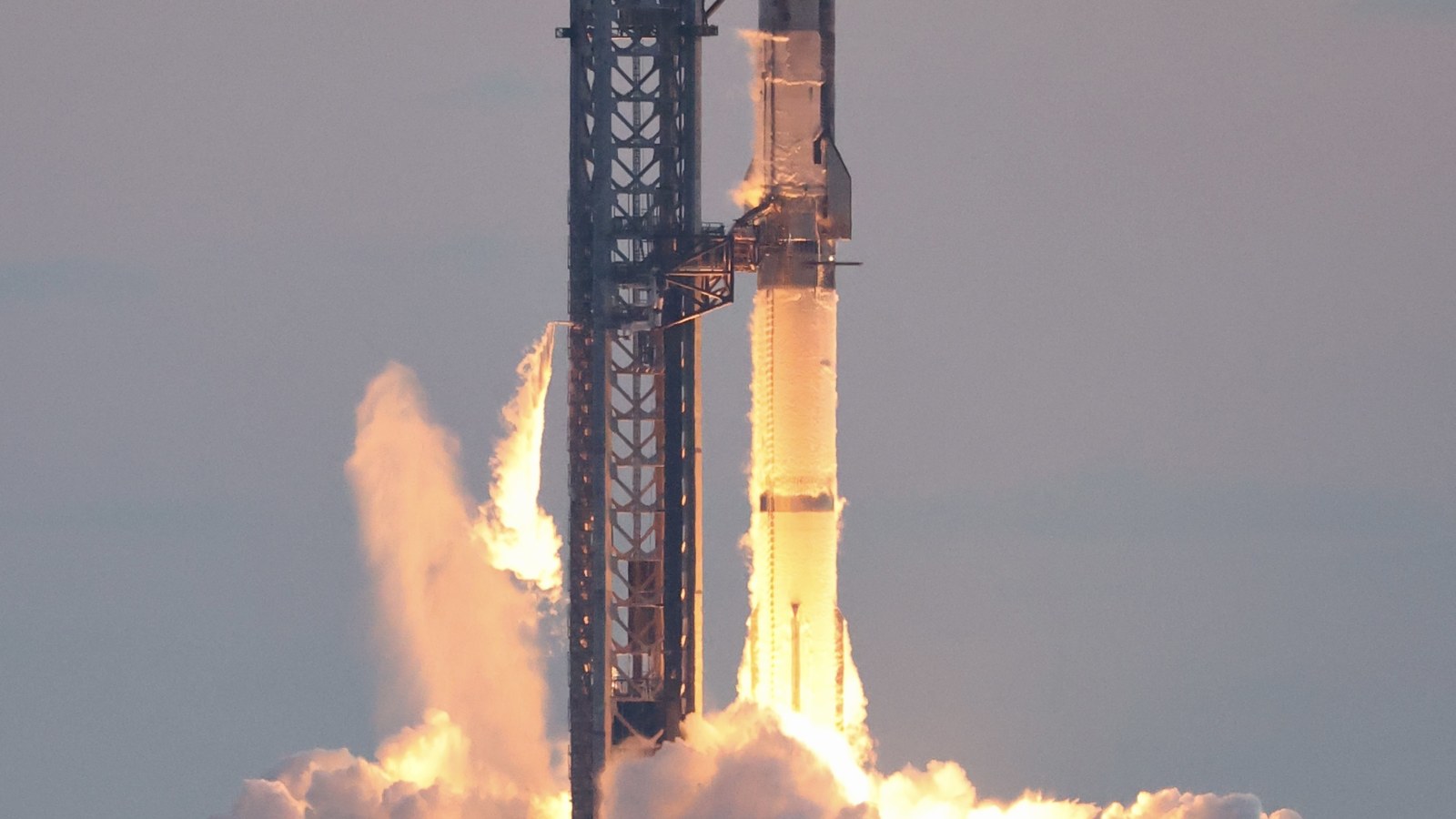
Starship changes the ambition
Starship is the signal that the company is not only selling launches; it is trying to make payload scale and future missions feel normal.
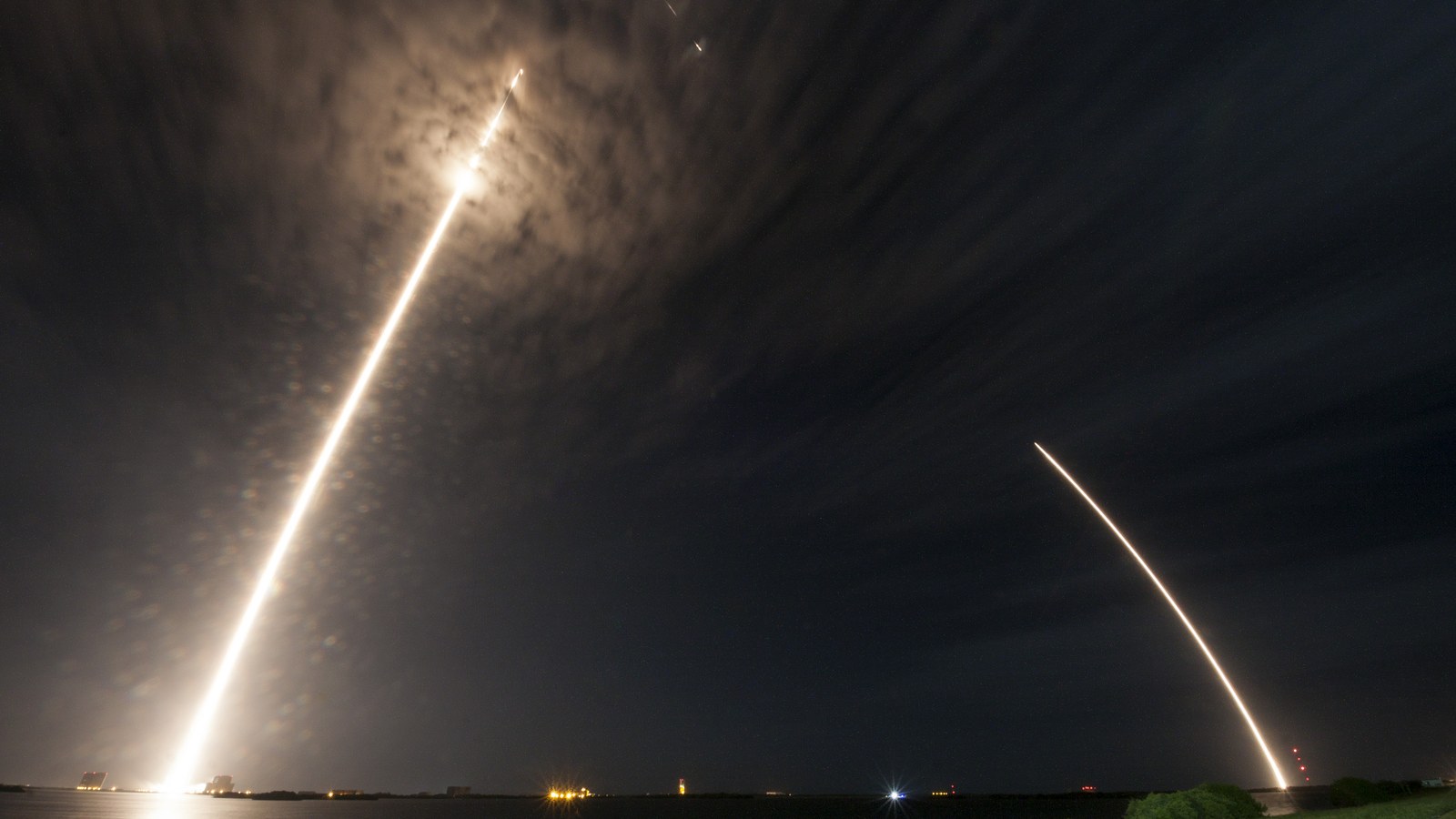
Dragon makes crew and cargo credible
Dragon turns SpaceX from a launch provider into a human-spaceflight and station-logistics brand.
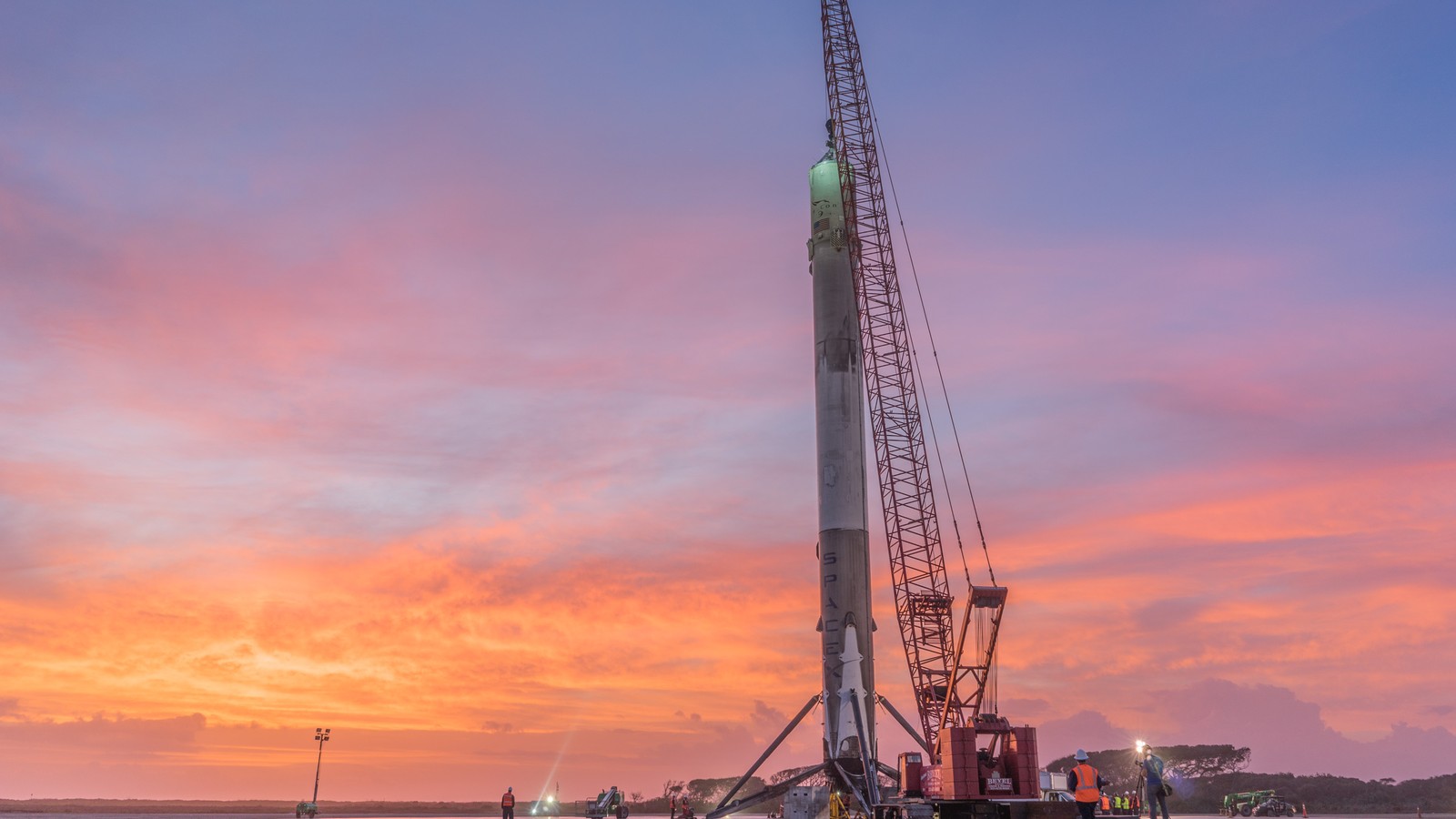
Landing makes reuse believable
The booster on the pad is the repeatable cue that reusable launch is operating proof, not only a presentation claim.
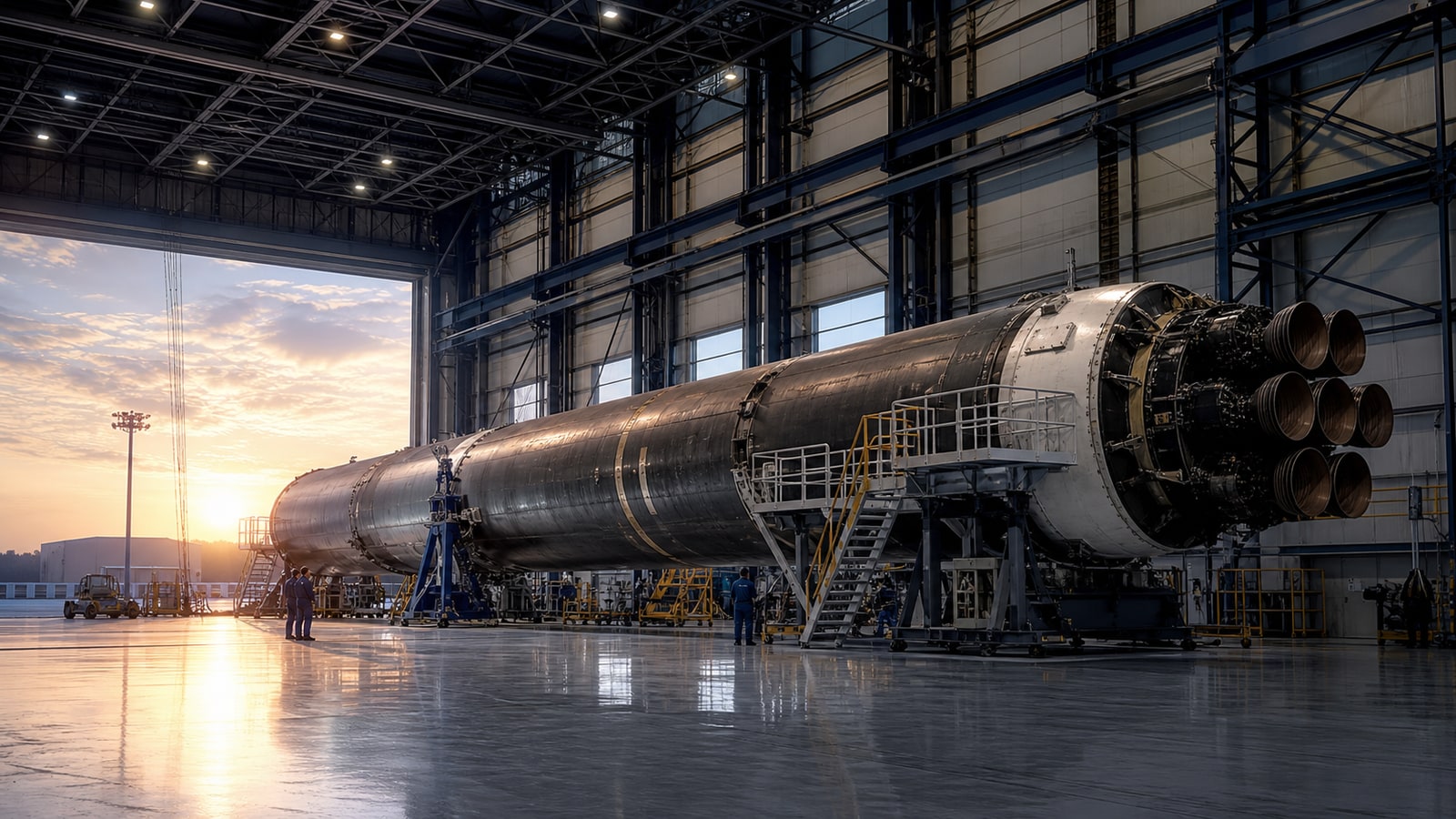
Turnaround makes reuse operational
Maintenance platforms, inspection work, and hangar scale show the operating system behind flying a booster again.
Product and service system
Reusable launch is the visible proof system: rocket, pad, landing, cadence, and payload trust.
Crew and cargo missions make the brand credible in human spaceflight, not only commercial satellite launch.
Flight 14 delivered 26 Starlink V3 satellites on 28 September 2026, giving Starship its first orbital payload proof. Source
Starship's first orbital delivery adds V3 satellites to the connectivity business that already uses Falcon launches. Source
Government and defense space services make the system a national-security infrastructure brand.
Small-sat rideshare and contracted missions keep the commercial access story legible.
Turning points.
Events that changed what buyers could see, buy, repeat, or trust.
Dragon reaches the International Space Station on a commercial resupply mission.
Falcon 9 first-stage landing makes reuse a public proof cue.
SpaceX reflights an orbital-class booster and makes reuse a business argument.
Revenue reaches USD 7.81B and operating loss narrows to USD 143M, while capital spending rises to USD 18.4B.
NASA awarded three additional Crew Dragon missions for USD 946 million, bringing the Commercial Crew contract to 17 missions and USD 5.92 billion, with performance through 2030.
SpaceX reported that Flight 14 reached orbit and deployed 26 Starlink V3 satellites. The flight encountered engine problems and returned earlier than planned.
Reuters valued SpaceX at about USD 2 trillion at the 25 September close. Flight 14 ended after roughly three hours of a planned 10; Reuters described a fireball after its Pacific splashdown. Recovery and reuse were not planned for this flight. The reported goal of 60 V3 satellites per launch remains a future target.
Public reaction.
The useful reaction is about trust and pressure, not sentiment counts.
The strongest SpaceX proof connects launches, reuse, Dragon missions, Starlink service, and Starshield contracts into one operating machine.
The brand weakens when IPO hype, Mars language, AI assets, or social platforms hide launch safety, reliability, and service proof.
Full timeline.
SpaceX is founded by Elon Musk. Source
Falcon 1 becomes the first privately developed liquid-fueled rocket to reach orbit. Source
Falcon 9 launches for the first time. Source
Dragon reaches the International Space Station on a commercial resupply mission. Source
Falcon 9 first-stage landing makes reuse a public proof cue. Source
SpaceX reflights an orbital-class booster and makes reuse a business argument. Source
Falcon Heavy launches and adds heavy-lift spectacle to the proof system. Source
Starlink deployment begins turning launch cadence into a network service. Source
Crew Dragon carries NASA astronauts, making crew transport part of public trust. Source
Starlink opens a wider public beta and moves the brand into homes and terminals. Source
Starshield is introduced for government and national-security customers. Source
Starship integrated flight testing begins. Source
Starship booster catch imagery turns reusability into a new public spectacle. Source
SpaceX is reported to complete the largest IPO by proceeds, moving the brand into public-market scrutiny. Source
SpaceX acquires xAI, including X, and the prospectus recasts the consolidated company across Space, Connectivity, and AI. Source
NASA extends reliance on Crew Dragon Source
Starship delivers its first orbital payload Source
Payload proof meets public-market expectations Source
Steal / avoid.
- Make the operating proof public: launches, landings, terminals, contracts, and missions.
- Give each sub-brand a specific job instead of saying everything is innovation.
- Let a financial superlative increase proof discipline, not replace it.
- Do not reduce SpaceX to rockets only.
- Do not mix Starlink, Starshield, Dragon, and Starship without separating their buyer jobs.
- Do not use fake mission screens, fake logos, or invented spacecraft visuals.
Short answer.
SpaceX builds launch vehicles and spacecraft and operates satellite services. Falcon 9 is a rocket with a reusable first-stage booster; Dragon is the spacecraft it can carry for crew or cargo missions. Starship and Starlink extend that business into a different launch system and a satellite network, with separate milestones and capabilities.
Frequently asked questions
What is the difference between SpaceX Falcon 9 and Dragon?
Falcon 9 is the rocket that launches a payload into space. Dragon is a spacecraft that can ride on Falcon 9 and carry crew or cargo. On a Dragon mission, the rocket and spacecraft perform different jobs: launch propulsion and transport in space are separate parts of the same mission.
Is the whole Falcon 9 rocket reusable?
Falcon 9's first-stage booster is designed for recovery and reuse; its second stage is not recovered for another flight. A booster landing therefore demonstrates reuse of one major part of the launch vehicle, not return of the complete rocket. This distinction matters when comparing Falcon 9 with SpaceX's broader reuse ambitions.
What did Starship Flight 14 actually prove?
It reached orbit and delivered 26 Starlink V3 satellites. It did not demonstrate a routine 60-satellite service or full vehicle reuse.
Does Starlink V3 mean every user gets ten times the speed?
No. Starlink specifies a design capacity of 1 Tbps downlink per V3 satellite, approximately ten times the V2 satellite’s downlink capacity. That is satellite capacity, not a promise to multiply each subscriber’s download speed by ten.
How is Falcon Heavy different from Falcon 9?
Falcon Heavy combines three Falcon 9-derived first-stage boosters side by side, giving it 27 Merlin engines at liftoff. Its extra boosters distinguish it from the single-core Falcon 9. NASA's history of the first flight also shows why recovery and launch success are separate questions: both side boosters landed, but the centre core was lost.
Did SpaceX actually send a Tesla Roadster to Mars?
The Roadster launched on Falcon Heavy's demonstration flight on February 6, 2018. NASA describes its destination as a solar orbit reaching as far as the orbit of Mars. It did not land on Mars or enter orbit around the planet; the car remained attached to the rocket's second stage.
Need help with your own brand?
Use Private brand work when your name, identity, proof, or message needs a sharper branding decision.
Sources.
Use the education shelf for the concepts behind this brand page.
Private brand workIf one technology brand covers vehicles, services, infrastructure, government work, and customer hardware, Private Brand Work can separate each offer without losing the shared mission.
All brandsReturn to every brand page.
- https://www.businessinsider.com/spacex-ipo-live-updates-pricing-spcx-stock-2026-6
- https://www.spacex.com/vehicles/falcon-9/
- https://www.spacex.com/vehicles/falcon-heavy/
- https://www.spacex.com/vehicles/dragon/
- https://www.spacex.com/vehicles/starship/
- https://starlink.com/
- https://www.starshield.com/
- https://www.spacex.com/rideshare/
- https://www.spacex.com/launches/
- https://apnews.com/article/3b7b66a3e522e51d75caebc40af7e09e
- https://www.satellitetoday.com/finance/2026/08/05/spacex-outlines-starlink-mobile-plans-in-first-earnings-report/
- NASA awards three additional SpaceX crew flights
- Starship delivers its first orbital payload
- Payload proof meets public-market expectations
- Starlink V3 satellite design capacity
- https://www.spacex.com/assets/media/falcon-users-guide-2025-05-09.pdf
- https://new.spacex.com/vehicles/falcon-9