Tiffany & Co. · Grow Your Brand · High-recognition / Luxury ritual system · United States / Active / LVMH maison
Tiffany & Co.
Tiffany & Co. makes the box part of the ownership proof. A brand page for Tiffany & Co.: Tiffany Blue, the Blue Box, white ribbon, Fifth Avenue retail memory, the Tiffany Setting, high-jewelry craft, and the lesson that a package gets stronger when the company controls the handoff behind it.
Positioning, name, and architecture.
Three evidence checks before the page talks about scale, color, or public reaction.
Tiffany owns a color-and-box ritual that the buyer recognizes before the jewelry is visible.
Tiffany positions luxury as a controlled handoff: the color, box, ribbon, store, Setting, diamond proof, and gift moment all point to one house.
Tiffany & Co. is a founder name tied to Charles Lewis Tiffany. Tiffany's legacy page also names John B. Young as the cofounder of the 1837 New York store.
Tiffany Blue, the Blue Box, and the handoff ritual carry the public signal more directly than a slogan.
maison inside LVMH Watches & Jewelry
Tiffany works like a house code system: the parent owns the maison, but the buyer-facing memory stays with Tiffany Blue, the box, the Setting, named jewelry families, retail architecture, and gift behavior.
Color, packaging, ribbon, and controlled gift handoff.
House code: Blue Box source
Six-prong setting, diamond light, and engagement authority.
Product system: Tiffany Setting source
T, Lock, HardWear, Knot, and Return to Tiffany create collection memory.
Portfolio: Tiffany T source
Blue Book, Bird on a Rock, artisans, and The Landmark carry the maison's highest craft proof.
Experience system: Blue Book source
Naming and tagline progression
Tiffany, Young and Ellis begins as a New York stationery and fancy goods store.
Blue Book gives the brand an early catalog and color-memory surface.
The Tiffany Setting turns an engagement-ring construction into a named proof object.
Tiffany Blue is registered as a color trademark and standardized with Pantone as 1837 Blue.
Market and scale snapshot.
LVMH does not disclose Tiffany revenue or earnings separately, so the scale view uses the documented USD 15.8B acquisition and current ownership while keeping that historical price distinct from a present valuation.
LVMH does not disclose Tiffany revenue separately.
LVMH does not disclose Tiffany earnings separately.
Historical LVMH completion value in January 2021, not a current Tiffany valuation.
Tiffany has no standalone ticker; its parent is LVMH.
Color system.
Tiffany Blue owns the first read. White gives the handoff precision. Black keeps the wordmark and editorial frame sharp.
How the palette behaves
Tiffany Blue works because it is protected by repetition and behavior: catalog memory, box, store, ribbon, product, and gift moment.
White keeps the ritual clean and lets the box feel precise instead of decorative.
Black gives the wordmark enough authority to keep the blue from feeling like a novelty color.
The color should not be treated as mood. It is a protected cue tied to the way the customer receives the object.
Recognition assets.
Memory pieces the brand can use before someone finishes a sentence.
The color is valuable because it repeats on packaging, retail, product, and gift surfaces.
The box makes ownership visible before the jewelry appears.
The six-prong lift gives the engagement ring a named product behavior.
Scores.
Use these scores to compare recognition, trust, proof, pressure, and risk.
The box and color are fast cues even without the wordmark.
Tiffany Blue is trademarked and tied to Pantone 1837 Blue.
The box and ribbon make the handoff part of the product memory.
The Tiffany Setting and high-jewelry craft keep the signal attached to objects, packaging, and store behavior.
The Landmark, store network, and workshops give the cue real places to operate.
The brand, owner, category, and core assets are clear; standalone financials require care.
LVMH reports group and Watches & Jewelry figures, but not standalone Tiffany revenue.
The color and box are widely copied as an idea; the behavior behind them is harder to copy.
How the logo changed.
Two sourced treatments show the restrained refinement of a wordmark that has stayed unusually stable while Tiffany Blue and packaging carried most recognition.

The high-contrast serif wordmark stayed restrained while the blue box and retail ritual built recognition around it. source

The 2005 refinement sharpened the letterpress character without abandoning the house's established typographic memory. source
Product and service lineage.
Tiffany's useful brand lesson is not color alone. It is the chain from store origin to Blue Book, box, Setting, diamond proof, retail architecture, and controlled handoff.

Service makes the handoff credible
Gloves, tray, lighting, jewelry detail, box, and ribbon make luxury service part of the product experience.
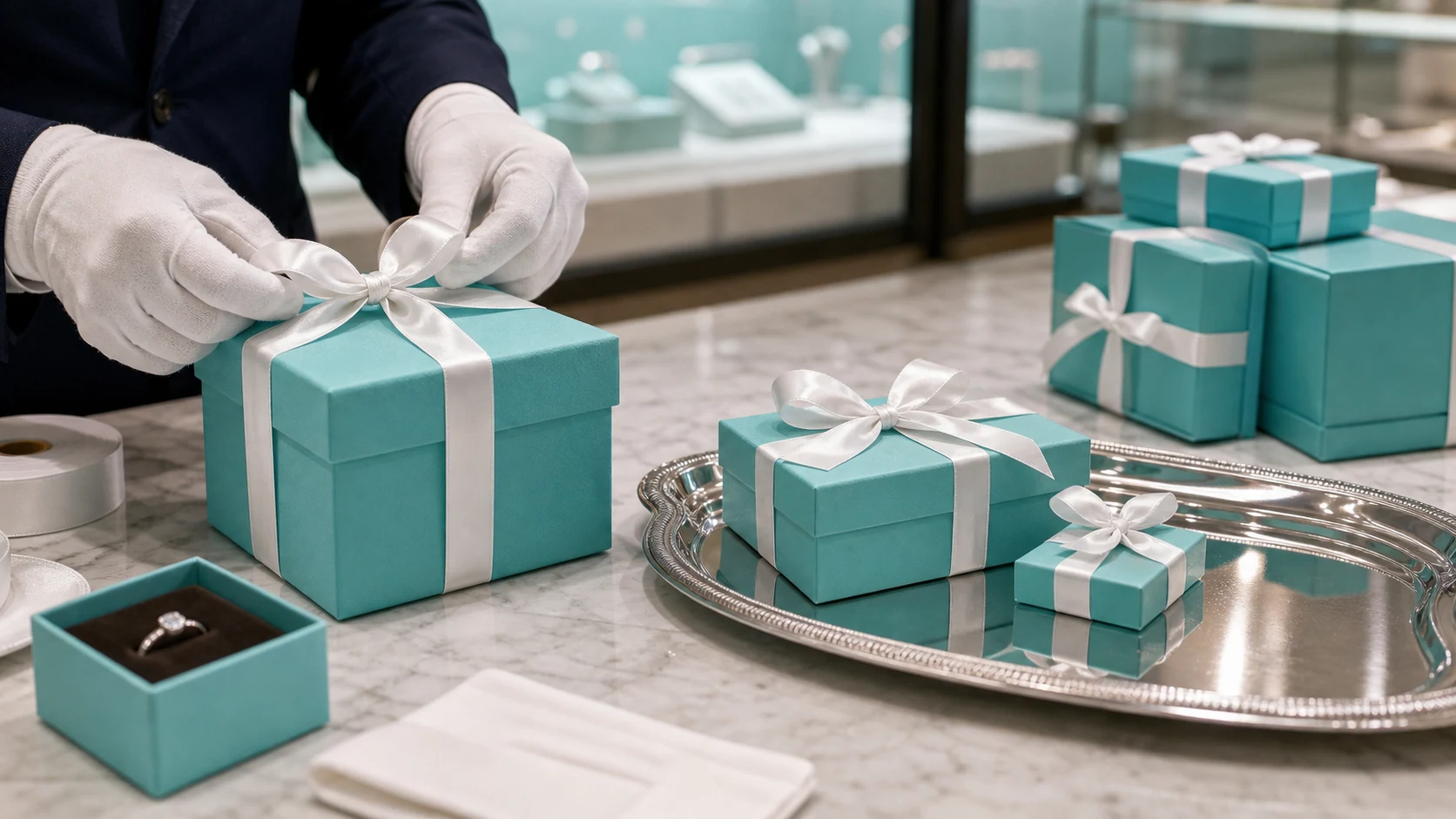
Blue Box ritual
The package works because the company treats the handoff as part of the product.
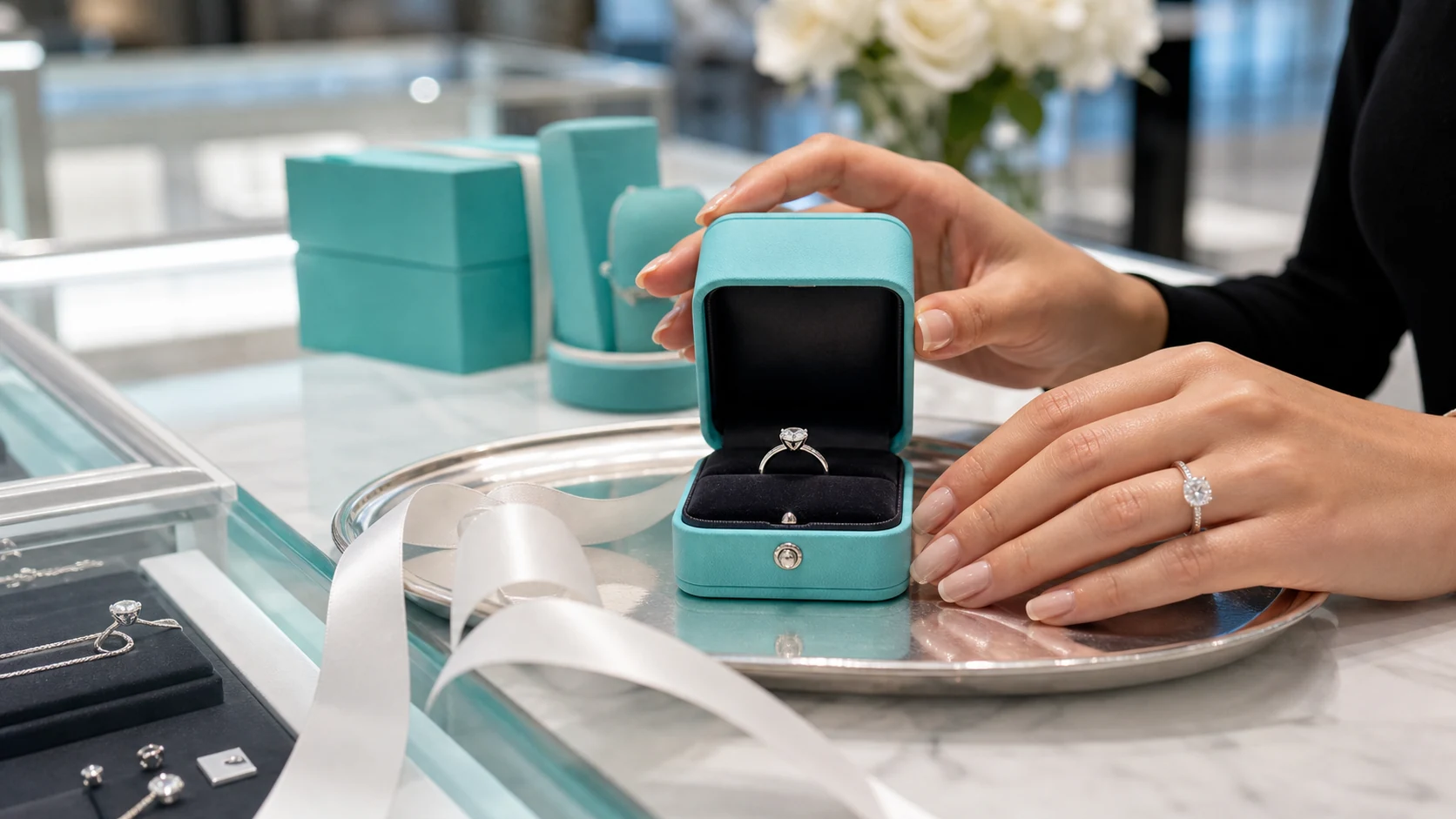
Product proof
The luxury signal has to connect color memory to craft, sourcing, setting, and store trust.
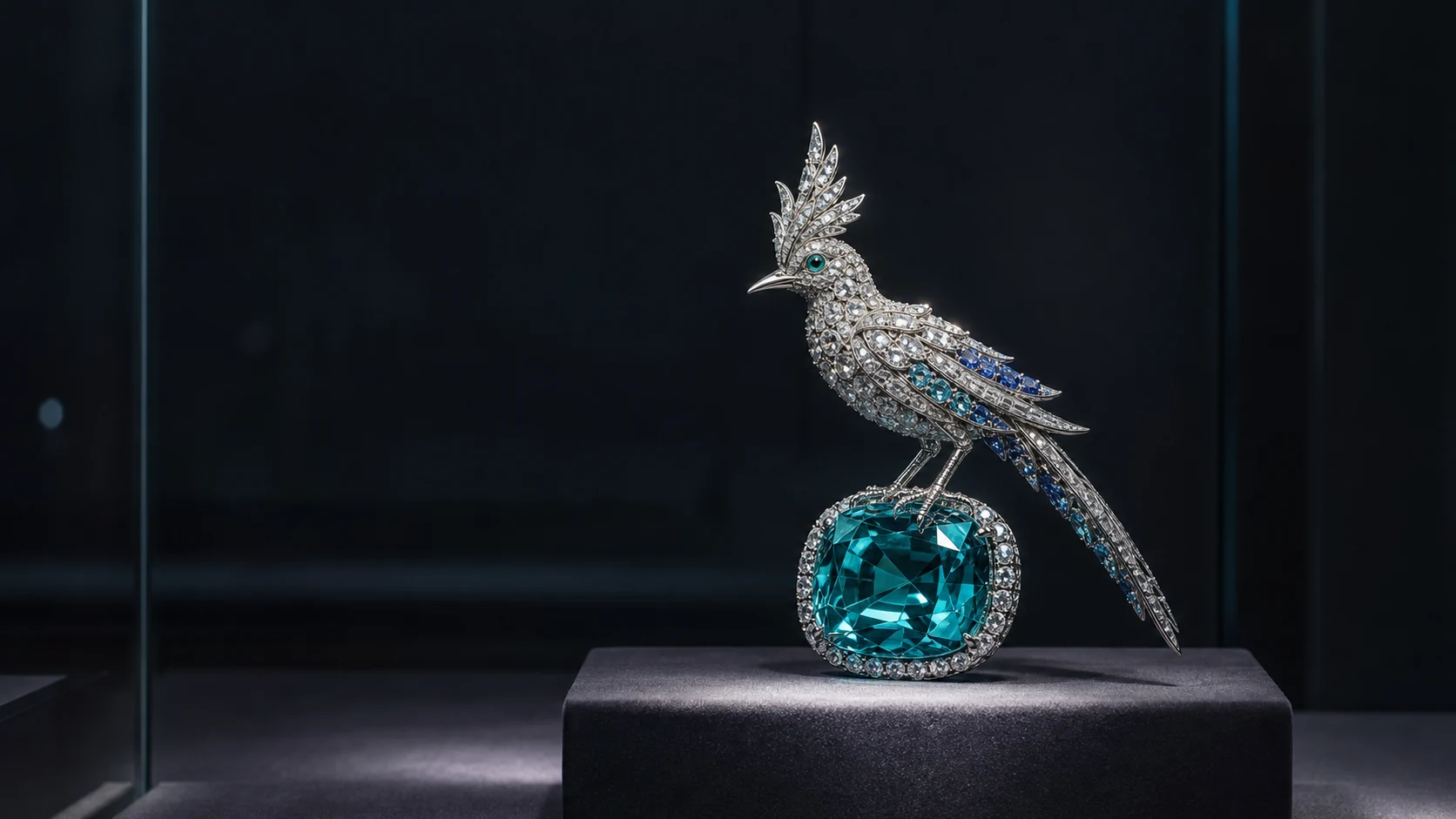
High jewelry carries invention
A Bird on a Rock-style object makes design authorship, stone selection, setting skill, and display theatre visible beyond the blue box.
Product and service system
Charles Lewis Tiffany and John B. Young open a New York stationery and fancy goods store.
The Blue Book gives Tiffany an early direct-mail catalog and a durable color-memory surface.
Tiffany acquires the yellow diamond later known as the Tiffany Diamond, now listed by LVMH at 128.54 carats.
The Tiffany Setting lifts the diamond above the band and gives the engagement ring a named form.
Tiffany cites the New York Sun report that the box could leave only with an article sold by Tiffany.
Tiffany Blue is registered as a color trademark and standardized with Pantone as 1837 Blue.
Tiffany says it began providing provenance information for newly sourced, individually registered diamonds of 0.18 carats and larger.
The Landmark opens after a full renovation of Tiffany's Fifth Avenue and 57th Street flagship.
LVMH reports 345 Tiffany stores worldwide and 4,000 dedicated artisans in Tiffany's workshops.
Turning points.
Turning points only: color, box control, product proof, store scale, and trust pressure.
A box that cannot be bought loose becomes part of the product's proof.
Tiffany Blue gains strength when it stays linked to actual packaging and branded surfaces.
The Tiffany Setting makes a design behavior easy to name and remember.
The owner context gives Tiffany global infrastructure, but the buyer-facing cue still has to feel like Tiffany.
Diamond provenance becomes part of the trust layer when jewelry buyers ask where value comes from.
Public reaction.
No invented sentiment count. Tiffany's reaction pattern is visible in gift behavior: people recognize the box, desire the handoff, and judge the product by whether the promise inside deserves the ritual.
The buyer, recipient, and observer can understand the gift before the object is opened.
A similar blue box can look familiar, but it does not carry Tiffany's store rule, product proof, or house trust.
Full timeline.
The New York store opens under Charles Lewis Tiffany and John B. Young.
Blue Book gives Tiffany a catalog memory surface.
The Tiffany Diamond enters the house story and is later cut to 128.54 carats.
The Tiffany Setting gives engagement rings a public product proof.
Tiffany cites the box rule that ties the package to an article sold by the house.
Tiffany Blue is registered as a color trademark.
Pantone standardizes the Tiffany color as 1837 Blue.
Tiffany begins diamond provenance disclosure for newly sourced, individually registered diamonds of 0.18 carats and larger.
The Landmark opens after the Fifth Avenue flagship renovation.
LVMH key figures show owner scale and Watches & Jewelry group scale.
Steal / avoid.
- Make the handoff part of the product memory.
- Protect a color by tying it to repeated real surfaces.
- Give product proof a name buyers can repeat.
- Let packaging carry trust only when the company controls the behavior behind it.
- Use restraint so the signal feels owned, not loud.
- Do not copy a color without copying the operating discipline behind it.
- Do not let packaging become more credible than the product.
- Do not turn luxury ritual into loose decoration.
- Do not imply standalone financial scale when only owner-level data is public.
- Do not make the wordmark do work the color, box, store, and product should carry.
Short answer.
Tiffany & Co.'s brand signal is Tiffany Blue, the Blue Box, the white ribbon, the Tiffany Setting, and the controlled gift handoff around them. The useful lesson is that packaging becomes a brand asset when it is tied to product proof, store behavior, sourcing trust, and a rule the company keeps enforcing.
Frequently asked questions
What is Tiffany & Co.'s core brand signal?
Tiffany & Co.'s core signal is the controlled ownership ritual around Tiffany Blue, the Blue Box, white ribbon, store handoff, the Tiffany Setting, and jewelry proof.
What should another brand steal from Tiffany & Co.?
Make one recognizable surface carry real behavior. The package, color, and handoff should prove something the customer can trust.
What should another brand avoid copying from Tiffany & Co.?
Do not copy the color or box if the product, service, store experience, and ownership rules cannot support the signal.
Need help with your own brand?
Use Private brand work when your name, identity, proof, or message needs a sharper branding decision.