Mars
01
Petcare, snacking, food, and veterinary trust sit with front-facing brands while the private parent carries standards and ownership discipline.
Portfolio System / 1911-present
Branding guide · evidence and decision
A parent company can organize brands. It cannot replace the proof each public brand still has to earn.
decision · proof · use
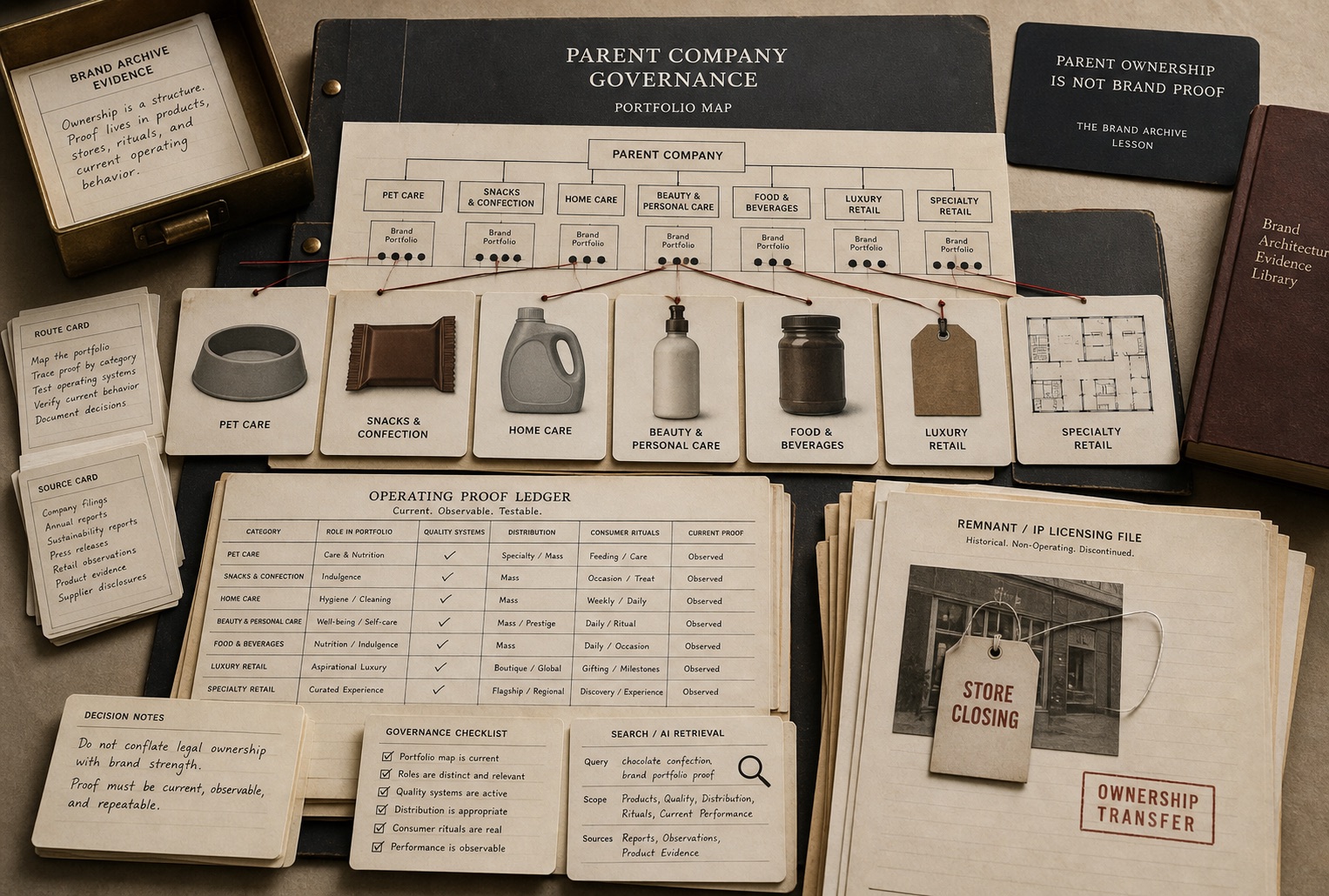
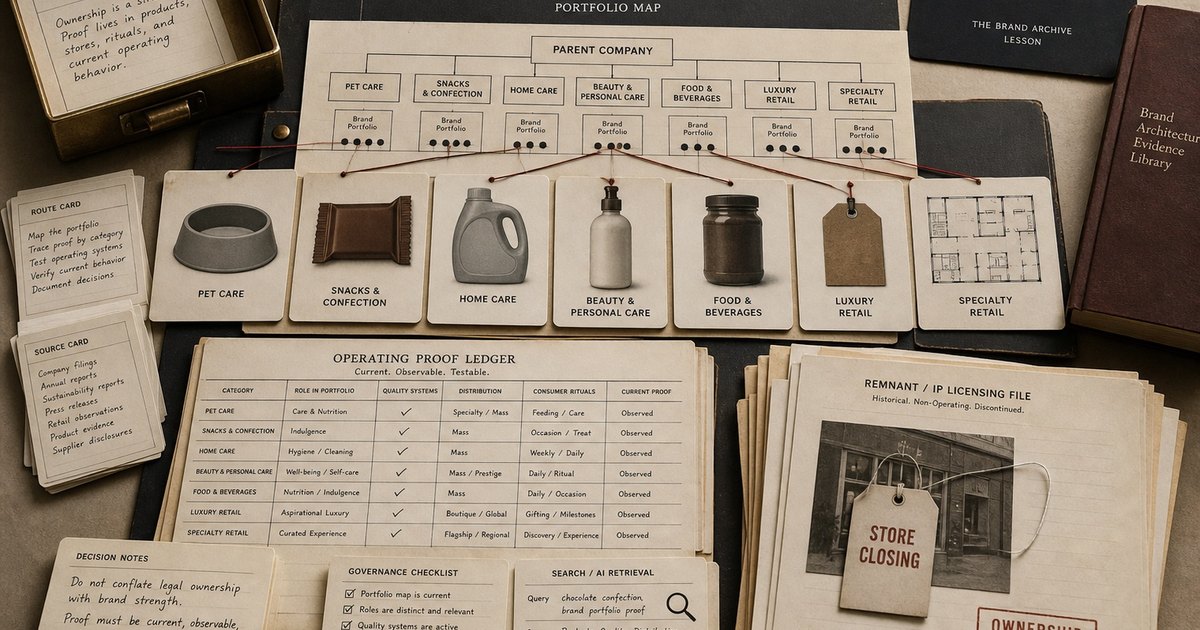
Parent ownership can explain who controls a brand. It does not prove that the brand still works. A holding company, corporate parent, or license owner still needs live proof in the product, store, service route, quality system, customer ritual, or recovery path customers can see.
"Grow Your Brand defines parent ownership is not brand proof as the rule that legal ownership, parent-company scale, and portfolio structure do not replace current product, service, retail, quality, or ritual proof."
Use ownership to explain control, then look for the public proof customers actually use.
Portfolio structure matters, but customers usually meet proof through the front-facing brand. When the operating route weakens, a name can become an asset on a licensing file instead of a working business.
The mistake is treating a famous owner, acquisition, license, or portfolio map as proof that the brand still has demand.
Ownership explains control. It does not automatically explain why customers choose.
Parent ownership is often confused with brand strength. A parent can provide capital, governance, distribution, sourcing, shared services, standards, or licensing control, but the customer may still choose the front-facing brand for a different reason.
P&G, Unilever, Mars, LVMH, Marriott, and Yum all show portfolio logic. The parent can matter, but it does not replace category proof. Shampoo, pet food, luxury, hotels, and restaurants are bought in different moments with different risks.
The bad example is using ownership as the answer. Saying a brand is strong because a famous parent owns it skips the customer question: what does the buyer see, trust, repeat, search, compare, and pay for?
A failed brand can also retain ownership value. The parent may hold trademarks, archives, licensing routes, or nostalgia value after the original operating proof is gone. That is asset value, not proof that the old business still works.
Parent visibility should depend on the job. In some categories the parent reduces risk. In others it creates clutter or weakens local meaning. Architecture has to decide when the parent speaks and when it stays backstage.
The operator test is to separate legal control from buyer evidence. Write what the parent owns, what the customer uses, what the product proves, and where trust is created. Those may be four different places.
Do not let ownership language replace proof language. A portfolio is strongest when each brand has a clear customer job and the parent role makes that job easier to trust.
Use the page as a worksheet, not a quote bank. Write the case, the customer moment, the proof surface, and the mistake in four columns. If the proof surface is blank, the lesson is still too vague to guide a decision.
The bad copycat move usually happens when a team borrows the visible artifact and ignores the constraint that gave it value. The artifact can be a logo, color, parent brand, platform word, service claim, operating ritual, category label, or nostalgia cue.
The stronger move is to name the constraint first. What risk did the customer face? What behavior did the brand reduce, protect, or repeat? What public evidence could a buyer inspect without hearing an internal explanation?
A lesson should also name the failure mode. The cue can be deleted too early. The habit can move before the company reacts. The platform can lose gravity. The parent can over-speak. The category can remain a slogan. The operation can break the promise it once proved.
Before approval, compare at least three cases that sit near the decision. One case gives a story. Three cases reveal the mechanism. If the cases disagree, the team should narrow the rule instead of forcing a universal lesson.
The practical output should be a stop rule. Decide what evidence would pause the launch: recognition loss, source confusion, customer support friction, weaker search language, channel pushback, failed usability, lower repeat behavior, or a trust complaint tied to the core promise.
The page should help a reader act in a meeting. A strong lesson gives the sentence someone can say before budget moves: protect this cue, prove this claim, keep the parent quiet, show this handoff, repair this source, or do not launch this language yet.
the guide standard is evidence before advice. A lesson earns its place when the reader can open the named files, see the same pressure appear more than once, and leave with a test that would catch a bad brand decision before it becomes public.
The final check is whether the rule survives a skeptical customer. If the customer would ask for clearer proof, simpler choice, safer recovery, better continuity, or a route that actually works, the lesson has to answer that before it answers the brand team.
A final pass should ask what would make the decision expensive if it went wrong. The expensive part is rarely the sentence on the page. It is the lost recognition, support burden, channel confusion, weak source trail, customer doubt, or habit shift that follows.
Use the lesson to write a short decision memo. One paragraph should name the current proof, one should name the risk, one should name the case pattern, and one should name the stop rule. If the memo cannot be written plainly, the decision is not ready.
The reader should leave with something sharper than inspiration. They should know what to protect, what to test, what to publish, what to compare, and what to stop doing before the brand spends money teaching the market a weaker habit.
This is also how the page avoids commodity SEO. The value is not a longer definition. The value is the named mistake, the specific bad example, the consequence, and the practical decision test a team can reuse.
When the lesson is used properly, it changes the next meeting. It gives the team a way to challenge a pretty surface, a broad claim, a portfolio chart, a platform story, or a nostalgic revival before the market has to pay for the mistake.
That is the reader value: fewer slogans, fewer copied surfaces, and more decisions tied to proof customers can inspect.
Each row links to a public brand pages. The case is here because it proves the rule under pressure.
01
Petcare, snacking, food, and veterinary trust sit with front-facing brands while the private parent carries standards and ownership discipline.
Portfolio System / 1911-present
02
Separate household brands own separate use moments instead of forcing one parent promise onto every shelf.
Brand System / 1837-present
03
Portfolio focus only works when local category brands keep usable proof close to the customer.
Brand System / 1929-present
04
Beauty science and portfolio scale need different brand roles for salon, mass, luxury, and dermatology choices.
Brand System / 1909-present
05
Food trust has to stay visible at breakfast, coffee, snack, water, nutrition, and pet-care moments.
Trust / 1866-present
06
Luxury portfolio control works when maisons keep their own memory while the parent carries governance.
Portfolio System / 1988-present
07
A loyalty umbrella can simplify a portfolio only if points, status, redemption, service, data, and app access stay trusted.
Trust / 2016-2019
08
The name retained luxury memory as IP after the old store system failed.
Failure / 1923-2019 / licensed brand asset
Use this as a pressure test before the same pattern becomes an expensive mistake.
The weak copy takes the visible asset and skips the constraint. A stronger reader asks what customer behavior, proof surface, recognition cue, or trust risk made the case work or fail.
Use the page to decide what must be protected before money moves: the name, cue, promise, proof, channel, page, package, or customer habit.
The useful output is not a prettier opinion. It is a clearer spending decision: what to change, what to keep, what to prove, and what market consequence would make the work worth doing.
No. A strong parent can provide capital, standards, governance, or distribution, but the public brand still needs proof customers can see.
The risk is flattening different customer jobs into one parent story or mistaking legal ownership for live demand.
Yes. A failed operating business can still leave a name, memory, trademark, or licensing asset behind.
check where the customer sees proof today: product, store, service, app, quality system, loyalty route, or recovery path.