Brand case guide · evidence and decision
WhatsApp Brand System Guide
A messaging brand became a default communication layer by making identity simple, private chats familiar, and encryption visible enough for ordinary users.
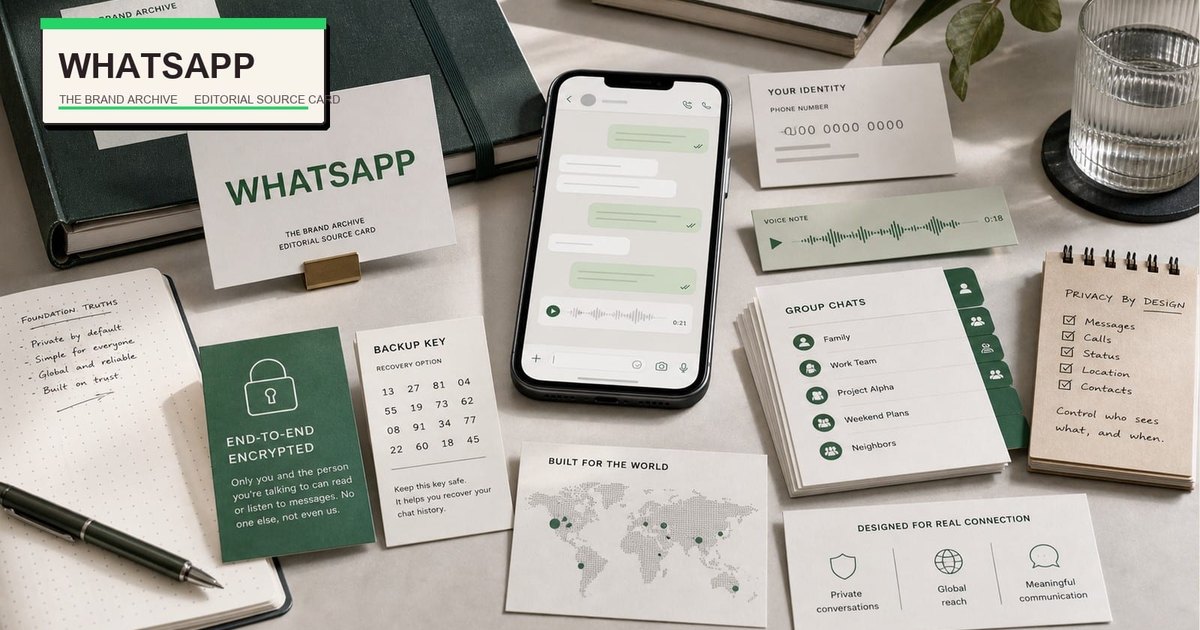
Whatsapp Private Messaging Encryption System
decision · proof · use
Short Answer
WhatsApp Brand System Guide is a trust case about WhatsApp in 2009-present. A messaging brand became a default communication layer by making identity simple, private chats familiar, and encryption visible enough for ordinary users to repeat. Trust in communication tools is built from defaults. If the app asks people to talk to family, workers, sellers, schools, and groups, the identity model, encryption model, backup model, reporting model, and interface all become part of the brand.
What WhatsApp teaches
- WhatsApp reported more than 2 billion users in 2020.
- Meta said WhatsApp added end-to-end encryption by default in 2016.
- The company said end-to-end encryption protected more than 100 billion messages a day by 2021.
- The brand system is phone-number identity, simple chat behavior, groups, voice, calls, encryption, and backup choices.
- The operator lesson is to make the safest behavior the default when the product carries private communication.
What Changed
A messaging brand became a default communication layer by making identity simple, private chats familiar, and encryption visible enough for ordinary users to repeat.
The change forced the market to decide whether the old shortcut still worked, whether the new proof was strong enough, and whether the brand had made the category easier or harder to understand.
The Decision Context
Messaging apps have to earn behavior before they earn attention. People open them for family, work, trades, schools, travel, small business, and daily coordination. The brand has to disappear enough to let the message matter.
WhatsApp won that behavior by keeping the identity model simple. A phone number was enough. The contact graph was already on the device. The interface stayed plain, and the service became useful across borders where SMS and carrier habits did not solve the same problem.
Privacy Became The Public Promise
WhatsApp's official 2020 note said every private message sent on the service was protected with end-to-end encryption by default. Its 2021 backup announcement said the app protected more than 100 billion messages a day as they traveled between more than 2 billion users.
That kind of claim has to be handled carefully. Encryption does not remove every privacy question around backups, metadata, businesses, reports, or platform ownership. The brand lesson is narrower and more useful: a communication product needs security defaults users can understand before a crisis forces them to learn.
The Interface Stayed Ordinary
WhatsApp's strength is how little it asks from the user. Chats, groups, voice notes, calls, images, delivery marks, and phone contacts all sit in a familiar pattern. That ordinary surface matters because private communication is not a special event.
The product's visual identity is also restrained: green, chat, phone, check marks, groups. The brand does not need a heavy explanation every time someone sends a message. It needs the message to arrive, stay understandable, and feel private enough to use again.
the guide Reading
WhatsApp belongs in the guide because it shows how a trust brand can be built from defaults rather than speeches. The user does not want to manage a security architecture every morning. The user wants the private channel to behave as expected.
For operators, the lesson is to make the trust contract concrete. Tell people what is protected, what is not, where backups live, how reporting works, and which parts of the service depend on device, cloud, business, or platform choices.
Before copying WhatsApp, test the proof.
WhatsApp is useful only if the reader can see the constraint, the proof, and the failure mode. The page should make those three things inspectable.
- Name the real customer or market risk: users depend on the system to work in ordinary moments, not in brand campaigns.
- Find the proof surface: daily usage, uptime, distribution, account trust, partner tools, switching cost, and recovery when the service fails.
- Separate the visible cue from the operating proof. The cue is not enough on its own.
- Write the bad version of the strategy: talking about scale, innovation, or ecosystem reach while hiding the exact behavior people repeat.
- check the failure mode: the name becomes large but less useful because the user cannot tell which part of the system solves the problem.