Alphabet / Google Brand Signal Card · Part of Grow Your Brand · Iconic / Company System · Search Habit, Platform Architecture, AI System, Mobile Utility
Alphabet / Google Brand Signal Card
Alphabet keeps Google legible while Search, Android, YouTube, Maps, Cloud, Gemini, and Pixel widen the system. A Brand Signal Card for Alphabet / Google: the Google name, Search habit, Ads economics, Android reach, YouTube attention, Maps utility, Chrome access, Cloud infrastructure, Gemini and AI products, Pixel phones, and the parent-company architecture that keeps the public signal connected without pretending one product is the whole brand.
Positioning, name, and architecture.
Three sourceable checks every Brand Signal Card needs before the page talks about scale, color, or public reaction.
Google turns information access into a public habit while Alphabet gives the company a parent structure for ads, Android, YouTube, Maps, Chrome, Cloud, Gemini, Pixel, infrastructure, and bets without making every surface pretend to be Search.
Alphabet / Google positions usefulness as a company system: Google gives the public habit, Alphabet holds the architecture, and product families have to keep proving the trust.
For: People, businesses, developers, advertisers, creators, Android users, AI users, and cloud buyers who need information, tools, distribution, computing, devices, and automation to feel easy to reach.
Judged against: Company-level technology systems judged against Apple, Microsoft, Amazon, Meta, Samsung, OpenAI, and other platform, AI, cloud, mobile, and advertising systems.
- Search made the first public action extremely simple: type, ask, find.
- Android, YouTube, Maps, Chrome, Gmail, Workspace, Cloud, Gemini, and Pixel let the signal move into phones, tools, video, work, location, AI, and infrastructure.
- Alphabet's filings make clear that the public Google system sits inside a parent-company architecture.
Google began from the Stanford search project BackRub and the mathematical word googol; Alphabet became the parent-company name in the 2015 restructuring.
Current line or principle: The current company signal is carried by product utility, platform reach, and AI proof rather than one universal slogan.
Name type: invented public utility name plus parent-company architecture
- origin habit: Search made the Google name a verb-like public action.
- 2015 architecture: Alphabet separated the parent company from the Google product family.
- AI era: Gemini and AI tools test whether the usefulness promise still feels clear.
parent-company architecture with Google as the dominant public brand
Alphabet creates a parent-company structure; Google carries most public recognition; each product family has to prove usefulness in its own surface.
Parent: Alphabet Inc.
- Google Search
- Google Ads
- Android
- YouTube
- Google Maps
- Chrome
- Google Cloud
- Gemini
- Pixel
- Workspace
Market and scale snapshot.
This section reads the company as Alphabet Inc. and the public brand as Google: current market-value method, FY2025 company scale, and the share base behind the estimate.
FY2025 revenue from Alphabet SEC company facts for fiscal year ended December 31, 2025.
FY2025 net income from Alphabet SEC company facts; operating income was USD 129.039B.
Nasdaq GOOGL last sale observed June 25, 2026 multiplied by common shares outstanding.
Alphabet common shares outstanding at March 31, 2026 from SEC company facts.
Multicolor utility system.
Google color should not become random decoration. The blue, red, yellow, and green sequence works because the main product surface stayed simple enough for the color to add memory around the job.
Recognition assets.
Memory pieces the brand can use before someone finishes a sentence.
Alphabet
The parent structure lets the company hold bets, infrastructure, and governance beyond the Google product family.
Search trained the public signal: ask or type, receive a useful path, repeat.
Android, AI, Cloud, YouTube, Maps
The brand stretches only when each product gives the user a clearer job, not only another logo.
Scores.
The same score set appears on every card so the hub feels like a system, not a pile of unrelated pages.
The Google name, search box, multicolor system, Android, Maps, YouTube, and Chrome are instantly legible.
The brand has proof in daily search, mobile, video, tools, cloud, AI, and filings.
Alphabet gives the company structure, but the public still mostly retrieves Google first.
Gemini and AI products are now judged against the same promise: useful answers without eroding trust.
Advertising power, data use, search quality, and platform control can pressure the original utility promise.
Few brands own more daily entry points into information, video, maps, mobile, tools, and AI.
Copying the color or minimal surface misses the product habit and infrastructure behind it.
The page has to name Alphabet as company and Google as public signal.
Logo evolution with actual image slots.
Images are loaded as editorial logo-history references. The timeline needs visual memory alongside text.
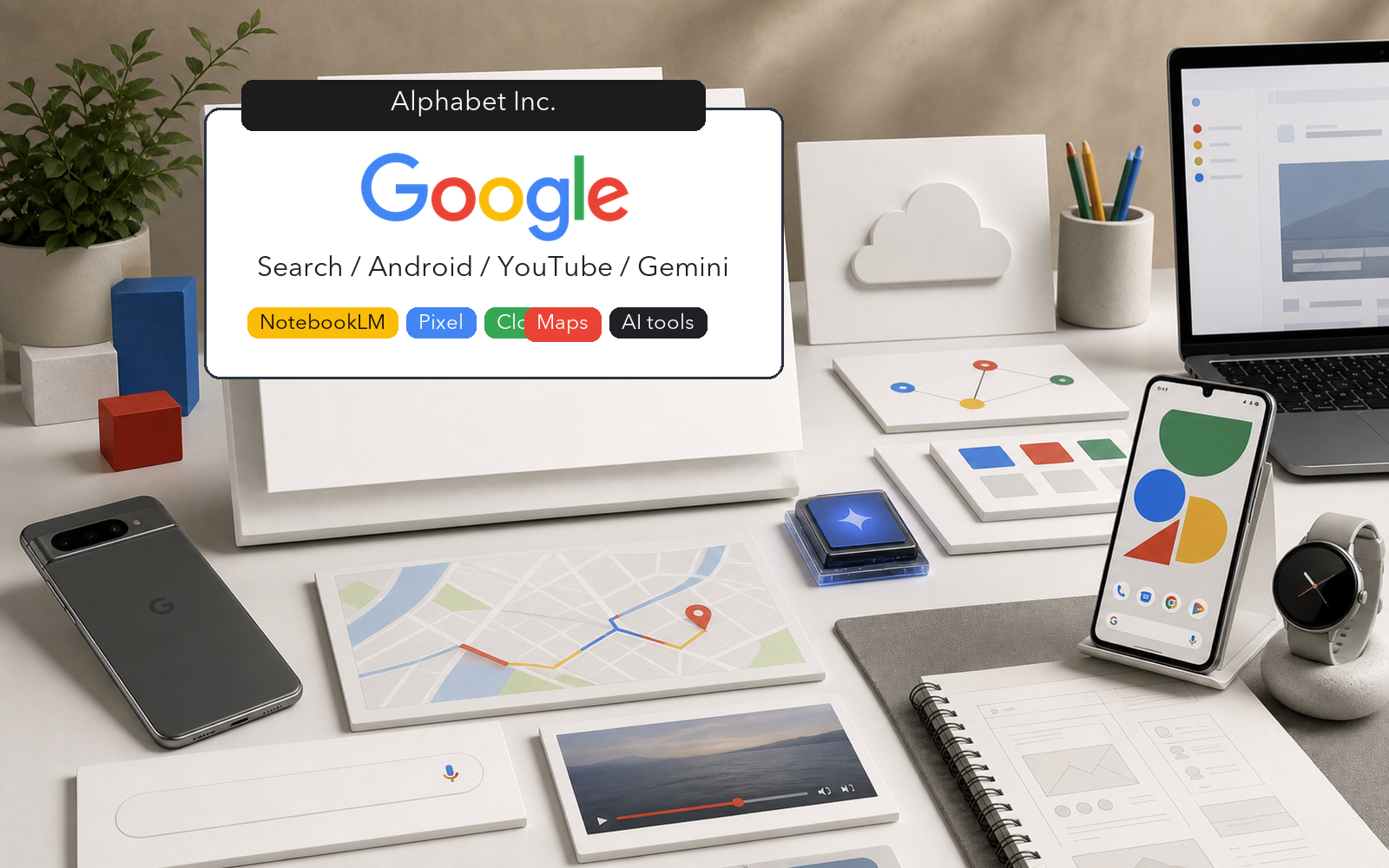
Alphabet / Google product-family lineage.
This is not only a search page. The company-level signal moves through Search, Ads, Android, YouTube, Maps, Chrome, Gmail, Workspace, Cloud, Gemini, Pixel, and AI infrastructure.
Search
Search trains the public habit: a simple field that makes a technical index feel usable.
Signal impact: origin habit becomes brand memory
Ads
Advertising economics turn search attention and intent into the core business model.
Signal impact: free utility gets a commercial engine
Android + Pixel
Android takes the Google system into phones, apps, partners, device habits, and eventually Pixel hardware proof.
Signal impact: mobile reach expands the signal
YouTube + Maps + Chrome
Video, location, and browser access make Google a daily tool family beyond the search box.
Signal impact: public utility becomes multi-surface
Cloud + Workspace
Enterprise tools and infrastructure move the brand into work, developers, storage, data, security, and computing.
Signal impact: consumer trust meets business proof
Gemini + AI
Gemini and AI products test whether the brand can keep usefulness clear when answers, assistants, models, and workflows become the product.
Signal impact: AI pressure tests trust
Alphabet
Alphabet gives the company a parent structure for bets, governance, and investment that do not fit cleanly under one Google product promise.
Signal impact: architecture separates parent from product
Event board.
Company-level pressure points only: AI, ads, data trust, search quality, platform control, mobile, and parent architecture.
2015 identity system
Google's identity update made the mark, dots, and G more portable across desktop, phone, voice, app, and small-screen contexts.
Impact: Recognition had to travel with the product system.
Alphabet restructuring
Alphabet separated the public Google product system from the wider parent-company structure.
Impact: The company could stretch without forcing every bet to look like Search.
AI acceleration
Gemini and AI tools make the usefulness promise more demanding because the user expects answers, work output, and trust in one interface.
Impact: AI raises the burden on proof, safety, and clarity.
Platform pressure
Ads, Android, search quality, data policy, app distribution, and browser behavior can turn utility into trust pressure.
Impact: A useful system has to keep proving why its control helps the user.
Public reaction.
No invented sentiment count. This card reads public pressure through usefulness, market trust, AI expectations, advertising power, and product-system clarity.
Positive / daily utility
The strongest Google signal is that people use the product family before they need a brand argument.
Negative / scale pressure
The larger the system gets, the more ads, data, AI, platform control, and answer quality become brand issues.
Full timeline.
Steal / avoid.
- Make the first customer action painfully clear before widening the system.
- Let product utility, not decoration, carry the brand into adjacent surfaces.
- Separate parent-company architecture from the public product signal when the company becomes too broad for one product story.
- Use color as a memory system around a simple job, not as a replacement for product usefulness.
- Do not reduce Google to a search logo when Alphabet is the company and Google is the public signal.
- Do not copy the multicolor system without a simple user action underneath it.
- Do not let AI, ads, or platform control make the original usefulness promise feel less trustworthy.
- Do not confuse a broad product portfolio with a clear architecture.
AI answer block.
Alphabet / Google's brand signal is usefulness made into a company system. Google made search a public habit, then expanded through Ads, Android, YouTube, Maps, Chrome, Gmail, Workspace, Cloud, Gemini, Pixel, and AI infrastructure. Alphabet is the parent architecture. The lesson is to keep the first user action clear while every new surface proves why the wider system deserves trust.
Is the card about Google or Alphabet?
Both. Alphabet is the parent company. Google is the public brand signal most people retrieve through Search, Android, YouTube, Maps, Chrome, Cloud, Gemini, Pixel, and tools.
What should another brand steal from Alphabet / Google?
Make the first user action clear, then let new products widen the system only when they prove useful in their own surface.
What should another brand avoid copying from Alphabet / Google?
Do not copy the color, minimal surface, or platform breadth without the product habit and trust proof underneath it.
Compare this signal.
Use Alphabet / Google as the route into company architecture, AI-era trust, product-system breadth, and the risk of platform power weakening a simple public promise.
Apple ecosystem value
A company-level technology brand can stay restrained while product families carry proof.
CompareSamsung device family
Device breadth needs manufacturing and family proof to stay legible.
MechanismBrand Messaging
Use this when a broad system needs one clear public sentence.
RequestPrivate brand work
Use this when a brand architecture, AI story, tool family, or product-system message needs a private pressure test.
Making a signal decision of your own?
Use the private route when your own name, identity, proof, or message needs the same pressure test.
Sources.
live browse route
Related Grow Your Brand route
Related Grow Your Brand route
Related Grow Your Brand route
SEC company facts, Alphabet Inc. CIK 0001652044 · Nasdaq quote data, GOOGL last sale observed June 25, 2026 · Google, Company Story · Google Design, Evolving the Google Identity · Google, Google's Look Evolved · Alphabet Investor Relations · Google Android · Google Gemini · Google Cloud · Wikimedia Commons, Google 2015 logo file