IKEA Brand Signal Card · Part of Grow Your Brand · Global / Customer-Operated Retail System · Customer-Operated Retail, Value System, Home Assembly, Store Path
IKEA Brand Signal Card
IKEA made low-price furniture credible by making the customer part of the operating model. A Brand Signal Card for IKEA: blue-and-yellow store memory, showroom path, flat-pack logistics, self-service pickup, food, product names, assembly instructions, and the lesson that price works only when the whole system explains it.
Positioning, name, and architecture.
Three evidence checks every Brand Signal Card needs before the page talks about scale, color, or public reaction.
IKEA makes the value promise visible in the whole buying path: home settings, flat packs, pickup, food, transport, assembly, returns, and repeat planning.
IKEA positions home furnishing as a shared job: the company designs, sources, packs, displays, and prices; the customer chooses, carries, assembles, and lives with the result.
For: People furnishing real homes who want acceptable design and function at a low total price, and who will trade store time and assembly effort for cost control.
Judged against: Home furnishing retailers, big-box retail, online furniture sellers, home-improvement stores, and local furniture shops.
- IKEA Global states the business idea around well-designed, functional home furnishing at prices as many people as possible can afford.
- The How We Work page reports 504 IKEA stores in 63 markets and explains the franchise system behind the brand.
- FY25 reporting shows the model still works at scale: USD 51.16 billion equivalent in retail sales, 222,000 co-workers, and 28% online sales.
IKEA was registered as a trading company by Ingvar Kamprad in 1943. As a public name, it works like a short founder-and-place code rather than a literal furniture description.
Public signal: The business idea is the durable line: well-designed, functional home furnishing at prices many people can afford.
Name type: acronym / founder-place code
- 1943 registration: IKEA starts as a trading company.
- Current business idea: Affordable, functional home furnishing for the many people.
franchise brand system
The brand is held together by one retail idea while stores are operated through franchisees across markets.
Parent: Inter IKEA Systems B.V. is the franchisor for the IKEA brand.
- IKEA stores
- IKEA food
- IKEA Family
- IKEA for Business
Market and scale snapshot.
This section reads IKEA as the global IKEA retail system: Inter IKEA Systems B.V. as franchisor, franchisees in 63 markets, FY25 retail sales, store count, online share, and co-worker scale.
FY25 IKEA retail sales converted to USD equivalent using the FRED DEXUSEU 18 Jun 2026 reference rate.
IKEA Global reports 504 stores in 63 markets, updated 28 Nov 2025.
FY25 co-worker count from the IKEA Global year review.
FY25 online sales share from the IKEA Global year review.
Color signals.
IKEA blue and yellow are not decoration. They make the building, sign, bag, website, and product tag feel like one retail system.
Recognition assets.
Memory pieces the brand can use before someone finishes a sentence.
Blue box, yellow signal
The palette works because it appears on buildings, signs, bags, tags, web surfaces, and the primary mark.
The showroom path
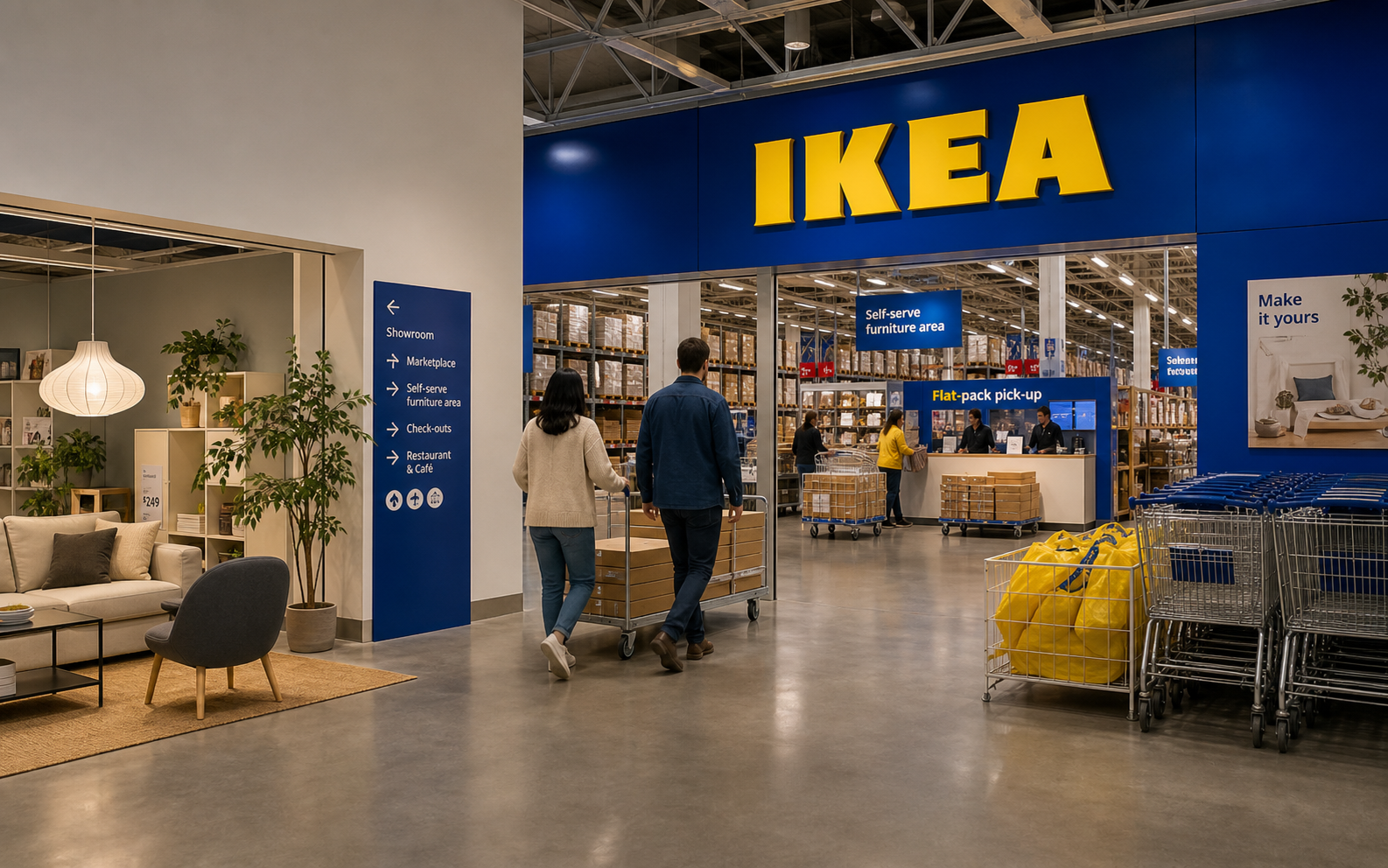
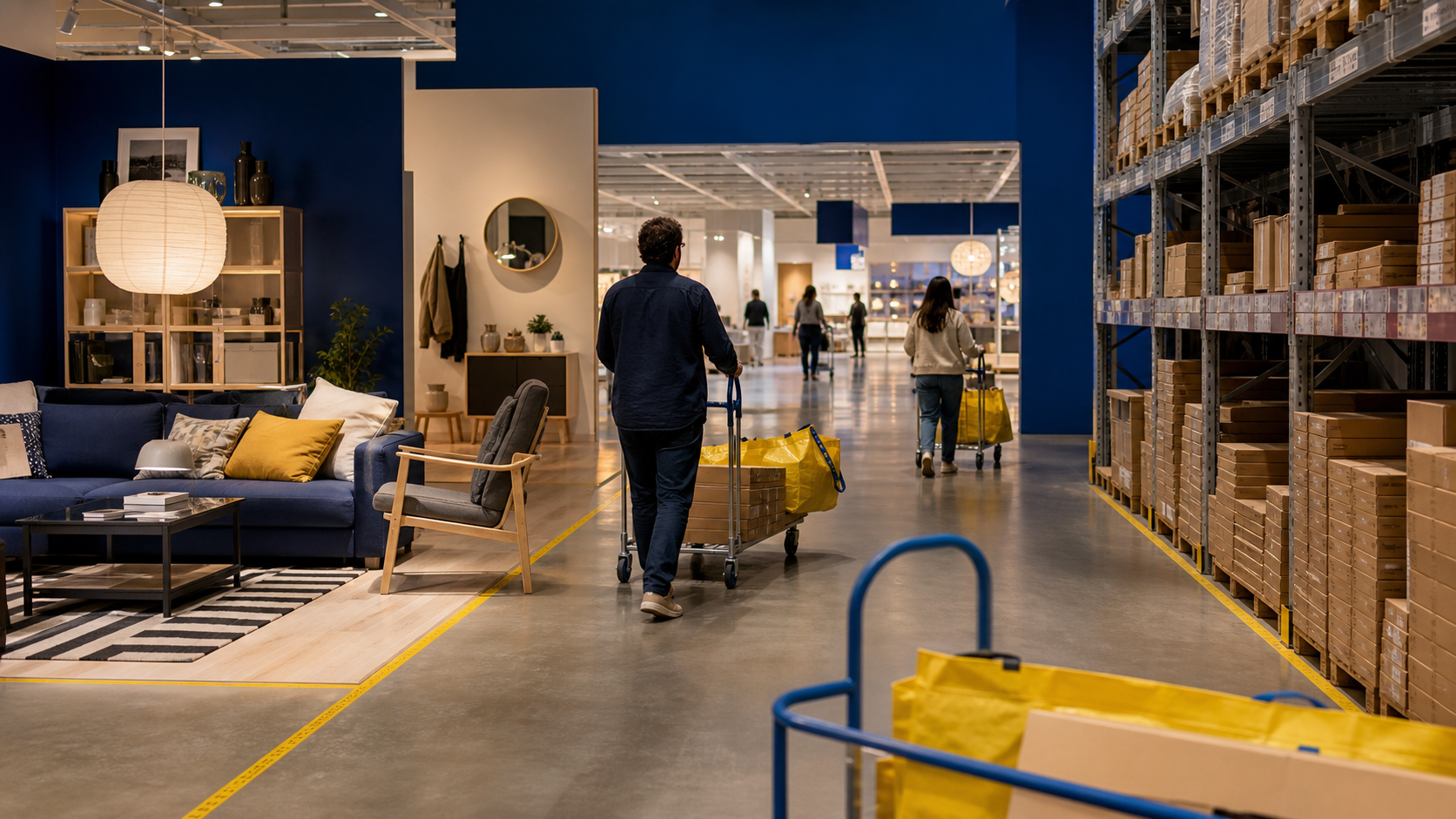
IKEA teaches shoppers to imagine a home setting first, then find the product, carry it, and assemble it at home.
Flat-pack proof
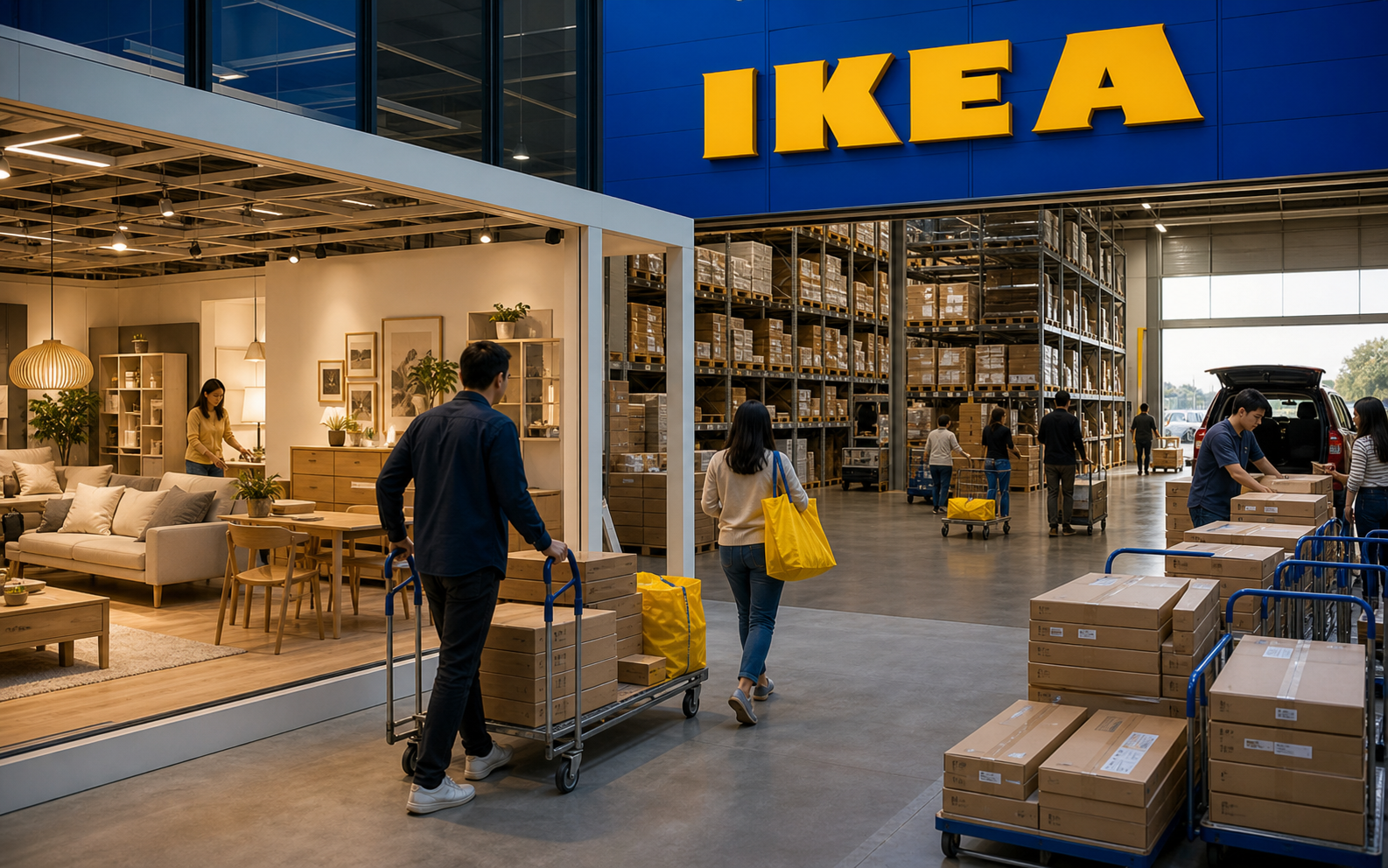
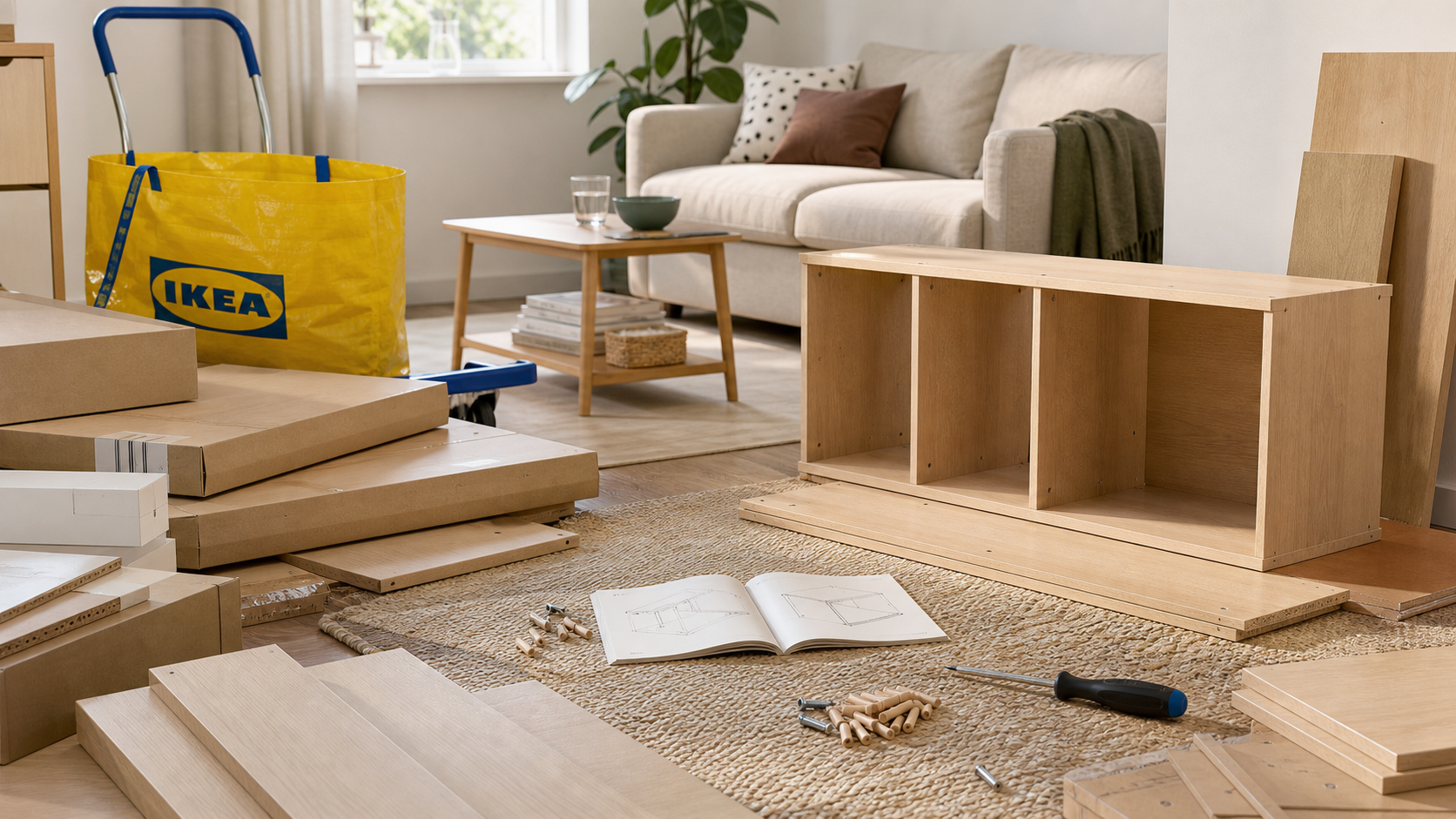
The package is proof of the value model. It shows how lower price depends on design, logistics, and customer effort.
Scores.
Use these scores to compare recognition, trust, proof, pressure, and risk at a glance.
Blue, yellow, store shape, bags, food, and flat packs make the brand easy to spot.
Trust is strong when product quality, instructions, delivery, and returns match the price promise.
Customers can see why the price works because the model gives them a clear job.
A long visit, stock gap, confusing pickup, missing part, or late delivery can weaken the same value story.
The brand is clear, but the private franchise structure needs careful wording.
Blue and yellow are trained across store, sign, web, bag, and mark.
Product names, household settings, catalogs, instructions, and repeat purchases create memory beyond the logo.
Scale creates scrutiny around materials, transport, product lifespan, returns, and circular claims.
How the logo changed.
The mark has to keep recognition intact while the brand adapts to new products, places, and screens.
Product / service lineage.
IKEA's signal is not one object. It is the repeatable system around home furnishing: idea, display, package, transport, assembly, and use.
1943
IKEA is registered as a trading company by Ingvar Kamprad.
Signal impact: The name starts before furniture becomes the focus.
1948
Furniture is added to the range.
Signal impact: The brand starts moving toward home furnishing.
1951
IKEA history materials tie early catalog logic to the growth of the home-furnishing range.
Signal impact: The catalog trains home planning before the store trip.
1958
The first IKEA store opens in Almhult, Sweden.
Signal impact: The brand moves from mail-order logic into a physical retail experience.
1978
IKEA Museum product stories list BILLY as a 1978 product story.
Signal impact: A bookcase becomes a durable product-memory cue.
1979
IKEA Museum product stories list KLIPPAN as a 1979 product story.
Signal impact: Simple sofa design turns into a repeatable household signal.
FY25
IKEA reports 504 stores in 63 markets, USD 51.16 billion equivalent in retail sales, and 222,000 co-workers.
Signal impact: The low-price system is still tested at global scale.
Event board.
Turning points only: proof, memory, pressure, and operating consequence.
Business idea
IKEA's official business idea ties design, function, home furnishing, and low price into one public promise.
Impact: The price signal is anchored in an operating claim, not a discount mood.
Store as teacher
Home settings, tags, arrows, warehouse pickup, and food turn a shopping trip into a planned household behavior.
Impact: The brand teaches the customer how to buy.
Flat-pack burden
The flat pack is efficient only when instructions, missing parts, tools, and transport feel manageable.
Impact: Customer effort is a brand asset until it becomes friction.
FY25 scale
FY25 reporting shows USD 51.16 billion equivalent in retail sales and 28% online sales.
Impact: Digital growth has to preserve the same clarity that stores trained.
Public reaction.
IKEA is loved and complained about for the same reason: it asks the customer to join the operating model.
Positive / market love
People accept assembly when the product, price, and home result make the trade feel honest.
Negative / pressure
The brand takes blame when the customer does their part and the system still wastes their time.
Full timeline.
Steal / avoid.
- Make the reason for low price visible in the operating model.
- Give the customer a clear job only when that job creates value they can feel.
- Repeat the same color system on store, sign, bag, tag, website, and mark.
- Use physical proof: package size, instructions, pickup, food, and home settings can carry more trust than slogans.
- Do not call something affordable if the buyer cannot see why the cost came down.
- Do not shift work to the customer without giving them enough guidance.
- Do not let scale weaken quality, delivery, returns, or sustainability proof.
- Do not copy the blue-yellow surface without copying the disciplined operating logic behind it.
Short answer.
IKEA's brand signal is the blue-and-yellow retail system around affordable home furnishing: showroom path, flat-pack design, warehouse pickup, customer assembly, food, product names, and repeat store memory. The lesson is that price becomes trusted when the whole system explains how the price is made.
What is IKEA's core brand signal?
IKEA's core brand signal is the blue-and-yellow value system: store path, home settings, flat packs, warehouse pickup, customer assembly, and affordable home furnishing.
Why does IKEA blue and yellow work?
It works because the same colors repeat on buildings, signs, bags, tags, web surfaces, and the primary mark. The palette is tied to real retail behavior.
What should another brand steal from IKEA?
Make the operating model visible. If customers trade effort for price, show them exactly why the trade is fair.
What should another brand avoid copying from IKEA?
Do not copy the surface cues without the system. Blue, yellow, flat packs, or food do not matter if the product, instructions, delivery, and returns fail.
Compare this signal.
Use IKEA to compare value retail, color ownership, flat-pack product logic, store behavior, and customer-operated service models.
Walmart price system
Useful comparison: scale, logistics, price trust, and the limits of everyday-low-price memory.
CompareTarget design at value
Useful comparison: affordable design, store recognition, private labels, and home goods.
MechanismBrand color psychology
Blue and yellow work because the same system repeats across store, sign, bag, tag, website, and mark.
MechanismRecognition assets
Use this when the question is what people recognize before they read the brand name.
Making a signal decision of your own?
Use Private Brand Work when your own name, identity, proof, or message needs the same pressure test.
Sources.
Related Grow Your Brand page
Related Grow Your Brand page
Related Grow Your Brand page
IKEA Global: FY25 Year in Review · IKEA Global: How We Work · IKEA Global: The Story of IKEA · IKEA Museum: The Story of IKEA · IKEA Museum: Product Stories · FRED: DEXUSEU daily USD exchange reference