Growyourbrand.net Reference notes on brand consequence May 2026
The Brand Archive

Decision Frame

How much does a bad rebrand actually cost?

14 cases priced. The line items most CFOs miss.

Short Answer

The visible cost on the public record runs from roughly one million dollars for a small reversal to over one hundred million for an aborted launch. The invisible cost, recognition-equity decay during the transition, is usually larger than the visible line item. The fourteen cases below show the spread.

What the Public Record Actually Says

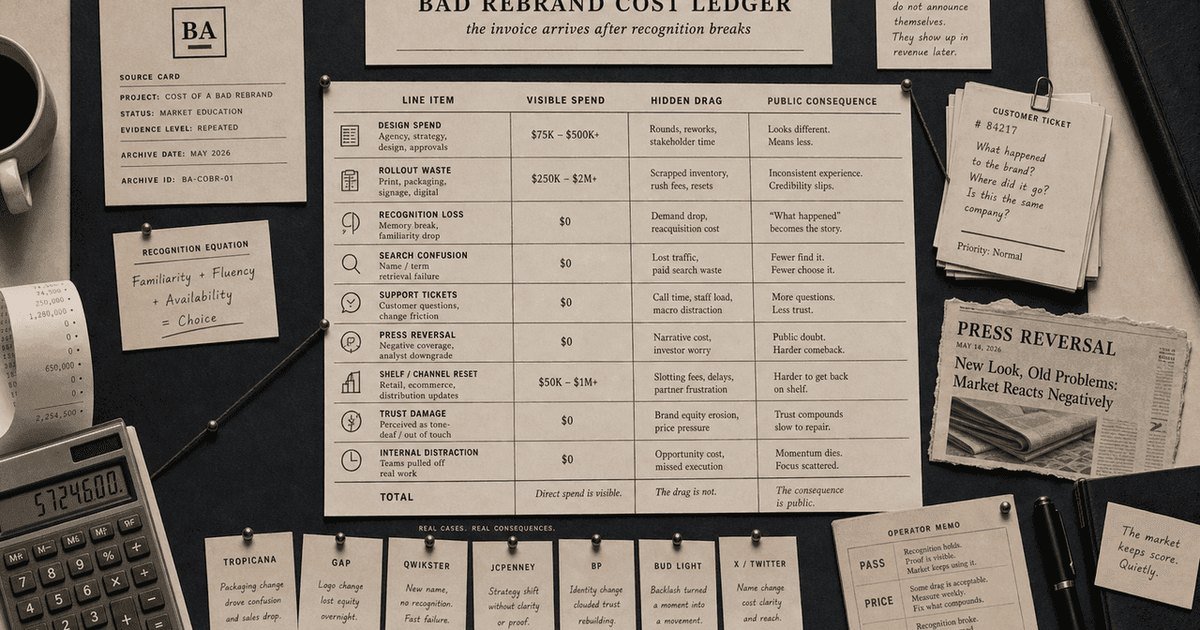
Most rebrand cost estimates carried in press coverage are partial. They cite the design fee, the agency engagement, or a single reversal headline. The full cost of a failed rebrand is the sum of at least seven line items, only one or two of which appear in the press.

The fourteen cases below are sorted by reported visible cost. The actual cost is in every case higher than the number listed, and the gap between the reported figure and the real figure is where the operating lesson lives.

The 14 Cases, Priced

Gap (2010) — ~$100 million. The aborted sans-serif wordmark was on the market for six days before the original was restored. The reported figure includes design, identity rollout, and rapid reversal. The hidden cost was a decade of postponed category repositioning that the rebrand was meant to substitute for.

Tropicana (2009) — ~$30 million in reported sales loss in weeks. The package redesign erased the orange-with-straw recognition anchor. Weekly sales dropped by a reported 20 percent until the original packaging was restored. The hidden cost was the recognition equity that had taken decades to build, briefly stripped from the asset.

Royal Mail / Consignia (2001) — ~£2 million in design plus a sustained morale and public-trust hit. The UK postal service renamed to Consignia and reversed within sixteen months. The pure design fee was reported at roughly two million pounds. The political and morale cost was orders of magnitude larger.

Pepsi (2008) — ~$1 million in design plus an estimated $1.2 billion in identity rollout costs across packaging and assets. The new logo was not reversed but became a long-running cultural reference point for over-thought brand work.

Weight Watchers to WW (2018) — double-digit member decline cited in earnings calls. The repositioning toward general wellness diluted the category-defining promise. Stock value declined materially in the eighteen months that followed.

RadioShack to The Shack (2009) — an estimated $200 million in identity rollout, signage, and store collateral. The shorter name did not save the underlying business. The retailer filed for bankruptcy in 2015.

Sci Fi to Syfy (2009) — estimated $300 thousand in design plus reported drops in audience identification with the channel. The phonetic respelling was reversed in spirit when later positioning returned to genre clarity. The cost lived in years of lost positioning, not in the design budget.

JCPenney pricing rebrand (2012) — ~$985 million in lost sales in one year, per company filings. The removal of the discount-coupon mechanic was a positioning rebrand even though the logo barely changed. The audience that had been trained for thirty years on coupon-driven shopping did not return.

BP sunflower rebrand (2000) — ~$200 million in identity rollout. The environmental positioning was undermined by the 2010 Deepwater Horizon disaster, but the rebrand had already produced a years-long credibility gap before the spill.

X (formerly Twitter) (2023) — estimated $4 billion to $20 billion in brand-value destruction per various assessments. The rename consolidated control under Musk-portfolio identity but destroyed two decades of search-indexed brand recognition. The trade was strategic, not accidental, but the cost was real.

Sports Illustrated digital rebrand (2019 to 2024) — ongoing reputation damage and the closure of editorial operations. The licensing-driven rebrand toward AI-generated content destroyed the publication's editorial trust. The full cost is still being written.

Burger King (2021) — ~$15 million for the retro-leaning identity refresh. The refresh was generally well-received and produced no reversal. Included here as a counter-case for benchmarking: a competent rebrand at a meaningful chain operates in the eight-figure range.

Mastercard (2016) — ~$10 million for the refresh of an existing two-circle mark. Another counter-case. A targeted refresh of a recognition-equity-rich mark at a global brand operates in the eight-figure range when done well.

Slack rebrand (2019) — estimated $1 to $3 million for the new identity system. Reception was mixed but the company did not reverse. Counter-case showing what a software-category mark refresh costs when the underlying audience is unchanged.

Animal Planet (2018) — ~$2 million in identity work plus a slow audience departure that the rebrand did not arrest. The cost was not in the work itself; it was in the misdiagnosis of the audience problem as a brand-identity problem.

The Seven Line Items CFOs Miss

The design fee and the rollout cost appear in every rebrand budget. The following seven items appear in almost none, and they are usually larger than the design fee.

1. Recognition-equity decay. Customer acquisition cost spikes during the transition because the buyer no longer recognizes the asset on the shelf or on the page. For consumer brands this is the largest hidden cost. Tropicana lived this line for weeks.

2. Sales-team and channel retraining. Every salesperson, partner, distributor, and reseller has to relearn the story. Productivity drops for the duration. For B2B brands this is the largest hidden cost.

3. Customer-service ticket volume. Confused customers contact the company asking what changed. Service load rises for ninety to one hundred eighty days after launch.

4. Asset replacement. Signage, packaging, uniforms, business cards, vehicle livery, manuals, fixtures. The line item is straightforward to estimate and almost always under-estimated.

5. Search engine optimization loss. Domain changes, page renames, and lost backlinks reset organic discovery. Recovery takes between six and eighteen months. For brands whose customer acquisition depends on search, this is a substantial hidden cost.

6. Internal-alignment cost. Every team has to relearn the story, the words, the customer description, the value claim. Internal communications, training sessions, and the productivity dip during the learning curve. Larger than expected for enterprises above one thousand employees.

7. The opportunity cost of the failed diagnosis. A rebrand ordered to solve a reposition problem leaves the reposition problem unsolved. The years that follow are spent chasing the same buyer drift the rebrand was meant to fix. Gap lived this for a decade after the 2010 reversal.

The Total Cost Formula

A rebrand budget that captures the real cost looks more like the following than like the typical design-and-rollout line item.

Design and identity system, plus rollout and asset replacement, plus recognition-equity decay during transition (estimated as 1 to 3 months of customer-acquisition-cost spike), plus sales and channel retraining (estimated as 60 days of productivity loss for the affected teams), plus search-discovery rebuild (6 to 18 months of partial organic loss), plus internal-alignment cost (1 to 2 quarters of internal-comms and training overhead), plus the option cost of the substituted problem (often the largest line item, and the one most resistant to estimation).

For a mid-market brand, the visible design and rollout line is typically 15 to 30 percent of the real total. For an enterprise brand, the visible line is typically 10 to 20 percent. Most rebrand business cases that compare only the visible line to the expected revenue lift are off by a factor of three to seven.

The Operating Pattern

The cost of a bad rebrand is rarely the design budget. The cost is the recognition equity that had taken decades to accumulate, suddenly stripped from the asset, paired with the substituted problem that the rebrand was ordered to avoid solving.

The cases that recovered fast (Gap, Tropicana) reversed within weeks. The cases that did not recover (Sci Fi, JCPenney, X) lived with the decision for years or carried it to the end of the company. The reversal cost is small. The non-reversal cost compounds.

Building the business case for your own rebrand?

Describe what you are considering in four fields. The Archive reads it against the 1,100 precedents and replies by email within 3 business days with the precedent-matched cost picture for your specific decision. No call required. No mailing list.

Ask the Archive →

Related Cases

People Also Ask

How much does a bad rebrand cost?

The visible cost on the public record runs from roughly $1 million for a small reversal to over $100 million for an aborted launch, with category-resetting rebrands like Tropicana producing reported revenue losses in the $30 million range over weeks. The invisible cost, recognition equity decay measured in customer-acquisition-cost spike during the transition, is usually larger than the visible line item.

What was the most expensive rebrand failure?

By aborted-launch cost, Gap's 2010 logo change is widely cited at roughly $100 million for a logo that was on the market for six days before reversal. By sustained sales impact, Tropicana's 2009 redesign produced a reported $30 million revenue loss in a matter of weeks. By long-tail brand value destruction, Sci Fi to Syfy and JCPenney's pricing rebrand cost the businesses years of recovery.

What line items are most often missed in a rebrand budget?

Recognition-equity decay measured as a temporary CAC spike during the transition. Sales-team retraining and the period of lost productivity that follows. Customer-service ticket volume in the first 90 days. Reprinting all collateral, signage, packaging, and uniform stock. Search engine optimization loss from URL or name changes. Internal-alignment cost across teams that have to relearn the story. The hidden total often exceeds the design budget by a factor of two to four.

Does a successful rebrand pay for itself?

Sometimes. The Old Spice voice pivot and the Burberry rebrand both produced multi-year revenue lifts that exceeded the design and campaign costs. The Mailchimp evolution increased enterprise value by billions when the company was sold. Successful rebrands tend to share three features: the underlying audience or category problem was correctly diagnosed first, the visible identity change followed the structural change, and recognition equity was preserved or rebuilt deliberately.

Should I rebrand if I am not sure?

No. The Brand Archive's read across rebrand decisions is that most rebrand projects ordered without a precise diagnosis fail. The right move when the decision is unclear is a brand decision review against precedent cases before any design vendor is engaged. The diagnosis costs a fraction of the rebrand and prevents the larger loss.