Brand System / Energy / Fuel infrastructure / 1890-present
Shell and the Yellow-Red Energy Transition Risk
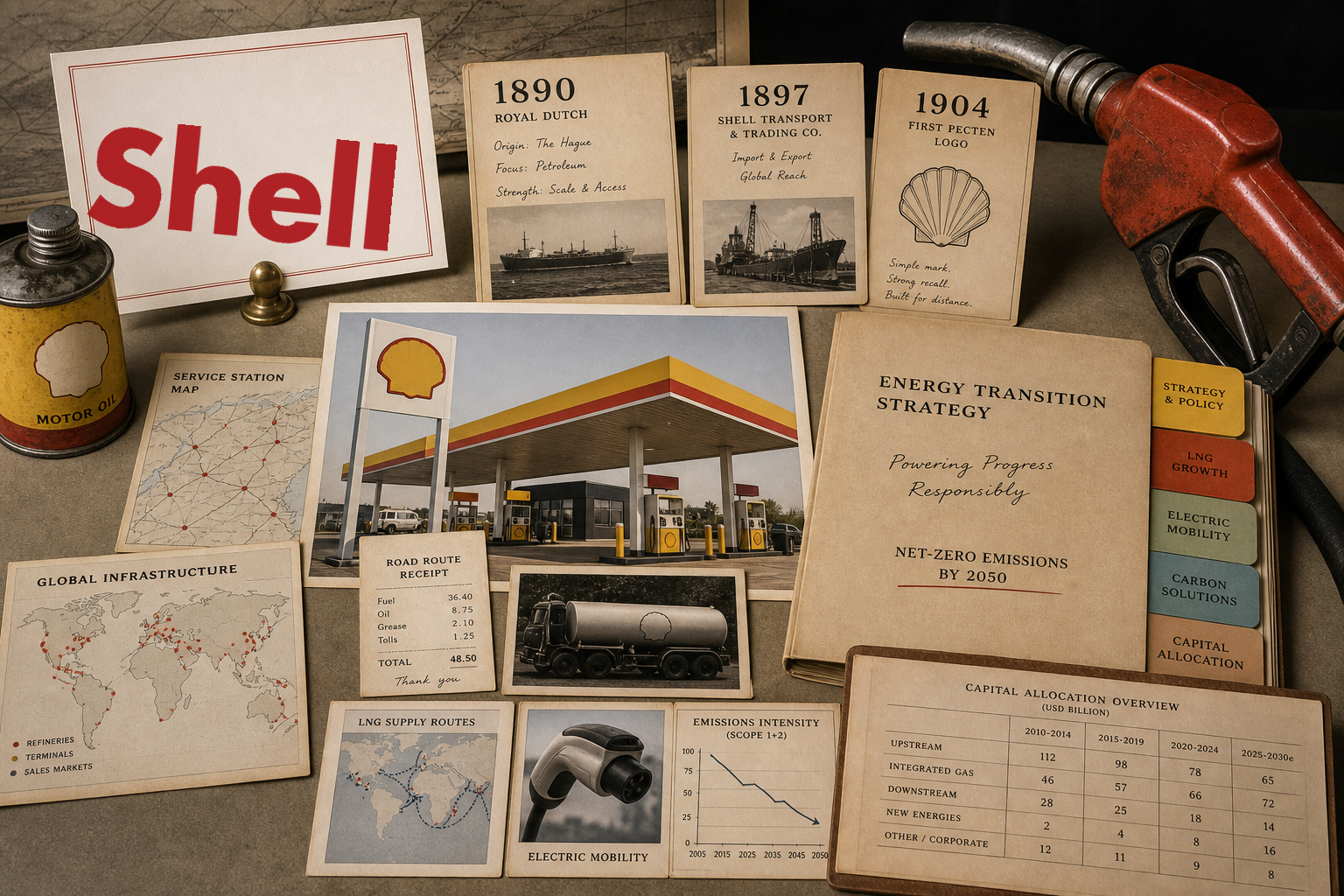
Shell made fuel infrastructure recognizable through the yellow-red Pecten, service stations, road travel, lubricant products, and energy supply, then had to explain how that memory fits an energy-transition promise.

Short Answer
Shell and the Yellow-Red Energy Transition Risk is a brand system case about Shell in 1890-present. Shell made energy recognizable at the roadside, then had to make transition credible beyond the roadside. A legacy energy brand cannot treat transition as a color update. Shell's brand risk is that yellow-red fuel recognition is clearer than the proof behind its future-energy promise.
Key Takeaways
- Shell traces the Royal Dutch side of its history to the Netherlands in 1890.
- Shell says the Shell Transport and Trading company was set up in 1897 and the first Pecten appeared in 1904.
- Shell's transition story now depends on net-zero 2050, LNG, EV charging, biofuels, renewable power, hydrogen, CCS, and investment discipline.
- The useful operator lesson is to make the future proof more concrete than the inherited symbol.
The Decision Context
Shell has a highly legible energy identity: yellow, red, a Pecten shape, service stations, fuel pumps, road travel, lubricants, and global supply.
That recognition sits close to habit. Customers have seen the brand at roadsides, on receipts, on fuel canopies, and on energy infrastructure for decades.
The Symbol Carried Fuel Memory
The Pecten did not stay a small corporate mark. It became a roadside shorthand for fuel access, trip continuity, product reliability, and local service.
That is the strength and the problem. The same recognition that makes Shell easy to find also keeps the public memory attached to oil, gas, and combustion.
Transition Needed A Stronger Proof Layer
Shell's transition promise has to compete with a very concrete old promise. A fuel pump is easy to understand. An energy-transition strategy is easier to doubt unless the company shows assets, investment choices, customer routes, and emissions movement clearly.
That is why LNG, charging, power, biofuels, renewables, emissions ledgers, and capital allocation matter as public proof objects. They make the transition more inspectable.
The Archive Reading
Shell belongs in the archive because it shows what happens when a legacy symbol outperforms the future story. The brand's recognition system is strong enough to carry the past, which means the transition story has to earn its own visibility.
For operators, the lesson is to give the future a proof layer. If the old brand asset is still clearer than the new operating claim, the market will keep reading the old category first.
Comparable Cases
Sources

People Also Ask
What happened to Shell?
Shell and the Yellow-Red Energy Transition Risk is a brand system case about Shell in 1890-present. Shell made energy recognizable at the roadside, then had to make transition credible beyond the roadside. A legacy energy brand cannot treat transition as a color update. Shell's brand risk is that yellow-red fuel recognition is clearer than the proof behind its future-energy promise.
Why is Shell a brand system case?
Shell is filed as a brand system case because the visible consequence sits in that decision pattern. Shell made energy recognizable at the roadside, then had to make transition credible beyond the roadside.
What can brands learn from Shell?
A legacy energy brand cannot treat transition as a color update. Shell's brand risk is that yellow-red fuel recognition is clearer than the proof behind its future-energy promise.
Is Shell still operating?
The Brand Archive marks Shell as Active / continuing. That means the brand, company, platform, product system, or parent organization is still operating, continuing, or being actively resolved.
What should Shell be compared with?
Compare Shell with Iberdrola, Petrobras, BP to see the same decision pattern from nearby cases.