Brand System / Retail / grocery / ecommerce / 1962-present
Walmart and the Everyday Low Price System
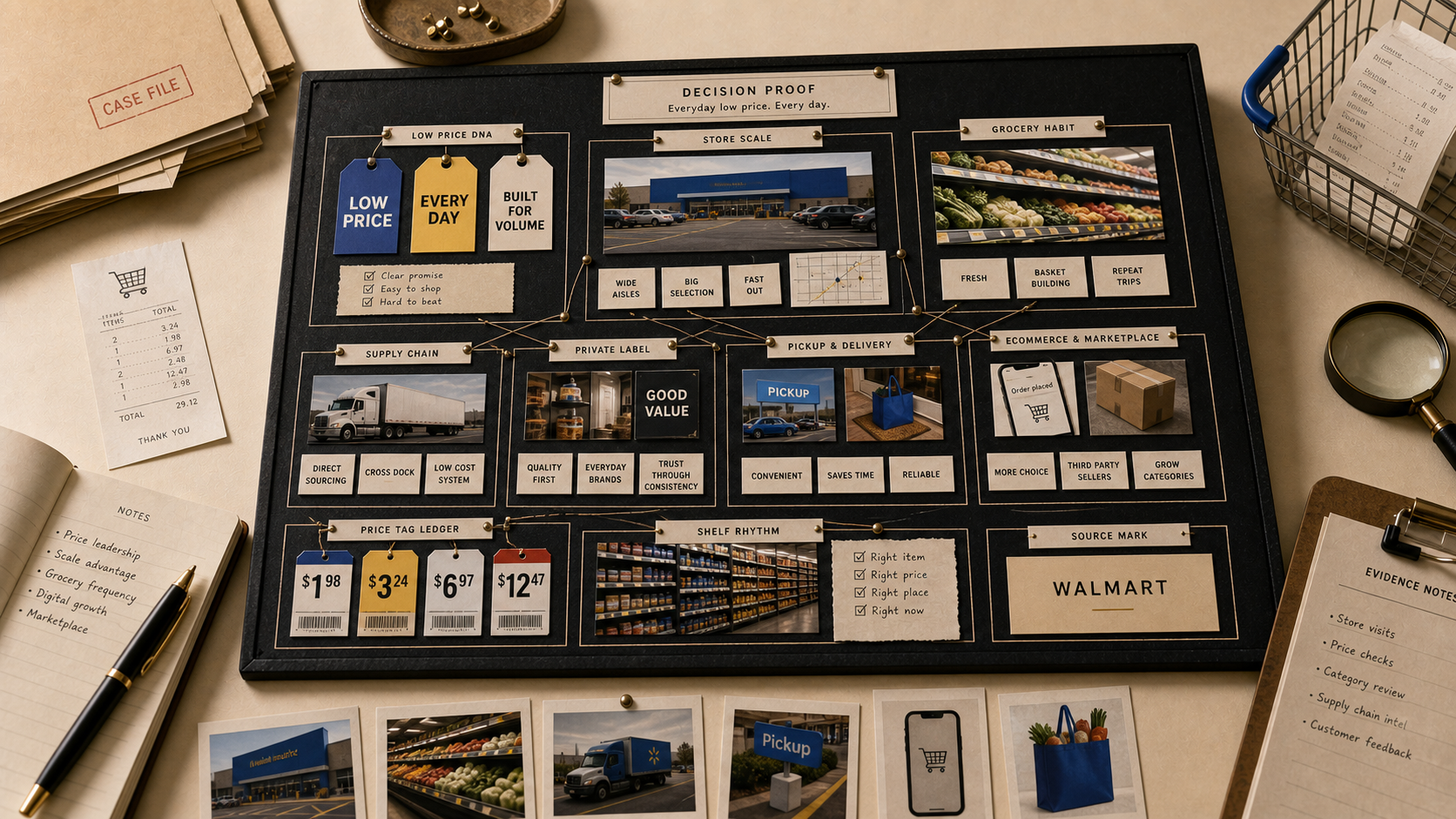
Walmart made low price credible by connecting store scale, buying discipline, logistics, grocery habit, private labels, pickup, delivery, and marketplace reach.

Short Answer
Walmart and the Everyday Low Price System is a brand system case about Walmart in 1962-present. Walmart made price a system customers could test every week. Low price is not a slogan when customers can verify it through store footprint, assortment, grocery frequency, pickup convenience, and repeated shelf behavior.
Key Takeaways
- Walmart traces its first store to Rogers, Arkansas in 1962.
- Everyday low price became credible because it was supported by scale, buying discipline, and logistics.
- Grocery made Walmart a repeat habit, not only a destination for general merchandise.
- Pickup, delivery, ecommerce, and marketplace services extend the promise beyond the big-box visit.
- The operator lesson is that a value brand has to make low cost visible without making the experience feel neglected.
The Decision Context
Walmart's public promise is easy to say and difficult to operate: everyday low price.
That promise works when customers believe the system behind it. Store scale, procurement, logistics, private labels, and grocery traffic have to make the price feel earned.
Low Price Needed A System
A discount sign can be copied. A low-price operating model is harder to copy because it depends on volume, supplier terms, distribution, shelf discipline, store density, and cost control.
That is why Walmart is a brand system case. The signal is not only a blue sign or a yellow spark. It is the weekly evidence that the basket will cost less enough times to become memory.
Grocery Made The Habit
Grocery gives a retail brand frequency. A customer may compare electronics occasionally, but food, household goods, and essentials pull the brand into a repeated routine.
That frequency helps the price promise stay alive. The customer does not only remember Walmart as a big store; the customer tests the brand through recurring baskets.
Omnichannel Changed The Promise
Pickup, delivery, ecommerce, and marketplace services changed what low price has to mean. The customer now judges value through time, trip friction, substitutions, availability, and confidence in the order.
Walmart's challenge is to keep the old price memory while making the new convenience layer feel equally practical.
The Archive Reading
Walmart belongs in the archive because it shows how a brand promise can be simple only when the operating system is deep.
For operators, the lesson is to make the value claim inspectable. Customers believe low price when the system gives them repeated proof in the basket, trip, receipt, and reorder.
Comparable Cases
Sources
People Also Ask
What happened to Walmart?
Walmart and the Everyday Low Price System is a brand system case about Walmart in 1962-present. Walmart made price a system customers could test every week. Low price is not a slogan when customers can verify it through store footprint, assortment, grocery frequency, pickup convenience, and repeated shelf behavior.
Why is Walmart a brand system case?
Walmart is filed as a brand system case because the visible consequence sits in that decision pattern. Walmart made price a system customers could test every week.
What can brands learn from Walmart?
Low price is not a slogan when customers can verify it through store footprint, assortment, grocery frequency, pickup convenience, and repeated shelf behavior.
Is Walmart still operating?
The Brand Archive marks Walmart as Active / continuing. That means the brand, company, platform, product system, or parent organization is still operating, continuing, or being actively resolved.
What should Walmart be compared with?
Compare Walmart with Target, Costco, Amazon to see the same decision pattern from nearby cases.