Apple · Grow Your Brand · Iconic / Ecosystem Value System · United States / Active / iconic
Apple
Apple turns product ecosystems, services, and design restraint into market value. A brand page for Apple: iPhone, Mac, iPad, wearables, home and accessories, Services, Apple silicon, operating systems, retail and support, FY2025 finances, and logo progression from Newton to the current monochrome mark.
Positioning, name, and architecture.
Three evidence checks before the page talks about scale, color, or public reaction.
A restrained master brand whose products, services, retail, software, privacy cues, and premium pricing reinforce one company-level ecosystem.
Apple positions premium technology as an integrated company system: hardware, software, services, retail, privacy cues, and design restraint working together.
Apple is a simple object name carried by Apple Inc.; the brand has repeatedly repaired and expanded what the name means through product and ecosystem proof.
Apple's current company-level brand is carried by integrated product, software, services, retail, privacy, and support proof rather than one universal slogan.
branded-house hardware, software, silicon, services, retail, and support ecosystem
Official reporting families are separated from cross-system layers so the page shows phones, computers, tablets, wearables, home, services, payments, silicon, software, and support without treating every product as a subbrand.
Distinct device jobs share silicon, software, account, design, retail, and service layers.
Core hardware families: iPhone source
Watch, AirPods, HomePod, Apple TV, AirTag, and accessories extend use beyond the primary screen.
Daily relationship layer: Apple Watch source
Content, cloud, apps, payments, health, fitness, news, books, and support turn installed devices into an ongoing system.
Account and recurring-use layer: iCloud+ source
Apple silicon, operating systems, stores, and AppleCare make the portfolio behave like one authored ecosystem.
Cross-system infrastructure: Apple silicon source
Naming and tagline progression
The Apple name stays simple while the product system carries the proof.
Mac, iPhone, iPad, Watch, audio, Vision, and Services make the company promise visible.
The ecosystem and product families carry the brand more than one slogan.
Market and scale snapshot.
Apple's record June quarter showed strong iPhone, Mac, and Services demand, while weaker guidance and memory-component constraints made supply, pricing, and AI execution part of the same premium-brand test.
FY2025 net sales.
FY2025 net income; this is not operating income.
Dated 3 Aug 2026 market-cap observation; market values move with the share price.
Nasdaq-listed parent company.
Color system.
The page keeps Apple's master brand restrained: near-black, UI gray, light gray, silver, and white. Product lines can still use color as a choice cue, but color belongs to the product strategy, not a random page accent.
How the palette behaves
Near-black gives Apple a serious company-level signal and keeps the mark from becoming decoration.
UI gray and silver connect the brand to product materials, interface restraint, and technical calm.
Light gray and white keep the page close to Apple's clean retail and interface world without pretending to be an official product page.
Multicolor belongs in product lines such as iPhone and iMac, where finishes help buyers choose without changing the master brand.
Recognition assets.
Memory pieces the brand can use before someone finishes a sentence.
The mark works because product families, software, services, retail, privacy, and support keep giving it current proof.
Mac, iPhone, iPad, Watch, audio, Vision, and Services make the company promise specific without fragmenting the master brand.
Multicolor works when it helps buyers read product choices; the company-level Apple palette remains restrained.
Scores.
Use these scores to compare recognition, trust, proof, pressure, and risk.
The Apple mark, product families, retail presence, and ecosystem are immediately legible.
The company has visible proof in product families, Services, retail, filings, and premium price behavior.
The brand is strong because restraint repeats across hardware, software, services, retail, and support.
Current product proof is spread across iPhone, Mac, iPad, Watch, audio, Vision, Services, software, retail, and support.
The brand weakens when the product ecosystem feels incremental, extractive, or slower than buyer expectations.
The company entity is clear when the card treats Apple Inc. first and product families as proof.
Apple remains one of the clearest public examples of company-level value carried by product, software, services, retail, and habit.
Many brands copy the attitude and miss the operating discipline.
How the logo changed.
Four sourced stages show the 1976 Newton seal, Rob Janoff’s 1977 rainbow silhouette, the 1998 monochrome transition, and the current flat monochrome mark.
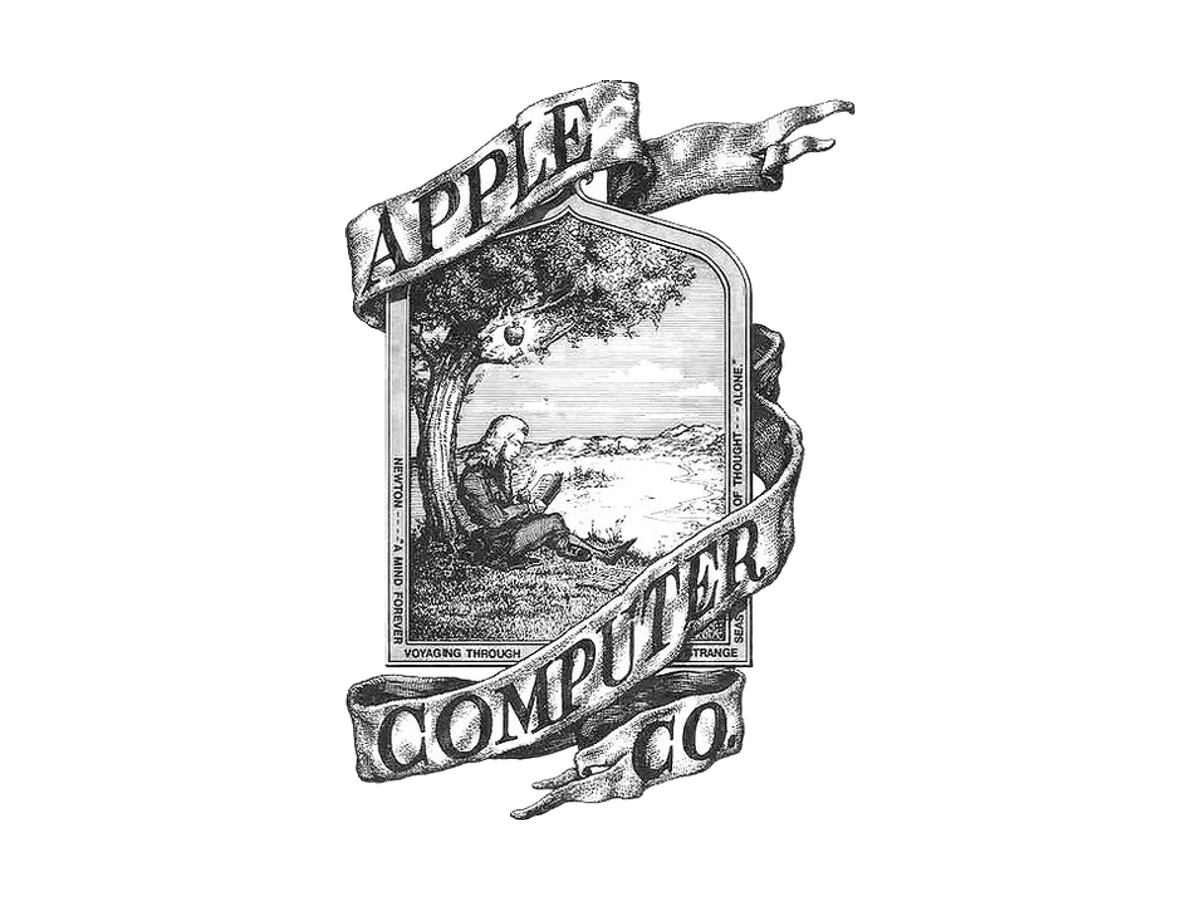
Ronald Wayne’s detailed Newton illustration gave the young computer company a literal, editorial identity. source

Rob Janoff replaced the illustration with the bitten silhouette and rainbow bands, creating the enduring recognition shape.
The iMac era removed rainbow stripes and used single-color treatments while preserving Janoff’s silhouette. source
The current flat monochrome treatment keeps the same silhouette flexible across hardware, software, stores, packaging, and services.
Product and service lineage.
This is Apple as a company system: Mac, iPhone, iPad, Watch, audio, spatial computing, software, services, and retail proof keep the master brand legible.

Continuity is the product
The company-level promise becomes visible when hardware, software, services, and custom silicon reduce friction across the devices one person actually uses.
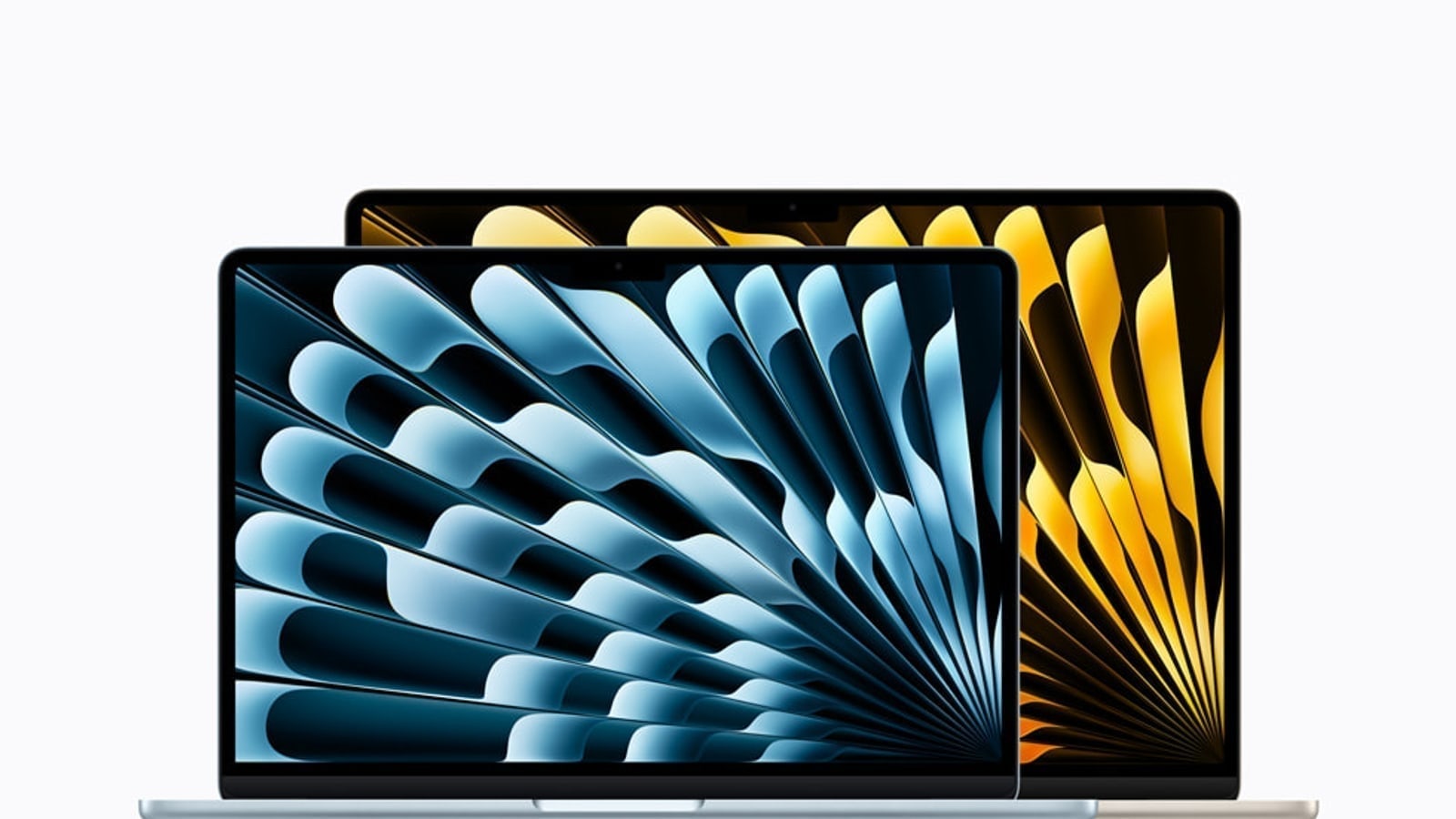
Mac joins silicon, software, and form
Apple silicon and macOS let industrial design, performance, battery life, software, and service feel like one authored system.
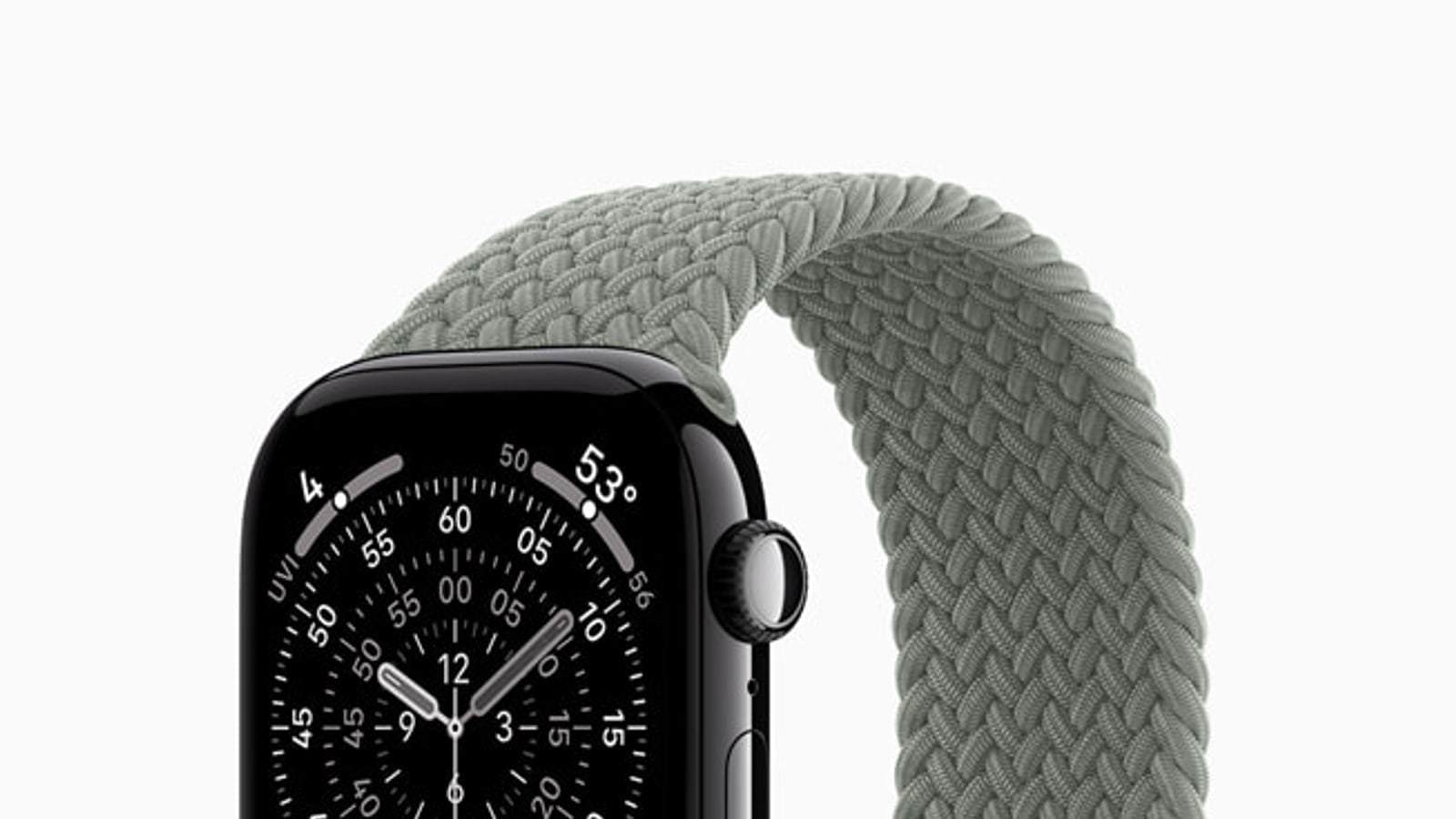
Wearables extend the relationship
Watch, AirPods, health, fitness, safety, notifications, and payments move Apple from a device purchase into daily behavior.
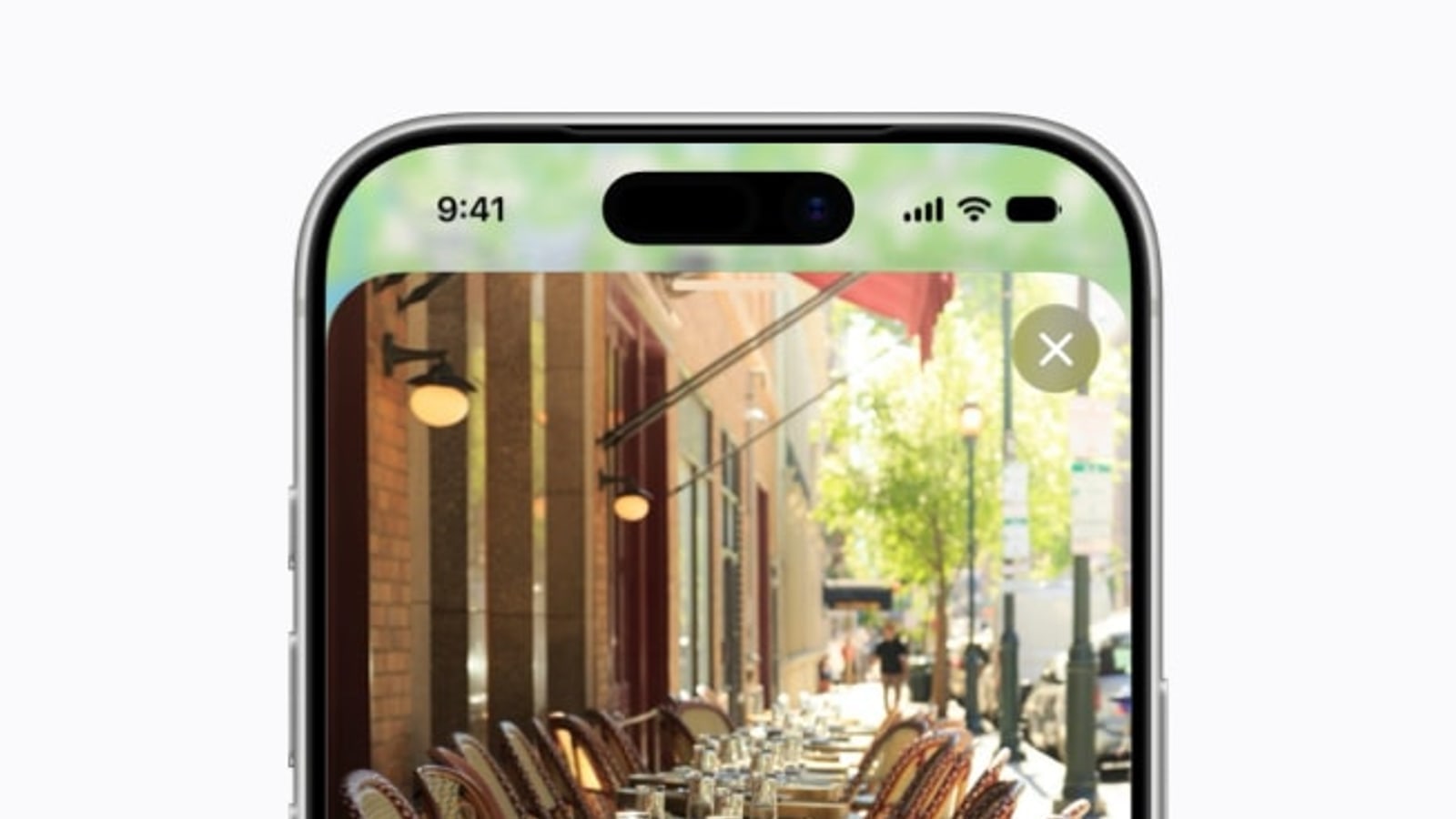
Services make the ecosystem continuous
App Store, iCloud, Music, TV, Arcade, Fitness, News, Pay, Wallet, and Maps connect devices through accounts, content, payments, and recurring use.
Product and service system
Mac and MacBook keep the productivity and creative-work surface visible, from portable laptops to desktops and displays.
iPhone makes the Apple relationship daily, mobile, personal, and hard for competitors to displace.
iPad extends the system into touch-first work, learning, drawing, entertainment, and lightweight computing.
Wearables and audio move Apple from devices on a desk into the body, commute, workout, payments, health cues, and ambient use.
Vision-style spatial computing and iOS-style interface continuity show Apple turning hardware, software, services, and interaction patterns into one recognizable system.
Apple’s first foldable iPhone adds a two-display format to the iPhone family.
Turning points.
Company-level pressure points only: ecosystem proof, Services, product-line color, retail/support, and the risk of premium belief outrunning visible utility.
Mac, iPhone, iPad, Watch, AirPods-style audio, Vision-style spatial computing, iOS, Services, retail, and support have to feel like one company system.
Apple reported USD 109.4 billion in quarterly revenue and June-quarter records for iPhone, Mac, and Services, but warned that memory-component supply could limit how much demand it can serve.
The master brand stays restrained while product lines such as iPhone and iMac can use finishes and color to help buyers choose.
If AI and device intelligence expectations move faster than visible product proof, Apple has to defend premium pricing with utility people can feel.
Apple is pushing Siri and Apple Intelligence updates while mixed market reaction keeps expectation pressure on AI momentum and integration delivery.
Supply pressure on memory and storage components adds margin and execution scrutiny to the AI push.
Apple's AI cycle now puts more weight on component supply and long-horizon chip relationships. The premium promise depends on visible intelligence and the supply chain behind it.
Apple's weaker forecast and supply warning put more weight on component availability, pricing, Services growth, and visible AI utility.
Apple introduced its first foldable iPhone, iPhone Duo, starting at USD 1,999 in the United States. The announcement names John Ternus as CEO.
Public reaction.
No invented sentiment count. This card reads public pressure through product proof, Services trust, premium pricing, retail experience, and whether the ecosystem keeps feeling useful.
Customers reward Apple when devices, software, services, retail, support, and privacy cues reduce friction in daily use.
The brand comes under pressure when buyers feel product launches, AI utility, or Services value are slower than the price signal.
Full timeline.
Macintosh establishes the computer as an integrated hardware-and-interface experience.
Apple introduces iPod and moves its design discipline from the desk into a daily portable music habit.
Apple introduces iPhone as a phone, widescreen iPod, and internet communications device in one product.
Apple launches iPad and extends Multi-Touch, apps, media, and productivity into a larger portable format.
Apple unveils Apple Watch as its first wearable computing platform.
Apple introduces M1, its first chip designed specifically for Mac.
Apple Vision Pro reaches the U.S. market with visionOS and a spatial-computing app layer.
iPhone gains a foldable branch
Steal / avoid.
- Make the master brand simple while product families do the proof work.
- Let product-line color help buyers choose without turning the company palette into random decoration.
- Keep the identity cue stable while products, software, services, retail, privacy, and support keep refreshing its meaning.
- Use filings, product surfaces, and daily habit to prove brand value instead of relying on attitude.
- Do not reduce Apple to one product era when the current signal is company-level ecosystem value.
- Do not invent accent colors from old product imagery and call them Apple branding.
- Do not treat Services, AI, privacy, retail, support, and device continuity as separate stories.
- Do not copy Apple's restraint if your product system cannot make the restraint feel useful.
Short answer.
Apple's current brand signal is company-level ecosystem value: the Apple mark, iPhone scale, Mac and iPad continuity, Watch and audio habit, Vision-style spatial computing, Services, retail, privacy cues, support, premium pricing, and product-line color all reinforcing one restrained master brand.
Frequently asked questions
What is Apple's core brand signal in this card?
The card reads Apple as ecosystem value made visible: iPhone scale, Mac and iPad continuity, Watch and audio habit, Vision-style spatial computing, Services, retail, privacy cues, support, and premium pricing reinforce one company-level mark.
What should another brand steal from Apple?
Keep the master brand simple, then make the promise visible through product families, software, services, retail, support, and daily customer habit.
What should another brand avoid copying from Apple?
Do not copy Apple's visual restraint or product-line color strategy if the underlying product system is still noisy or disconnected.
Need help with your own brand?
Use Private brand work when your name, identity, proof, or message needs a sharper branding decision.
Sources.
Use the education shelf for the concepts behind this brand page.
Private brand workUse this when the decision belongs to your own brand.
All brandsReturn to every brand page.
- SEC company facts, Apple Inc. CIK 0000320193
- Nasdaq quote data, AAPL last sale observed June 24, 2026
- Apple Mac product lineup
- Apple iPhone product lineup
- Apple iPad product lineup
- Apple Watch product lineup
- Apple AirPods product lineup
- Apple Vision Pro product page
- Apple iOS page
- Wikimedia Commons, Apple logo black file
- Wikimedia Commons, Apple first logo file
- Wikimedia Commons, Apple Computer rainbow logo file
- Wikimedia Commons, Apple Think Different vectorized logo file
- Apple Newsroom
- Apple FY2025 financial statements
- Apple H1 FY2026 financial statements
- Apple market capitalization
- Apple services
- Apple FY2025 financial statements
- Apple H1 FY2026 financial statements
- Apple market capitalization
- Apple services
- Apple FY2025 financial statements
- Apple H1 FY2026 financial statements
- Apple market capitalization
- Apple services
- Apple Q3 FY2026 results
- Apple memory-chip pricing and product-price pressure
- Apple introduces iPhone Duo


