BOSE · Grow Your Brand · Premium audio product ecosystem · United States / Active / private premium audio company
BOSE
BOSE turns premium sound, product naming, and retail trust into an audio system people recognize. BOSE shows how one master name can carry premium sound across quiet personal audio, portable speakers, home theater, aviation headsets, automotive sound, portable PA, retail trust, and private-company disclosure limits.
Positioning, name, and architecture.
Three evidence checks before the page talks about scale, color, or public reaction.
BOSE keeps the master name simple while product families explain the use case: QuietComfort, SoundLink, Lifestyle, Smart Soundbar, S1, L1, A30, ProFlight, and Bose Automotive.
BOSE is a premium audio brand for people who want the product choice to feel easy before the technology explanation gets complex.
The master name comes from founder Amar Bose; MIT News identifies him as Bose Corporation's founder and says he founded the company in 1964.
Sound is Power
branded house with product-family proof and separated pro-audio boundary
BOSE remains the masterbrand across personal audio, speakers, home theater, portable PA, aviation, and automotive. Bose Professional was sold to Transom Capital in 2023; portable PA stayed with Bose.
Makes noise cancelling, comfort, and travel/work focus legible before specs.
product family: Bose QuietComfort Ultra Headphones (2nd Gen) source
Carries noise cancelling, open-ear, in-ear, spatial audio, and fitness/work/travel contexts.
product family: Bose QuietComfort Ultra Earbuds (2nd Gen) source
Turns portable, waterproof, Bluetooth speaker proof into a named lane.
product family: SoundLink Max, SoundLink Plus, SoundLink Flex, and SoundLink Micro source
Makes room audio, soundbar, speakers, subwoofer, and TV sound one system instead of one object.
product system: Lifestyle Ultra Soundbar, Speaker, and Subwoofer; Smart Ultra Soundbar source
Lets BOSE speak to performers and small venues without claiming the separated Bose Professional company as current Bose-owned.
portable performance lane: S1 Pro+, L1 Pro16, L1 Pro32, and L1 Pro8 source
Turns noise reduction and pilot equipment into specialist trust proof.
specialist product family: Bose A30 Aviation Headset and ProFlight Series 2 source
Moves BOSE from consumer shelf to vehicle cabin partnerships and in-car sound technologies.
official operating lane: Bose Automotive vehicle/manufacturer and technology pages source
Return policy, price match, shipping/returns, product support, repair/replace, trade-in, and My Bose reduce buying friction.
trust layer: Bose.com category and support rails source
Naming and tagline progression
Better sound through research
Sound is Power
Market and scale snapshot.
Bose remains private. Public ownership records explain control, but the company does not publish a current revenue or profit statement.
No current official revenue figure is published.
Bose does not publish a public-company income statement.
A private-company market value is not published.
The 2011 gift transferred non-voting Bose shares to MIT while preserving company independence.
Color system.
BOSE should stay mostly black, white, and controlled neutral unless a verified product/system visual provides a stronger source-backed accent.
How the palette behaves
Black and white keep the master-name signal direct and technical.
Neutral gray supports product photography, retail cards, and audio equipment surfaces without pretending to be a separate brand color.
Accent color should come from verified BOSE product photography or source material during visual QA, not from a generated moodboard.
Recognition assets.
Memory pieces the brand can use before someone finishes a sentence.
The all-caps name is the recognition surface, backed here by a verified current source-mark canvas.
QuietComfort names the buyer benefit before listing noise-cancelling technology.
SoundLink keeps Bluetooth and portability attached to a repeatable BOSE product family.
Lifestyle, Smart Soundbar, TV Speaker, subwoofer, and surround products make the room the evidence point.
A30, ProFlight, and Bose Automotive show that the BOSE signal is not limited to home shelves.
Returns, price match, shipping/returns, product support, repair/replace, trade-in, and My Bose make the premium purchase feel lower-risk.
Scores.
Use these scores to compare recognition, trust, proof, pressure, and risk.
The BOSE name is strong, and the current source-mark canvas gives the page a verified mark slot.
The master brand carries many lanes, and the current prep packet keeps Bose Professional separated from current Bose Corporation ownership.
QuietComfort, SoundLink, Lifestyle, S1, L1, A30, and ProFlight teach use case quickly.
Direct-store policies and support rails matter because premium audio often needs trial, fit, repair, and accessory confidence.
The card should avoid public-company-style revenue and profit claims unless a current official source is available.
BOSE should teach a product ecosystem: personal listening, home rooms, portable speakers, portable performance, aviation, cars, retail trust, and the pro-audio separation boundary.
BOSE needs parent, product, service, market, and history lanes labeled cleanly so search systems do not flatten the brand into one vague entity.
BOSE is a premium audio brand for people who want the product choice to feel easy before the technology explanation gets complex.
How the logo changed.
The wordmark changed by refinement, not replacement: the italic silhouette stayed while small letter details were cleaned up.
Product and service lineage.
BOSE should teach a product ecosystem: personal listening, home rooms, portable speakers, portable performance, aviation, cars, retail trust, and the pro-audio separation boundary.
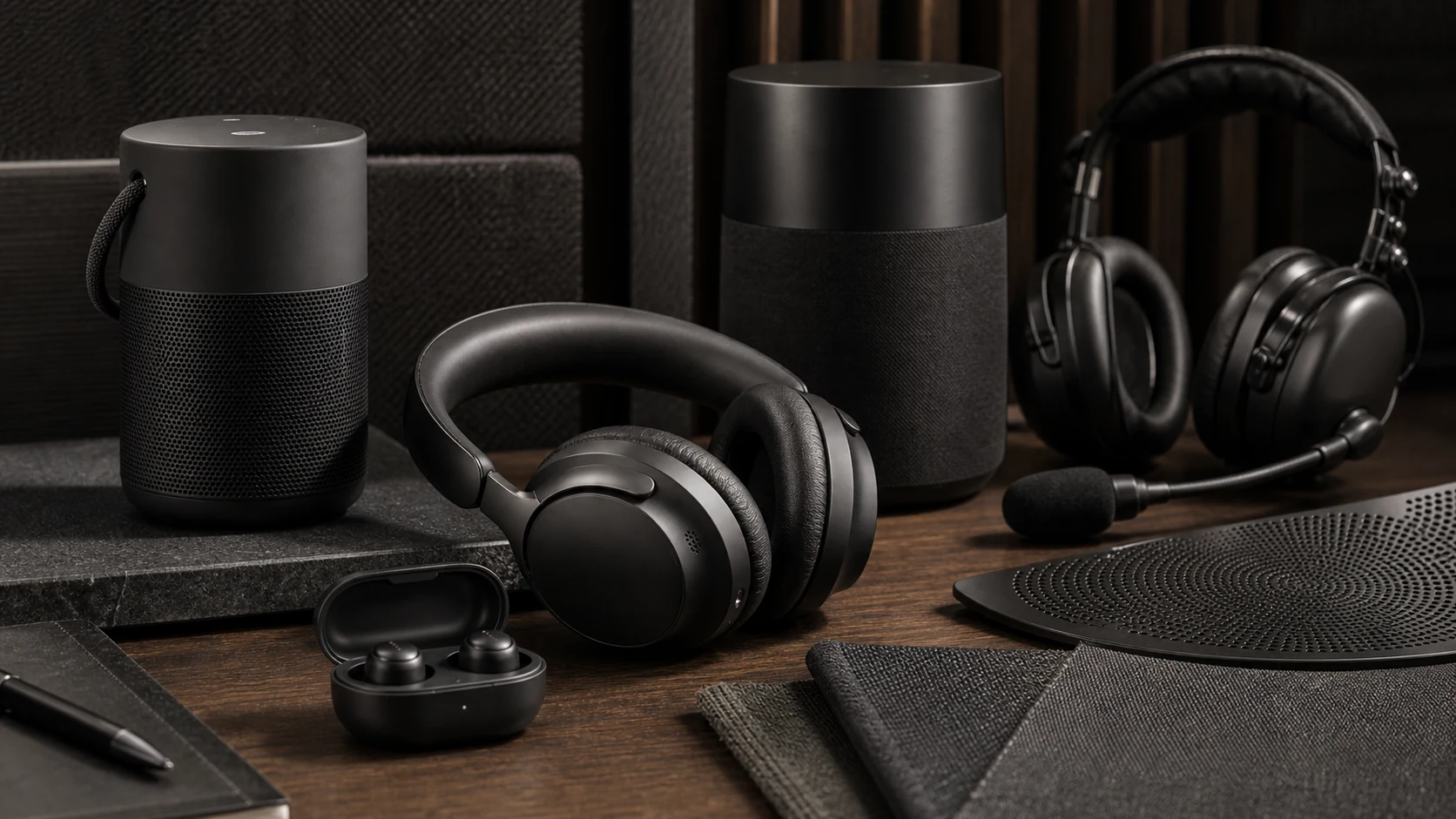
Audio breadth stays under one name
The product proof is breadth: headphones, earbuds, speakers, home theater, aviation, automotive, and portable PA without turning every line into a separate brand.
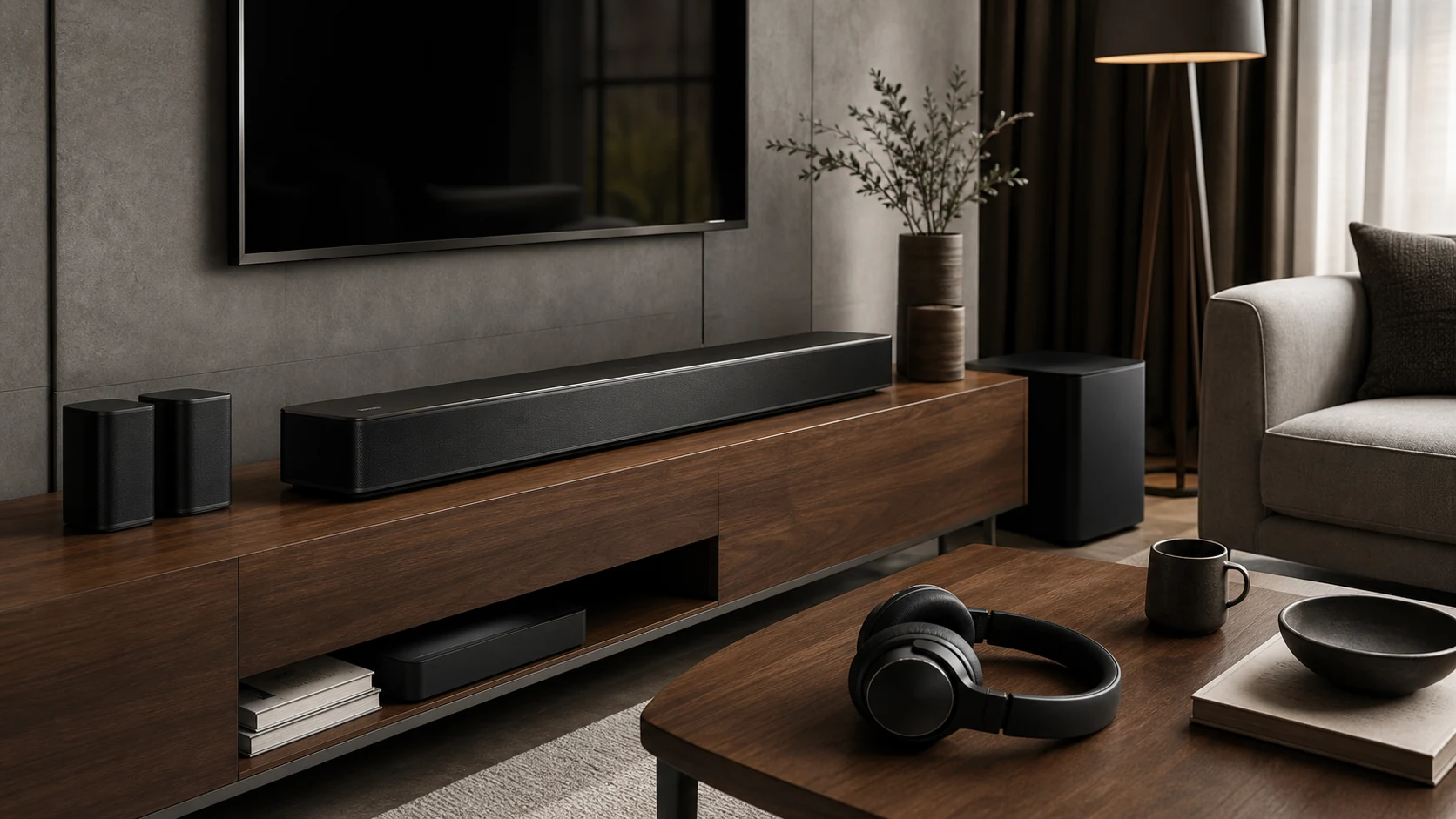
Listening-room system proof
The third evidence point makes the brand a listening system across TV, room speakers, bass, and personal audio.
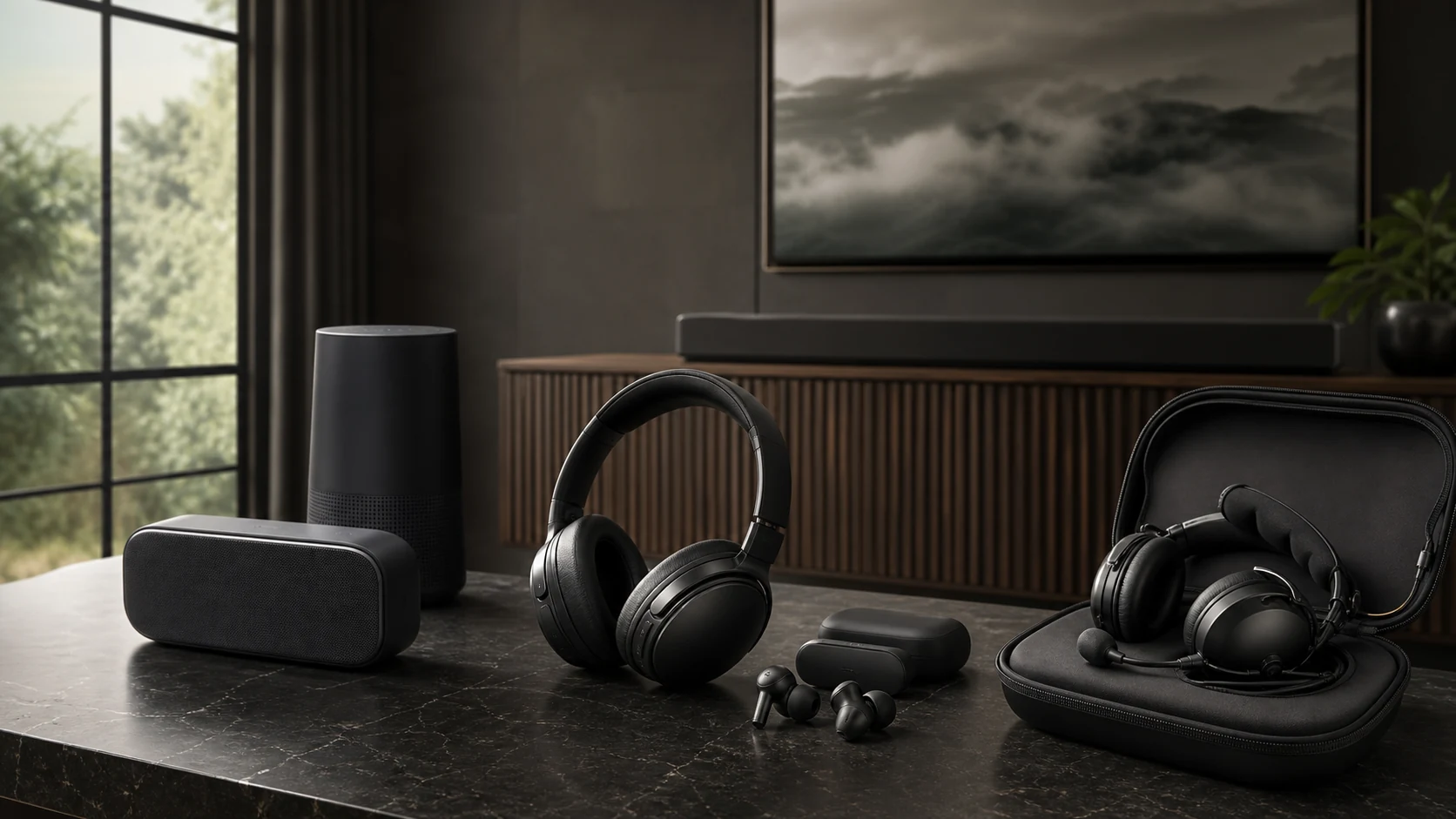
Listening room system proof
Headphones, speakers, and home-audio objects make BOSE a listening system rather than a single device.
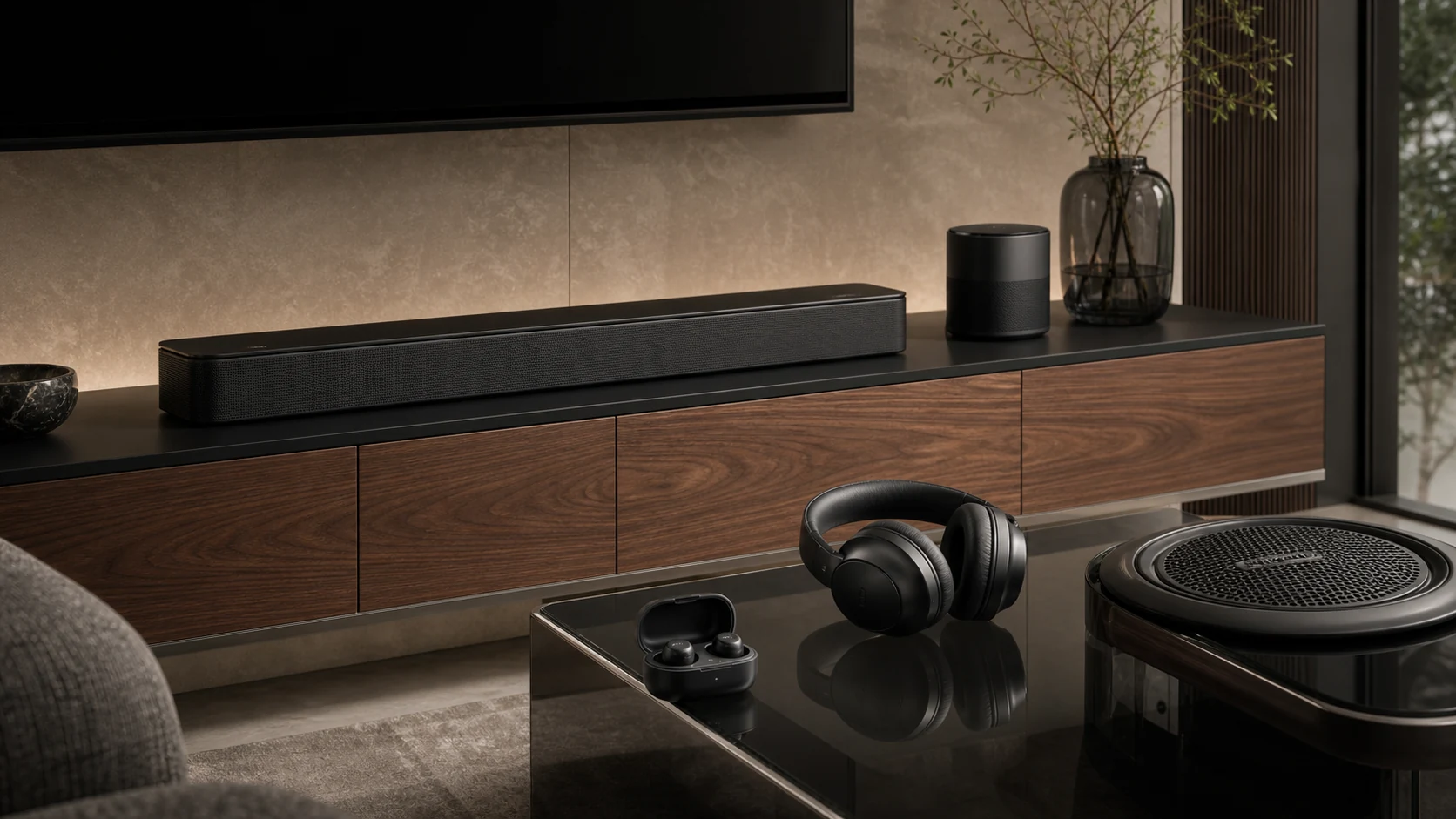
One name spans personal and room audio
The same BOSE signal has to work from earbuds and headphones to soundbars and speakers.
Product and service system
QuietComfort makes noise cancelling, comfort, and premium personal listening the visible buyer job.
BOSE earbuds carry in-ear, open-ear, noise-cancelling, spatial-audio, fitness, travel, and work use cases.
SoundLink and portable speakers show BOSE outside the living room through Bluetooth, waterproof, and portable formats.
Soundbars, subwoofers, surround speakers, and Lifestyle products make the room and TV setup part of the proof.
S1 and L1 portable PA lines let BOSE speak to live performance and small-venue contexts while keeping Bose Professional ownership claims bounded.
A30 and ProFlight make noise reduction and specialist pilot gear part of the wider trust story.
BOSE Automotive adds vehicle cabins, manufacturer relationships, music, seat-centric experiences, and active sound management.
Direct-store policies, product support, repair/replace, trade-in, and My Bose reduce premium-purchase friction.
Bose Professional says it became independent from Bose Corporation in 2023, so current BOSE data must not treat it as a current Bose Corporation division.
Turning points.
Events that changed what buyers could see, buy, repeat, or trust.
Amar Bose founds Bose Corporation.
The 901 Direct/Reflecting speaker makes spatial acoustic research visible.
MIT receives non-voting Bose shares under terms that keep Bose private and independent.
Bose Professional says it became an independent company, separating from Bose Corporation.
BOSE category proof spans personal audio, speakers, home theater, portable PA, aviation, automotive, and direct retail support.
Public reaction.
The useful reaction is about trust and pressure, not sentiment counts.
Direct BOSE retail promises such as returns, price match, shipping/returns, support, repair/replace, trade-in, and My Bose are part of the buying signal.
QuietComfort, SoundLink, Lifestyle, S1, L1, A30, and ProFlight make product selection easier before the buyer has to parse technical specs.
Bose Professional can teach the pro-audio lineage, but current BOSE data must say it separated from Bose Corporation in 2023.
The card should not invent revenue, profit, valuation, or ticker-style metrics for BOSE without a current official source.
Full timeline.
Amar Bose founds Bose Corporation.
The 901 Direct/Reflecting speaker system makes acoustic research visible.
Aviation headset trust expands the noise-reduction story into specialist use.
QuietComfort turns noise cancelling and comfort into a mainstream product language.
MIT receives non-voting shares while Bose remains private and independent.
Bose Professional separates from Bose Corporation.
Steal / avoid.
- Name product families around the buyer job, not internal model logic.
- Make retail trust part of the brand signal when the purchase is expensive, personal, or fit-sensitive.
- Keep private-company metrics bounded. A clean no-number card is stronger than a guessed number card.
- Do not reduce BOSE to one product category.
- Do not use generated, redrawn, stock, or downloaded logo art as source-mark proof.
- Do not claim Bose Professional as a current Bose Corporation division after its 2023 separation.
Short answer.
BOSE is useful for business owners because it shows how a premium brand can keep one master name while product families explain the job: quiet headphones, portable speakers, home theater, aviation headsets, automotive sound, portable PA, retail support, and private-company disclosure discipline.
Frequently asked questions
What is BOSE's core brand signal?
BOSE turns premium sound into easy product choices: quiet headphones, portable speakers, home theater, automotive sound, aviation headsets, portable PA, and retail support.
Is BOSE a public company?
BOSE is private with no public ticker; the company does not publish current revenue, profit, or market-value figures.
Should BOSE teach only QuietComfort?
No. QuietComfort is important, but BOSE should teach the wider premium audio ecosystem: personal listening, home rooms, cars, aviation, portable PA, and retail trust.
Need help with your own brand?
Use Private brand work when your name, identity, proof, or message needs a sharper branding decision.