Procter & Gamble · Grow Your Brand · House-of-brands household trust system · United States / Active
Procter & Gamble
Procter & Gamble turns repeated household problems into a managed portfolio of trusted category brands. A brand page on Procter & Gamble as a house of brands: Tide, Ariel, Dawn, Cascade, Febreze, Pampers, Always, Tampax, Bounty, Charmin, Olay, Pantene, Head & Shoulders, Old Spice, Secret, SK-II, Gillette, Venus, Braun, Crest, Oral-B, Vicks, and the marketing, retail, innovation, and category discipline that makes the parent matter.
Positioning, name, and architecture.
Three evidence checks before the page talks about scale, color, or public reaction.
Procter & Gamble turns repeated household problems into a managed portfolio of trusted category brands.
A brand page on Procter & Gamble as a house of brands: Tide, Ariel, Dawn, Cascade, Febreze, Pampers, Always, Tampax, Bounty, Charmin, Olay, Pantene, Head & Shoulders, Old Spice, Secret, SK-II, Gillette, Venus, Braun, Crest, Oral-B, Vicks, and the marketing, retail, innovation, and category discipline that makes the parent matter.
Procter & Gamble operates as the parent/company mark for a wider system.
No verified current portfolio-wide tagline; P&G is read through category brands, repeat-use claims, shelf execution, and brand-management discipline.
company system / portfolio architecture
Fabric and home care: Tide, Ariel, Dawn, Cascade, Febreze, Gain, and Mr. Clean turn cleaning into visible household problem-solving. Baby, feminine, and family care: Pampers, Always, Tampax, Bounty, Charmin, and Luvs make trust intimate because the products touch family routines. Beauty: Olay, Pantene, Head & Shoulders, SK-II, and hair-care systems translate proof into visible personal outcomes. Grooming: Gillette, Venus, Braun, Old Spice, and Secret give the portfolio precision, habit, and personal-care memory. Health care and oral care: Crest, Oral-B, Vicks, Pepto-Bismol, and Metamucil attach the system to credibility, relief, and prevention. Retail and category management: P&G wins when shelf, packaging, coupon, proof claim, media, and replenishment all agree. Brand management discipline: The parent brand is less about public glamour and more about repeatable decisions across claims, categories, research, and distribution. Portfolio pruning and acquisition: Gillette, Duracell exit, beauty pruning, and category focus show that a house of brands must remove as well as add.
Tide, Ariel, Dawn, Cascade, Febreze, Gain, and Mr. Clean turn cleaning into visible household problem-solving.
Portfolio family: Fabric and home care source
Pampers, Always, Tampax, Bounty, Charmin, and Luvs make trust intimate because the products touch family routines.
Portfolio family: Baby, feminine, and family care source
Olay, Pantene, Head & Shoulders, SK-II, and hair-care systems translate proof into visible personal outcomes.
Portfolio family: Beauty source
Gillette, Venus, Braun, Old Spice, and Secret give the portfolio precision, habit, and personal-care memory.
Portfolio family: Grooming source
Crest, Oral-B, Vicks, Pepto-Bismol, and Metamucil attach the system to credibility, relief, and prevention.
Portfolio family: Health care and oral care source
P&G wins when shelf, packaging, coupon, proof claim, media, and replenishment all agree.
Portfolio family: Retail and category management source
The parent brand is less about public glamour and more about repeatable decisions across claims, categories, research, and distribution.
Portfolio family: Brand management discipline source
Gillette, Duracell exit, beauty pruning, and category focus show that a house of brands must remove as well as add.
Portfolio family: Portfolio pruning and acquisition source
Naming and tagline progression
William Procter and James Gamble form the company in Cincinnati.
Ivory soap launches and gives P&G an early purity claim people can remember.
P&G sponsors radio serials, helping create the soap-opera link between household brands and media habits.
Market and scale snapshot.
P&G's FY2025 revenue, net income, and operating cash flow show the scale behind a house of brands spanning fabric care, baby care, beauty, grooming, health, and oral care.
FY2025 net sales in USD.
FY2025 net earnings attributable to P&G in USD.
Observed 10 Jul 2026 from StockAnalysis; market capitalization changes with share price.
FY2025 net cash provided by operating activities.
The Procter & Gamble Company.
The parent manages category promises rather than asking one masterbrand to sell everything.
Each category needs a separate problem, proof, and repeat-use cue.
P&G's long advantage is disciplined category marketing and retail execution.
Color system.
P&G blue identifies the parent and brand-management institution while category flagships keep their own shelf colors, claims, and pack codes.
How the palette behaves
Deep blue anchors the P&G parent mark without pretending it is the consumer's main shelf cue.
Bright blue separates corporate and retail-system proof from Tide, Pampers, Gillette, Crest, and other category brands.
Black and white leave room for each flagship's packaging, problem-solution claim, and retail discipline.
Recognition assets.
Memory pieces the brand can use before someone finishes a sentence.
The P&G mark signals governance and corporate trust, not a single product promise.
Tide, Pampers, Gillette, Olay, Crest, Dawn, Bounty, Charmin, Always, and Vicks each own a different household job.
P&G brands usually win with visible before/after logic: clean, dry, fresh, smooth, protected, relieved.
Packaging color, claim hierarchy, size architecture, and replenishment drive recognition at the shelf.
Scores.
Use these scores to compare recognition, trust, proof, pressure, and risk.
The parent is known, but the sub-brands carry most consumer memory.
The house-of-brands model is the page's main lesson.
P&G operates in intimate, repeat-use household categories where proof matters.
The warmth comes through routines: baby care, clean clothes, grooming, oral care, and home comfort.
P&G only reads correctly when the page keeps fabric care, home care, baby care, family care, beauty, grooming, health care, oral care, retail execution, and portfolio pruning in view.
Procter & Gamble needs parent, product, service, and history lanes labeled cleanly so search systems do not flatten the brand into one vague entity.
Procter & Gamble turns repeated household problems into a managed portfolio of trusted category brands.
Tide, Pampers, Gillette, Crest, Oral-B, Olay, Dawn, and other category leaders prove P&G's portfolio authority at household scale.
How the logo changed.
The parent identity moves from the restrained 2001 P&G wordmark to the current blue circular mark; portfolio-brand logos belong in the brand architecture, not this chronology.
The parent mark signals company governance behind many consumer relationships.
The current blue mark keeps the parent restrained while product brands carry most memory.
Product and service lineage.
P&G only reads correctly when the page keeps fabric care, home care, baby care, family care, beauty, grooming, health care, oral care, retail execution, and portfolio pruning in view.
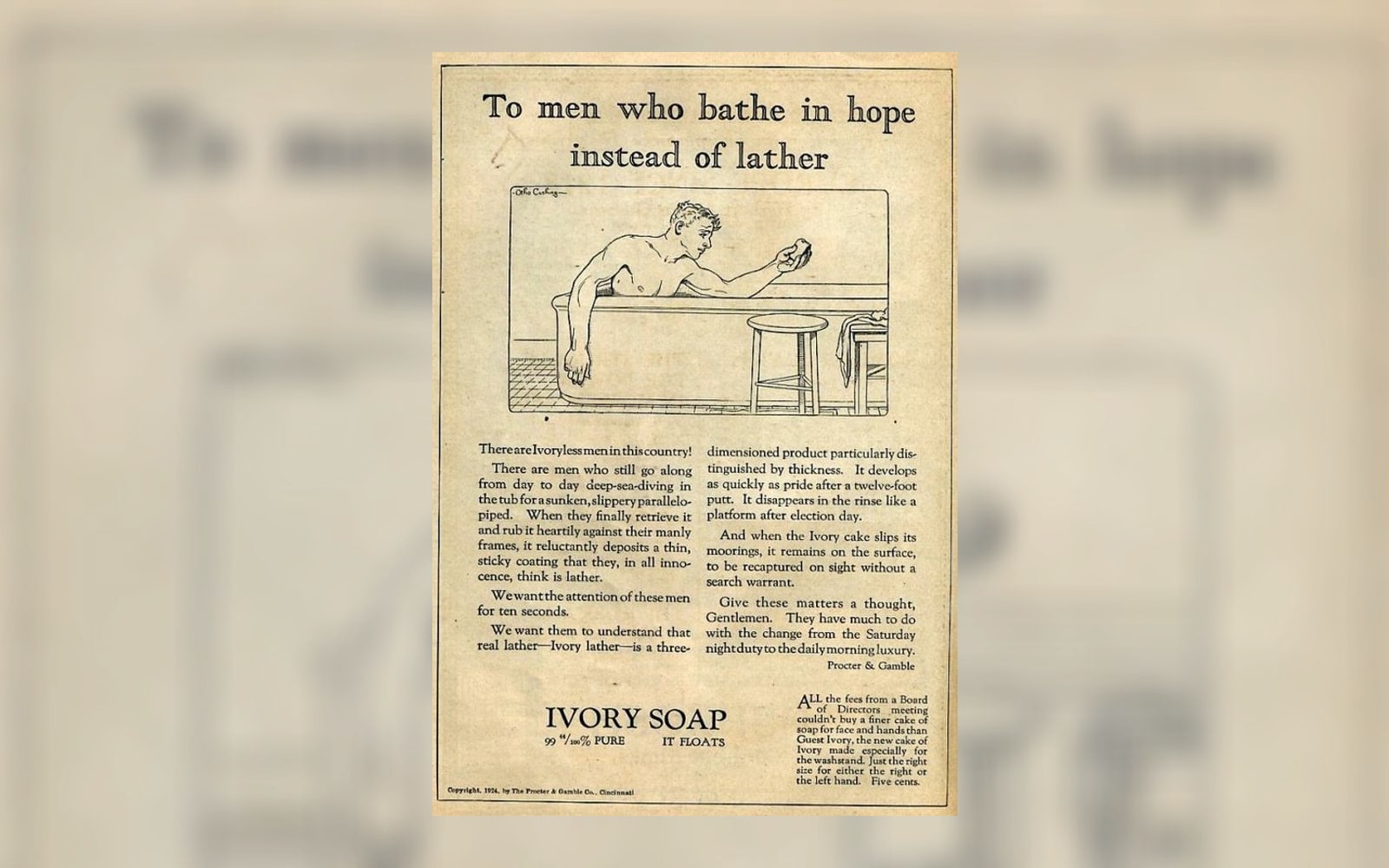
Ivory made purity repeatable
The early soap promise shows the P&G method: one product cue, one remembered claim, repeated until it becomes household memory.
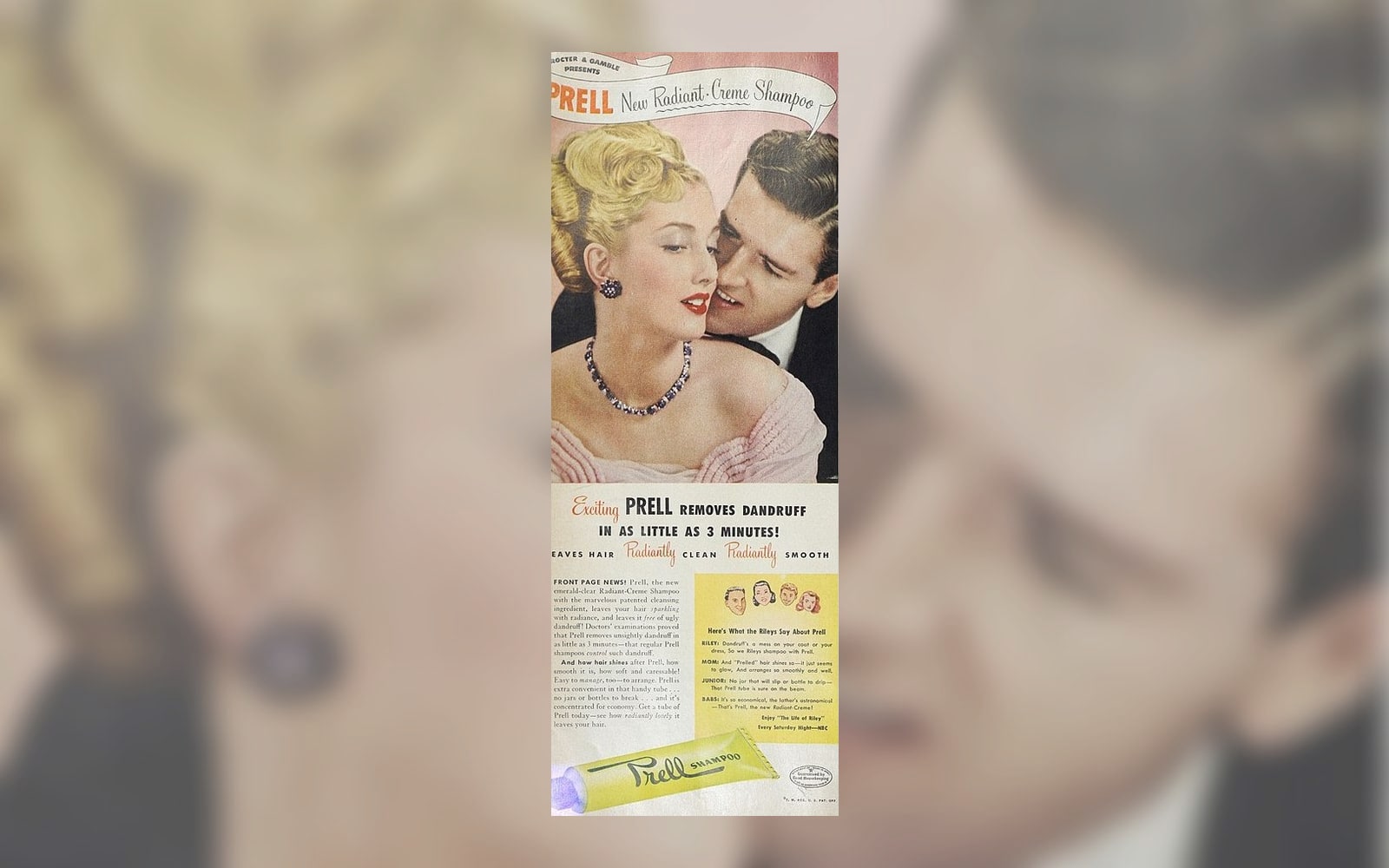
Beauty moved through demonstration
P&G brand-building often works by showing a product problem, a visible outcome, and a repeatable name.

House-of-brands discipline
The parent matters because Tide, Dawn, Pampers, Always, Bounty, Charmin, Olay, Pantene, Gillette, Braun, Crest, Oral-B, and Vicks need governance.

Scale without one flagship
P&G is strongest when the card shows category roles and flagship brands instead of pretending one product explains the company.
Product and service system
Tide, Ariel, Dawn, Cascade, Febreze, Gain, and Mr. Clean turn cleaning into visible household problem-solving.
Pampers, Always, Tampax, Bounty, Charmin, and Luvs make trust intimate because the products touch family routines.
Olay, Pantene, Head & Shoulders, SK-II, and hair-care systems translate proof into visible personal outcomes.
Gillette, Venus, Braun, Old Spice, and Secret give the portfolio precision, habit, and personal-care memory.
Crest, Oral-B, Vicks, Pepto-Bismol, and Metamucil attach the system to credibility, relief, and prevention.
P&G wins when shelf, packaging, coupon, proof claim, media, and replenishment all agree.
The parent brand is less about public glamour and more about repeatable decisions across claims, categories, research, and distribution.
Gillette, Duracell exit, beauty pruning, and category focus show that a house of brands must remove as well as add.
Turning points.
Events that changed what buyers could see, buy, repeat, or trust.
Tide launches and makes synthetic detergent a mass household category.
Crest begins building oral-care credibility around fluoride and dentist-backed proof.
Pampers launches and moves P&G into disposable baby-care trust.
Public reaction.
The useful reaction is about trust and pressure, not sentiment counts.
The strongest P&G proof is quiet repetition: a household buys the same brand because the claim worked last week and the shelf cue is easy to find.
The brand weakens when a claim feels inflated, a formula change breaks habit, or the portfolio becomes so broad that category roles blur.
Full timeline.
William Procter and James Gamble form the company in Cincinnati.
Ivory soap launches and gives P&G an early purity claim people can remember.
P&G sponsors radio serials, helping create the soap-opera link between household brands and media habits.
Tide launches and makes synthetic detergent a mass household category.
Crest begins building oral-care credibility around fluoride and dentist-backed proof.
Pampers launches and moves P&G into disposable baby-care trust.
The company expands global category management and international household reach.
P&G acquires Richardson-Vicks, strengthening health and personal care.
P&G acquires Noxell and adds CoverGirl and Noxzema to beauty and personal care.
P&G acquires Gillette, adding blades, razors, Braun, Oral-B, and Duracell.
P&G begins major portfolio pruning to focus on stronger brands and categories.
P&G exits much of its beauty portfolio through the Coty transaction.
P&G reorganizes into category-focused sector business units.
FY2025 results show a focused house of brands rather than a one-product consumer-goods company.
Steal / avoid.
- Give every product family a specific household problem to own.
- Use claims only when packaging, proof, retail, media, and repeat use can carry them.
- Prune the portfolio when too many brands weaken category focus.
- Let the parent brand govern the system without forcing the parent logo onto every consumer relationship.
- Do not reduce P&G to soap, Tide, or one corporate logo.
- Do not hide Pampers, Always, Bounty, Charmin, Olay, Pantene, Gillette, Braun, Crest, Oral-B, Vicks, Dawn, Cascade, Febreze, and Gain.
- Do not use fake package labels or an invented supermarket shelf.
- Do not skip middle-history events like radio sponsorship, Tide, Crest, Pampers, Gillette, portfolio pruning, and Coty.
Short answer.
Procter & Gamble should be read as a house-of-brands machine. The useful lesson is to assign each category brand a specific household problem, proof claim, retail cue, and repeat-use memory, then prune anything that weakens the system.
Frequently asked questions
What is Procter & Gamble's core brand signal?
Procter & Gamble turns repeated household problems into a managed portfolio of trusted category brands.
Why not describe Procter & Gamble as one product?
Because P&G spans fabric and home care, baby and family care, beauty, grooming, health, oral care, and many flagship brands; one detergent cannot explain the house-of-brands system.
What should another brand steal from Procter & Gamble?
Give every product family a specific household problem to own.
Need help with your own brand?
Use Private brand work when your name, identity, proof, or message needs a sharper branding decision.
Sources.
Use the education shelf for the concepts behind this brand page.
Private brand workIf a parent company manages strong category brands that consumers know better than the corporate name, Private Brand Work can define parent governance and the promise each brand must own.
All brandsReturn to every brand page.
- https://www.sec.gov/Archives/edgar/data/80424/000008042425000076/pg-20250630.htm
- https://us.pg.com/pg-history/
- https://us.pg.com/brands/
- https://us.pg.com/structure-and-governance/corporate-structure/
- https://us.pg.com/structure-and-governance/corporate-structure/
- https://us.pg.com/structure-and-governance/corporate-structure/
- https://us.pg.com/structure-and-governance/corporate-structure/
- https://us.pg.com/structure-and-governance/corporate-structure/
- https://us.pg.com/who-we-are/
- StockAnalysis, P&G market capitalization