Saudi Aramco · Grow Your Brand · Energy scale and public-listing proof · Saudi Arabia / Active
Saudi Aramco
Aramco’s name preserves an American connection from 1944. Arabian American Oil Company supplied the shortened name. Saudi ownership grew in stages during the 1970s and reached 100 percent in 1980; the Saudi Arabian Oil Company was established in 1988. The name and ownership dates tell different parts of the story.
Positioning, name, and architecture.
Three evidence checks before the page talks about scale, color, or public reaction.
Saudi Aramco turns reserves, production, downstream assets, and public listing into one scale signal.
A brand page on Saudi Aramco as a state-scale energy system: upstream oil and gas, Master Gas System, refining, chemicals, SABIC, trading, Motiva, SATORP, Yasref, and the public listing discipline.
Saudi Aramco operates as the parent/company mark for a wider system.
Aramco now carries the public identity across upstream, downstream, chemicals, and investor surfaces.
company system / portfolio architecture
Upstream oil and gas: Reserve base, production capacity, and field operations are the foundation cue. Master Gas System: Domestic gas infrastructure links the company to national industrial development. Refining and downstream: Refineries, fuels, lubricants, and distribution make the brand visible beyond extraction. SABIC and chemicals: Chemicals give the portfolio a materials and industrial-products lane. Trading and global supply: Aramco Trading and shipping flows make the company a market and logistics system. Motiva, SATORP, Yasref, and ventures: Joint ventures and owned downstream assets show the brand outside one headquarters or field. Public listing and dividends: The IPO and dividend story make state-scale energy visible to market investors.
Reserve base, production capacity, and field operations are the foundation cue.
Operating business: Upstream oil and gas source
Domestic gas infrastructure links the company to national industrial development.
Infrastructure system: Master Gas System source
Refineries, fuels, lubricants, and distribution make the brand visible beyond extraction.
Operating business: Refining and downstream source
Chemicals give the portfolio a materials and industrial-products lane.
Chemicals business: SABIC and chemicals source
Aramco Trading and shipping flows make the company a market and logistics system.
Trading and logistics: Trading and global supply source
Joint ventures and owned downstream assets show the brand outside one headquarters or field.
Joint-venture network: Motiva, SATORP, Yasref, and ventures source
The IPO and dividend story make state-scale energy visible to market investors.
Investor context: Public listing and dividends source
Naming and tagline progression
Saudi Arabia grants the original oil concession to Standard Oil of California.
Commercial oil is discovered at Dammam Well No. 7.
The company name changes to Arabian American Oil Company.
Market and scale snapshot.
FY2025 results and a dated public-market observation show the operating and investor scale behind Saudi Aramco.
FY2025 consolidated revenue reported by Aramco.
FY2025 consolidated net income reported by Aramco.
Dated 10 Jul 2026 market-cap observation converted from SAR at the currency peg.
Publicly listed with majority ownership held by the Government of Saudi Arabia.
Color system.
Aramco's blue-green system connects the corporate mark to fields, gas infrastructure, refining, chemicals, trading, and global facilities.
How the palette behaves
Deep blue anchors the Aramco name and the scale of fields, towers, pipelines, and facilities.
Bright blue separates gas, refining, trading, and global supply from the upstream oil shorthand.
Green marks chemicals and transition claims that require operating proof beyond the energy symbol.
Recognition assets.
Memory pieces the brand can use before someone finishes a sentence.
The palette has to hold engineering, energy, and national-scale trust.
Corporate and industrial scale are both needed; one without the other is incomplete.
The useful cue is the chain from reserves to products, trading, and dividends.
Public trust is tied to national strategy as much as product recognition.
Scores.
Use these scores to compare recognition, trust, proof, pressure, and risk.
The mark is globally known in energy and capital markets.
Revenue, production, reserves, and dividends make scale visible.
SABIC, trading, refining, and ventures need separation.
Energy-transition scrutiny raises the proof burden.
Upstream production, gas infrastructure, refining, chemicals, storage, and trading make the full Saudi Aramco system visible.
Saudi Aramco needs parent, product, service, and history lanes labeled cleanly so search systems do not flatten the brand into one vague entity.
Saudi Aramco turns reserves, production, downstream assets, and public listing into one scale signal.
Production, gas, refining, chemicals, storage, trading, and the public listing keep Saudi Aramco anchored in the full energy system.
How the logo changed.
Three sourced masterbrand stages show the move from an industrial monogram to the current Aramco starburst lockup.
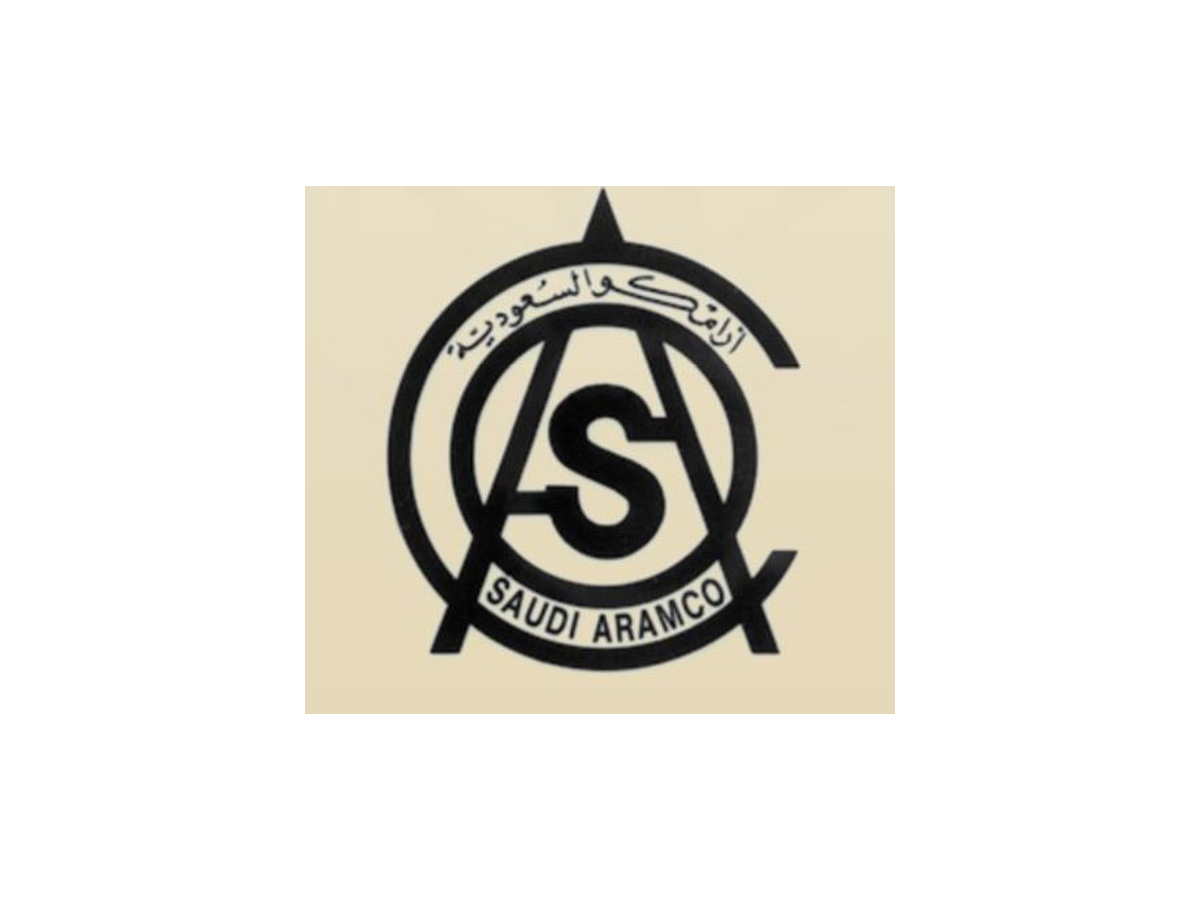
The mid-century circular mark combines Arabic lettering, the Saudi Aramco name, and a compact industrial monogram. source
The bilingual lockup pairs the blue-and-green energy burst with the full Saudi Aramco name. source
The current identity shortens the public name to Aramco while preserving the blue-and-green energy burst. source
Product and service lineage.
Upstream production, gas infrastructure, refining, chemicals, storage, and trading make the full Saudi Aramco system visible.
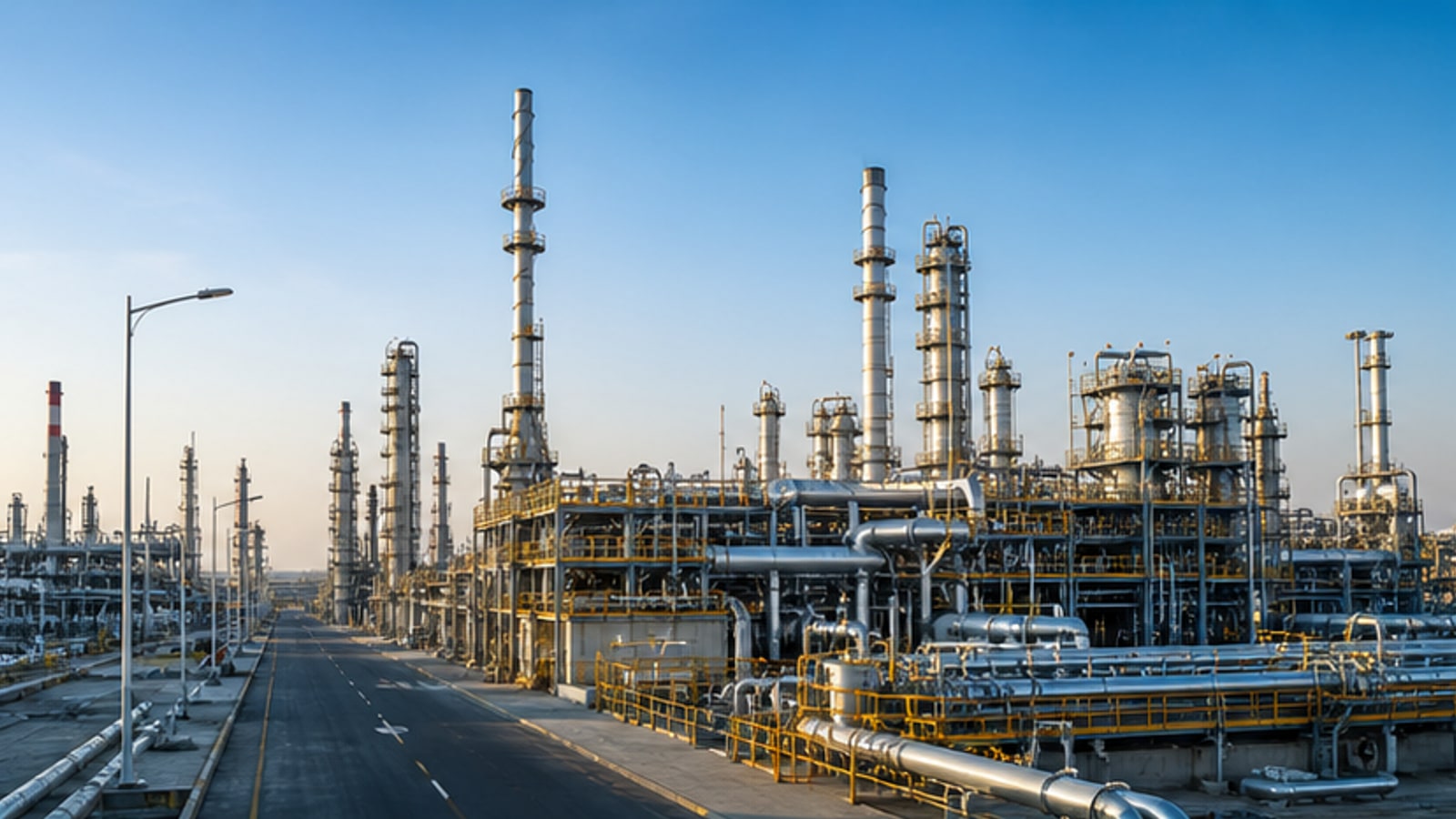
Refining makes downstream scale visible
A dense refinery system shows how the company extends beyond extraction into fuels and industrial processing.
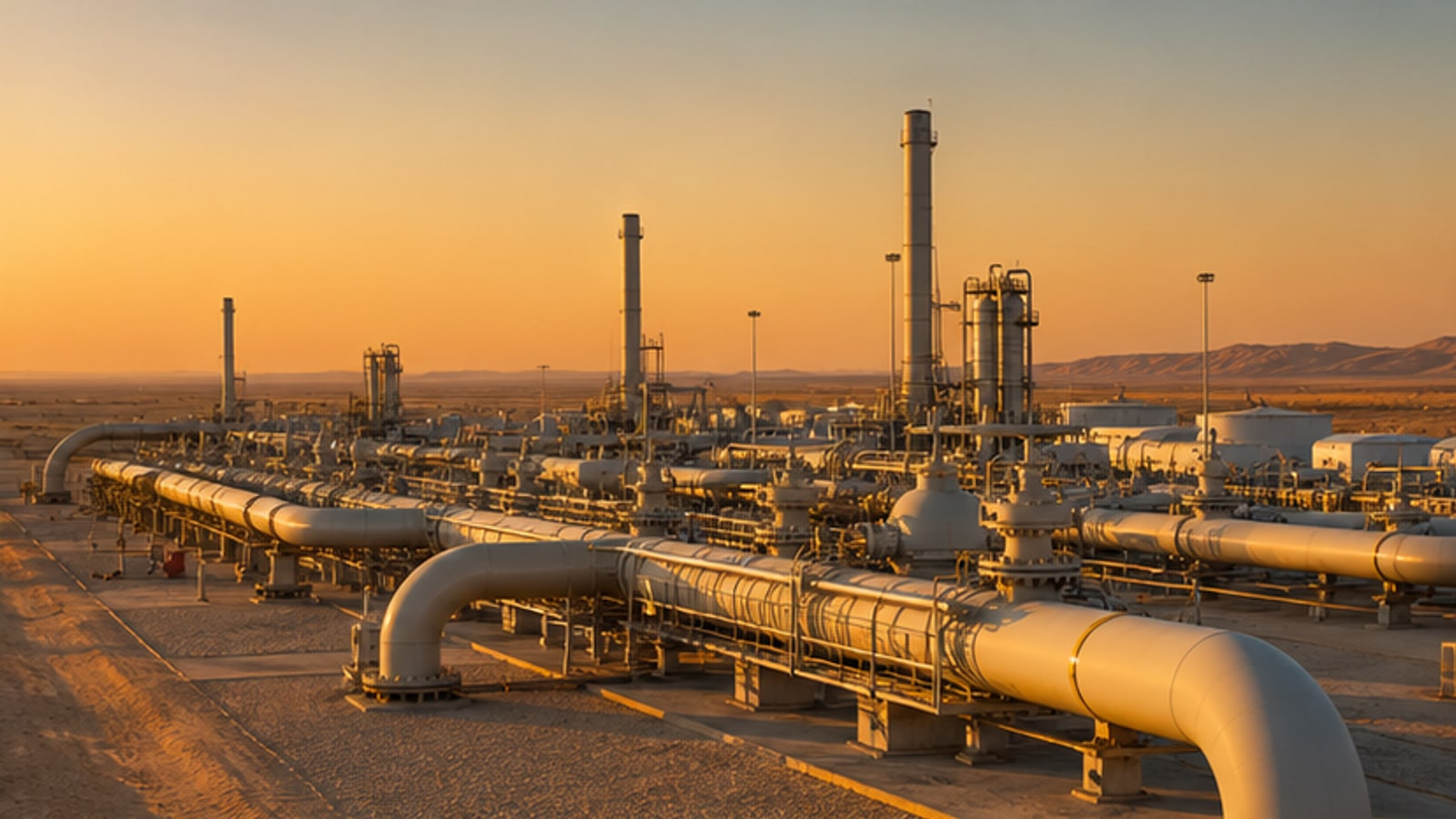
Gas infrastructure connects the system
Pipelines and processing equipment make domestic industrial infrastructure part of the company signal.
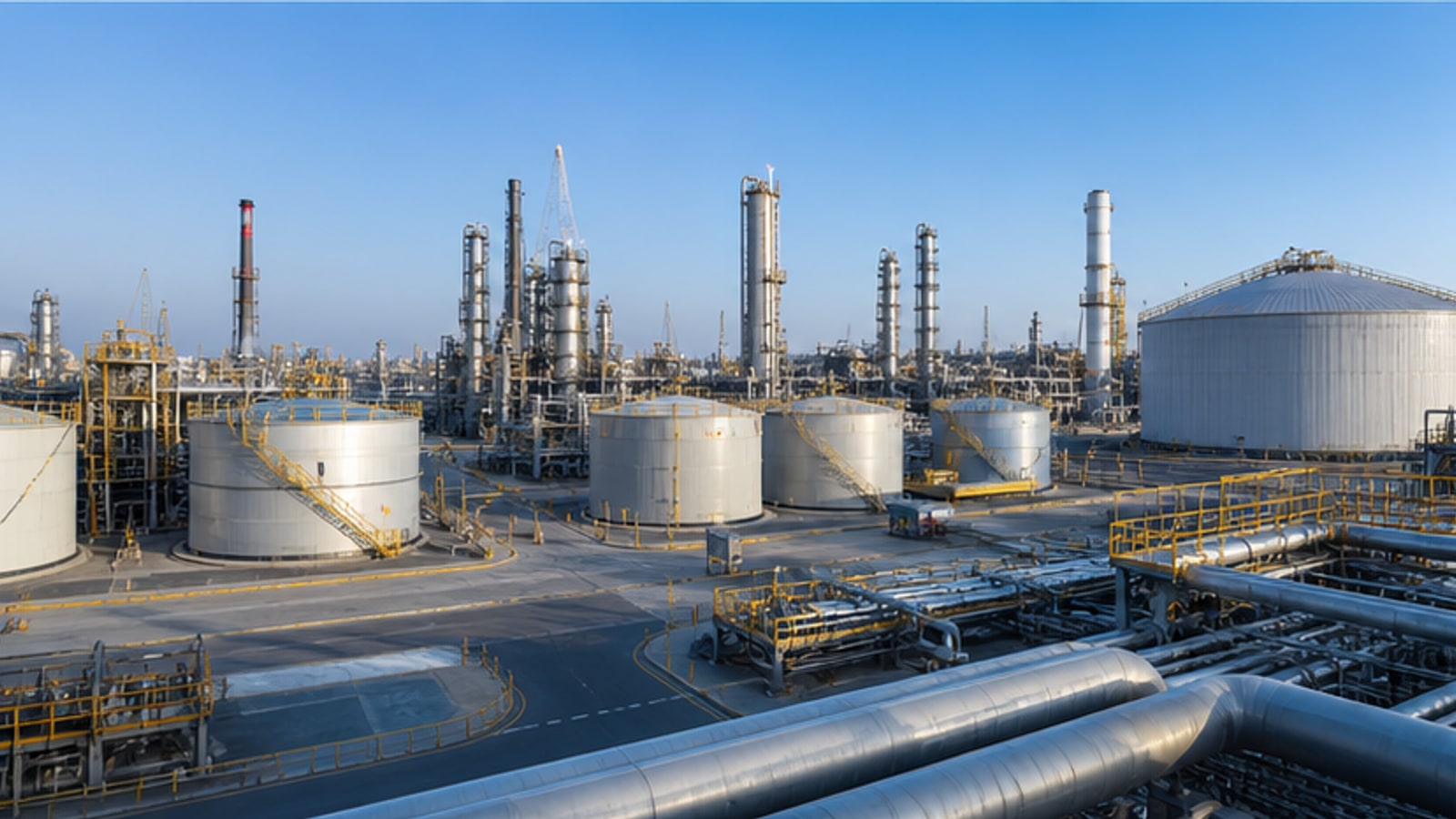
Storage links production to markets
Tank farms and logistics show the physical bridge between processing capacity and product movement.
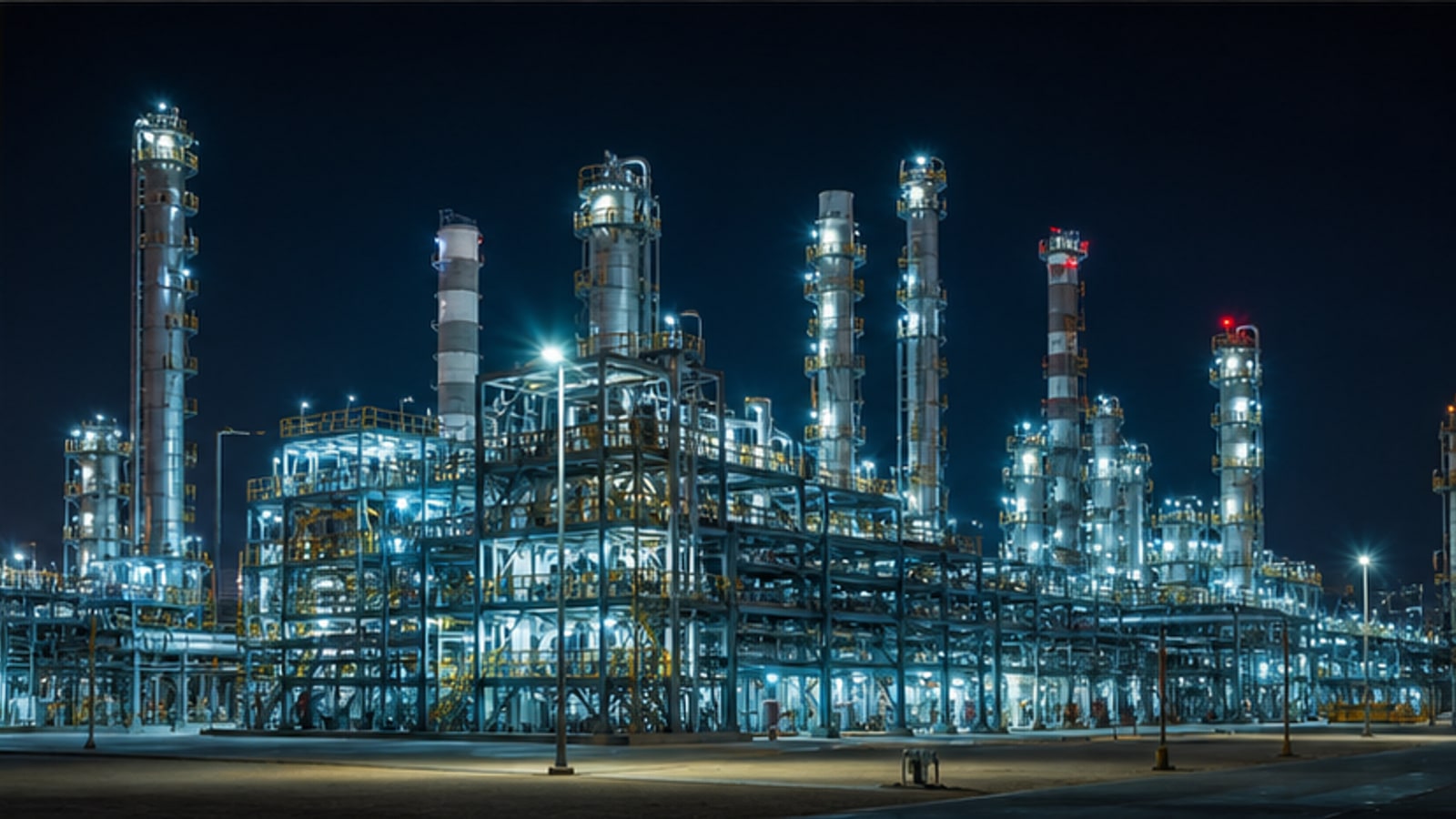
Continuous operations carry the scale
A working night refinery makes the capital intensity and operating continuity easy to see.
Product and service system
Reserve base, production capacity, and field operations are the foundation cue.
Domestic gas infrastructure links the company to national industrial development.
Refineries, fuels, lubricants, and distribution make the brand visible beyond extraction.
Chemicals give the portfolio a materials and industrial-products lane.
Aramco Trading and shipping flows make the company a market and logistics system.
Joint ventures and owned downstream assets show the brand outside one headquarters or field.
The IPO and dividend story make state-scale energy visible to market investors.
Turning points.
Events that changed what buyers could see, buy, repeat, or trust.
The Trans-Arabian Pipeline begins service and changes export reach.
Saudi Arabia begins acquiring ownership participation in Aramco.
Saudi Arabia completes full ownership of Aramco.
Public reaction.
The useful reaction is about trust and pressure, not sentiment counts.
The strongest Aramco proof is scale that can be traced from reserve base to refining, chemicals, trading, cash flow, and dividends.
The brand weakens when it is described only as an oil company and transition, chemicals, downstream, and public-market obligations disappear.
Full timeline.
Saudi Arabia grants the original oil concession to Standard Oil of California. Source
Commercial oil is discovered at Dammam Well No. 7. Source
The company name changes to Arabian American Oil Company. Source
The Trans-Arabian Pipeline begins service and changes export reach. Source
Saudi Arabia begins acquiring ownership participation in Aramco. Source
Saudi Arabia completes full ownership of Aramco. Source
Saudi Arabian Oil Company is established by royal decree. Source
Aramco assumes responsibility for domestic refining, marketing, and distribution assets. Source
The company accelerates gas and downstream investment to support industrial growth. Source
Motiva becomes wholly owned by Saudi Aramco. Source
Saudi Aramco lists shares on Tadawul in a historic IPO. Source
Aramco completes the SABIC acquisition. Source
The company reports record earnings during the energy-price surge. Source
Aramco remains a global energy, chemicals, trading, and dividend-scale company. Source
Steal / avoid.
- Show the full chain from resource to product, market, and owner.
- Use scale only when the proof path is visible.
- Keep state signal, industrial signal, and investor signal separate enough to inspect.
- Do not reduce Saudi Aramco to crude oil only.
- Do not ignore SABIC, refining, trading, Motiva, and joint ventures.
- Do not use non-USD figures in the public market snapshot.
Short answer.
Aramco comes from Arabian American Oil Company, the name adopted in 1944. Saudi government ownership rose from 25 percent in 1973 to full ownership in 1980. Saudi Aramco was formally established in 1988 to take over the earlier company's responsibilities.
Frequently asked questions
What does Aramco stand for?
Aramco originated as a shortened form of Arabian American Oil Company, the name adopted in 1944. Its predecessor was the California Arabian Standard Oil Company, formed to manage the Saudi oil concession signed in 1933. The name preserves that early American connection.
When did Aramco become Saudi-owned?
The Saudi government acquired a 25 percent interest in 1973, increased it to 60 percent in 1974 and reached full ownership in 1980. The Saudi Arabian Oil Company, or Saudi Aramco, was formally established in 1988 to take over the earlier company’s responsibilities. These are separate milestones in its ownership and legal history.
What was Aramco called before Arabian American Oil Company?
Its predecessor was the California Arabian Standard Oil Company, formed to manage the Saudi oil concession signed in 1933. It adopted the Arabian American Oil Company name in 1944.
When did Aramco buy its majority stake in SABIC?
Aramco announced completion of its purchase of a 70% stake in SABIC from Saudi Arabia's Public Investment Fund on June 17, 2020. The announced purchase price was SAR 259.125 billion, or US$69.1 billion. That was a majority-stake transaction, not a purchase of every SABIC share.
What does SABIC stand for, and why did Aramco buy into it?
SABIC stands for Saudi Basic Industries Corporation. Aramco's 2020 acquisition announcement described the investment as a way to expand its chemicals business and connect refining with petrochemical production. SABIC was the chemical company being acquired; it was not a new name for Aramco's oil business.
Need help with your own brand?
Use Private brand work when your name, identity, proof, or message needs a sharper branding decision.
Sources.
Use the education shelf for the concepts behind this brand page.
Private brand workIf one industrial name covers resources, infrastructure, manufacturing, trading, and transition claims, Private Brand Work can assign visible proof to each operating layer.
All brandsReturn to every brand page.
- https://www.aramco.com/en/investors/reports-and-presentations
- https://www.aramco.com/en/investors/annual-report
- https://www.aramco.com/en/about-us
- https://www.aramco.com/en/what-we-do/energy-products
- https://www.aramco.com/en/what-we-do/energy-products/chemicals
- https://www.aramco.com/en/news-media/news/2020/saudi-aramco-completes-acquisition-of-70-percent-stake-in-sabic
- https://www.aramco.com/en/news-media/news/2019/saudi-aramco-listed-on-tadawul
- https://www.motiva.com/home
- https://americas.aramco.com/en/about-us/our-history
- https://japan.aramco.com/en/about-us/aramco-overview/history-of-aramco