Trust / Enterprise software / database / cloud / 1977-present
Oracle and the Database Trust System
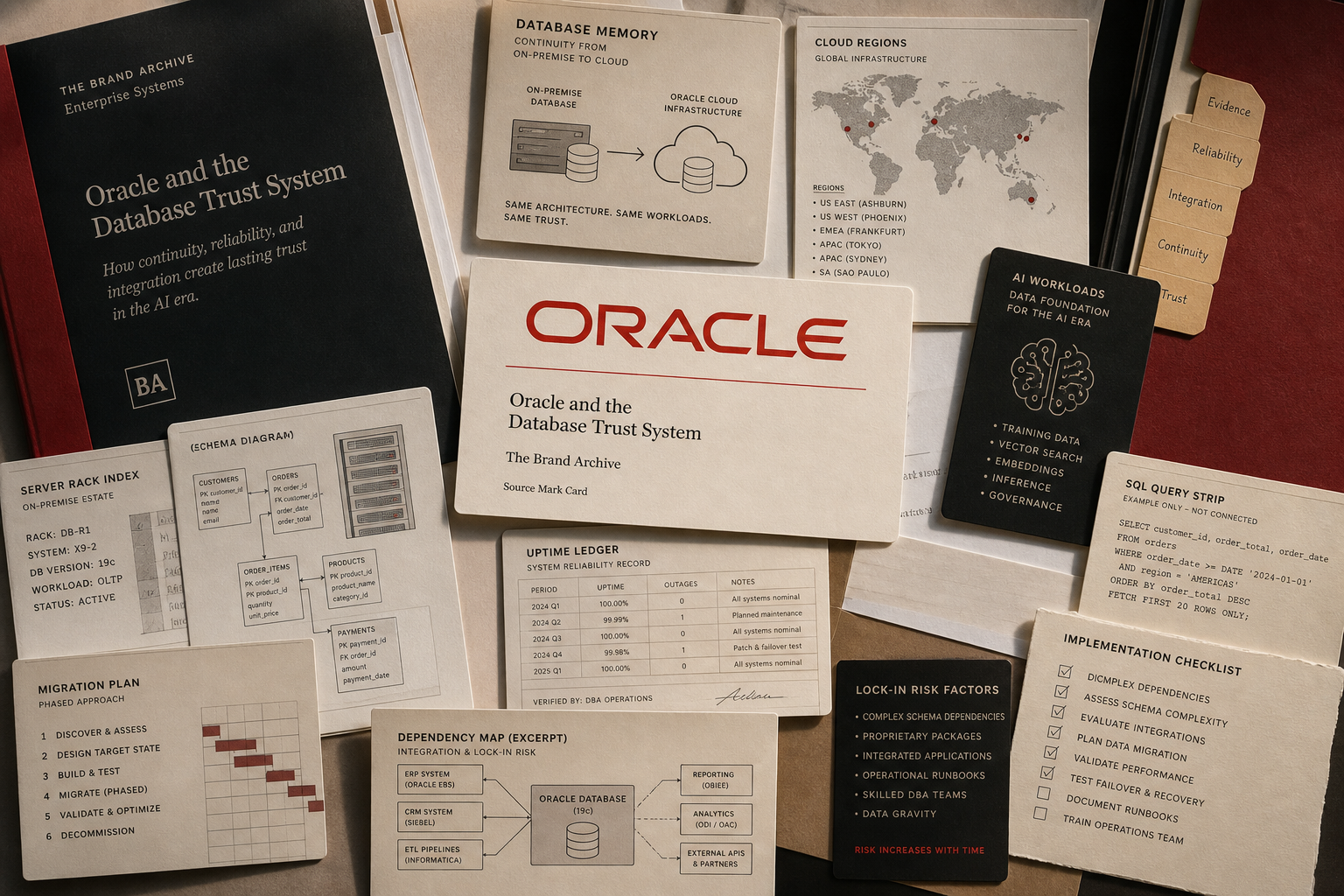
Oracle built enterprise trust around data persistence, database memory, implementation depth, cloud migration, and the belief that critical systems will keep running.

Short Answer
Oracle and the Database Trust System is a trust case about Oracle in 1977-present. Oracle made database continuity the brand asset. Enterprise trust is built through continuity, compatibility, integration, and recovery behavior. A cloud repositioning works only if it protects the system memory buyers already depend on.
Key Takeaways
- Oracle's public memory is tied to databases and enterprise systems that organizations cannot treat casually.
- The database brand grew because customers attached Oracle to persistence, scale, support, and mission-critical data work.
- Cloud and AI workloads add a new promise, but they do not erase the old trust burden.
- Migration raises brand risk because the buyer is moving data, process, people, and dependencies at once.
- The operator lesson is to protect the old proof while training the market to trust the new architecture.
The Decision Context
Oracle is a trust case because enterprise database decisions sit close to business risk. The buyer is not only choosing software. The buyer is deciding where critical data, processes, reports, audits, and integrations will live.
That makes Oracle different from a normal software brand. The company has to carry memory from on-premise database systems into cloud infrastructure and AI-era workloads without making continuity feel negotiable.
Database Memory Became The Asset
A database brand gets stronger when customers believe the system will preserve what the business cannot lose. Uptime, performance, backup, recovery, security, compatibility, support, and skilled labor all feed that belief.
That memory can be powerful, but it also creates gravity. Once a system becomes part of how a company runs, the brand is judged by migration risk as much as by new product claims.
Cloud Changed The Proof Burden
Oracle Cloud Infrastructure asks the market to carry old trust into a newer operating model. The pitch cannot be only cloud capacity. It has to answer whether workloads, data governance, enterprise applications, and database habits remain dependable in the new environment.
That is the reframe: cloud is not a fresh start for Oracle. It is a continuity test in public.
The Archive Reading
Oracle belongs in the archive because it shows how a B2B brand can be built around a system customers would rather not disturb.
For operators, the lesson is to make migration proof visible. When the old asset is trust, the new architecture must explain exactly what remains stable, what changes, and who carries the risk.
Comparable Cases
Sources
People Also Ask
What happened to Oracle?
Oracle and the Database Trust System is a trust case about Oracle in 1977-present. Oracle made database continuity the brand asset. Enterprise trust is built through continuity, compatibility, integration, and recovery behavior. A cloud repositioning works only if it protects the system memory buyers already depend on.
Why is Oracle a trust case?
Oracle is filed as a trust case because the visible consequence sits in that decision pattern. Oracle made database continuity the brand asset.
What can brands learn from Oracle?
Enterprise trust is built through continuity, compatibility, integration, and recovery behavior. A cloud repositioning works only if it protects the system memory buyers already depend on.
Is Oracle still operating?
The Brand Archive marks Oracle as Active / continuing. That means the brand, company, platform, product system, or parent organization is still operating, continuing, or being actively resolved.
What should Oracle be compared with?
Compare Oracle with IBM, Microsoft, NVIDIA to see the same decision pattern from nearby cases.