Brand System / Airline / Premium service / 1972-present
Singapore Airlines and the Eye-Level Service System Behind Premium Flight
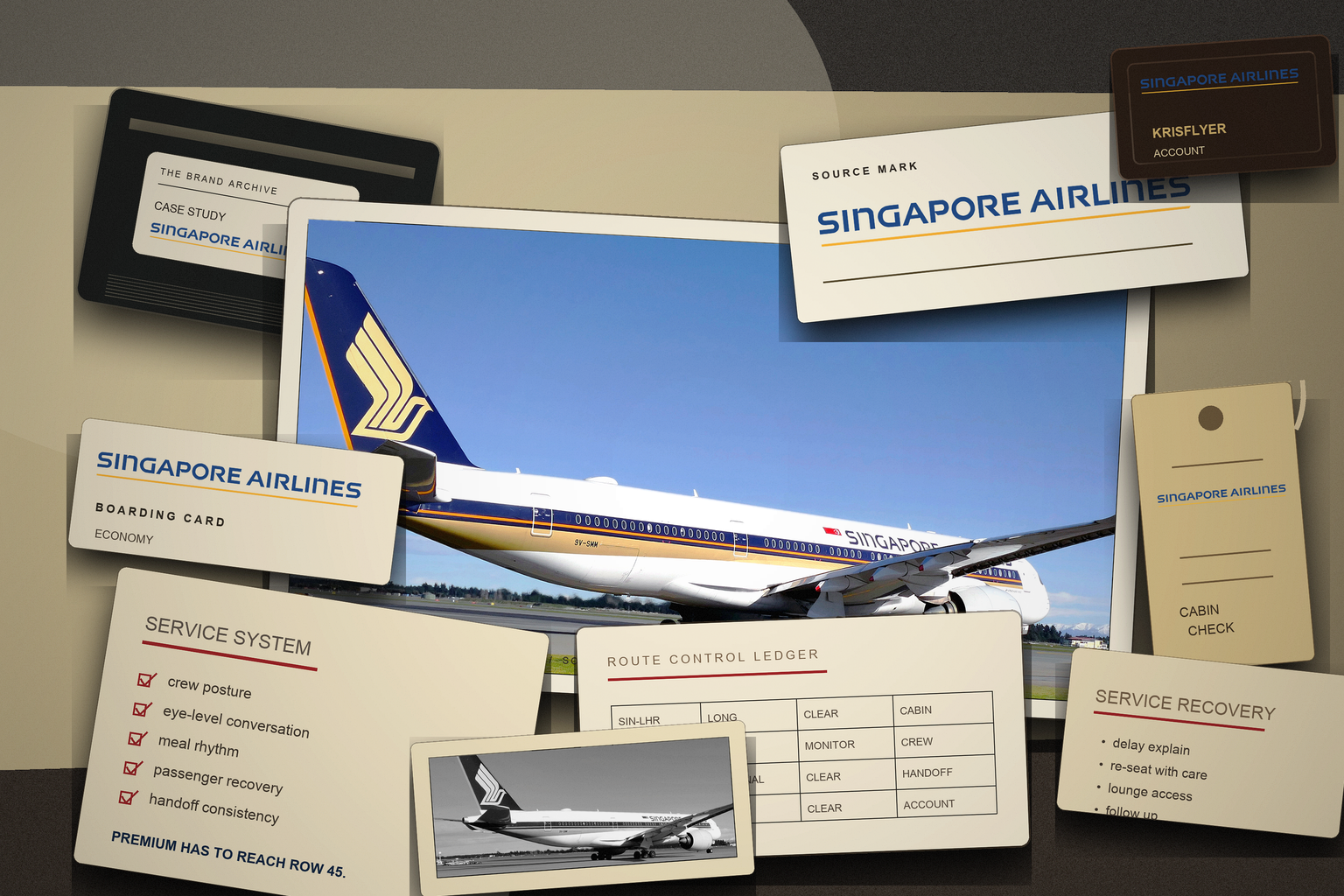
Singapore Airlines made premium travel feel operational by joining cabin training, eye-level service behavior, Changi handoffs, KrisWorld entertainment, KrisShop retail, KrisFlyer loyalty, and repeated crew standards into one passenger system.

Short Answer
Singapore Airlines and the Eye-Level Service System Behind Premium Flight is a brand system case about Singapore Airlines in 1972-present. Singapore Airlines made premium feel distributed through service behavior, not only through expensive seats. Premium airline brands are proven in the lowest-status passenger moments. The suite can signal luxury, but the middle seat tests whether service culture reaches the whole cabin.
Key Takeaways
- Singapore Airlines' heritage page ties the airline to Changi, the A380, KrisWorld, and repeated cabin investment.
- The airline says cabin crew training covers product knowledge, service procedures, passenger handling, grooming, communication, safety, and first aid.
- KrisWorld, KrisShop, KrisFlyer, Kris+, Pelago, and partner channels make the journey continue after the ticket purchase.
- The archive value is service unity: the passenger reads one system, not scattered perks.
- The operator lesson is to make premium visible in the least glamorous customer moment.
The Decision Context
Airline prestige is easy to show in the front of the aircraft. It is harder to prove in the ordinary seat, during a meal service, at the screen, in the loyalty account, or during the airport handoff.
Singapore Airlines belongs in the archive because its brand is not only a premium-cabin story. The useful reading is a service-distribution story: how much of the premium signal reaches the passenger who did not buy the highest tier.
The Least Comfortable Seat Is The Test
The case should start with the middle seat. That is where hierarchy is most obvious and where service can either reinforce the discomfort or soften it.
The eye-level service lens matters because premium service cannot feel like someone speaking down from the aisle. It has to make the passenger feel seen without pretending the cabin hierarchy has disappeared.
Training Made The Behavior Repeatable
Singapore Airlines' current cabin crew careers page says successful applicants go through a four-month training programme covering product knowledge, service procedures, passenger handling, deportment and grooming, language and communication, safety, emergency procedures, and first aid.
The airline's crew-training backgrounder gives the older but useful operating detail: cabin crew training included social etiquette, personal grooming, passenger handling skills, meal service, food and wine appreciation, first aid, and safety procedures. That is the machinery behind service that feels uniform rather than improvised.
The Cabin Became An Account
KrisWorld gave the cabin a named attention surface. Singapore Airlines says KrisWorld was the first system to provide audio and video on demand to all passengers in all classes, starting in October 2001.
KrisShop turns part of that cabin attention into retail behavior. Singapore Airlines says passengers can shop through KrisWorld on selected A350 flights, browse more than 4,000 products, earn KrisFlyer miles on KrisShop purchases made on KrisWorld, choose home delivery or pre-order to flight, and pay by card onboard.
KrisFlyer then turns the ticket into a repeat account. Singapore Airlines says members can earn miles with Singapore Airlines, Scoot, airline partners, and thousands of non-airline partners and merchants. Its FY2024/25 annual report says KrisFlyer had more than 10 million members globally, while KrisShop sales were heavily tied to KrisFlyer members.
The Archive Reading
Singapore Airlines is not interesting here because it is often ranked highly. Rankings are an outside signal, not the case.
The case is that Singapore Airlines built a system where cabin product, crew training, loyalty, entertainment, retail, and airport handoff all teach the same premium behavior. For operators, the lesson is to make the best seat and the worst seat feel like they still belong to one brand.
Comparable Cases
Sources
- Singapore Airlines, Our Heritage
- Singapore Airlines, Cabin Crew Careers
- Singapore Airlines, Crew Training Backgrounder
- Singapore Airlines, KrisShop on KrisWorld
- Singapore Airlines, KrisFlyer
- Singapore Airlines, Annual Report FY2024/25
- Skytrax, World's Top 100 Airlines 2025
- Bernard Spragg. NZ, Singapore Airlines Airbus A350-900 photograph, CC0 via Wikimedia Commons
- Singapore Airlines Logo.svg, Wikimedia Commons
.jpg)

People Also Ask
What happened to Singapore Airlines?
Singapore Airlines and the Eye-Level Service System Behind Premium Flight is a brand system case about Singapore Airlines in 1972-present. Singapore Airlines made premium feel distributed through service behavior, not only through expensive seats. Premium airline brands are proven in the lowest-status passenger moments. The suite can signal luxury, but the middle seat tests whether service culture reaches the whole cabin.
Why is Singapore Airlines a brand system case?
Singapore Airlines is filed as a brand system case because the visible consequence sits in that decision pattern. Singapore Airlines made premium feel distributed through service behavior, not only through expensive seats.
What can brands learn from Singapore Airlines?
Premium airline brands are proven in the lowest-status passenger moments. The suite can signal luxury, but the middle seat tests whether service culture reaches the whole cabin.
Is Singapore Airlines still operating?
The Brand Archive marks Singapore Airlines as Active / continuing. That means the brand, company, platform, product system, or parent organization is still operating, continuing, or being actively resolved.
What should Singapore Airlines be compared with?
Compare Singapore Airlines with Air France, Qantas, Turkish Airlines to see the same decision pattern from nearby cases.