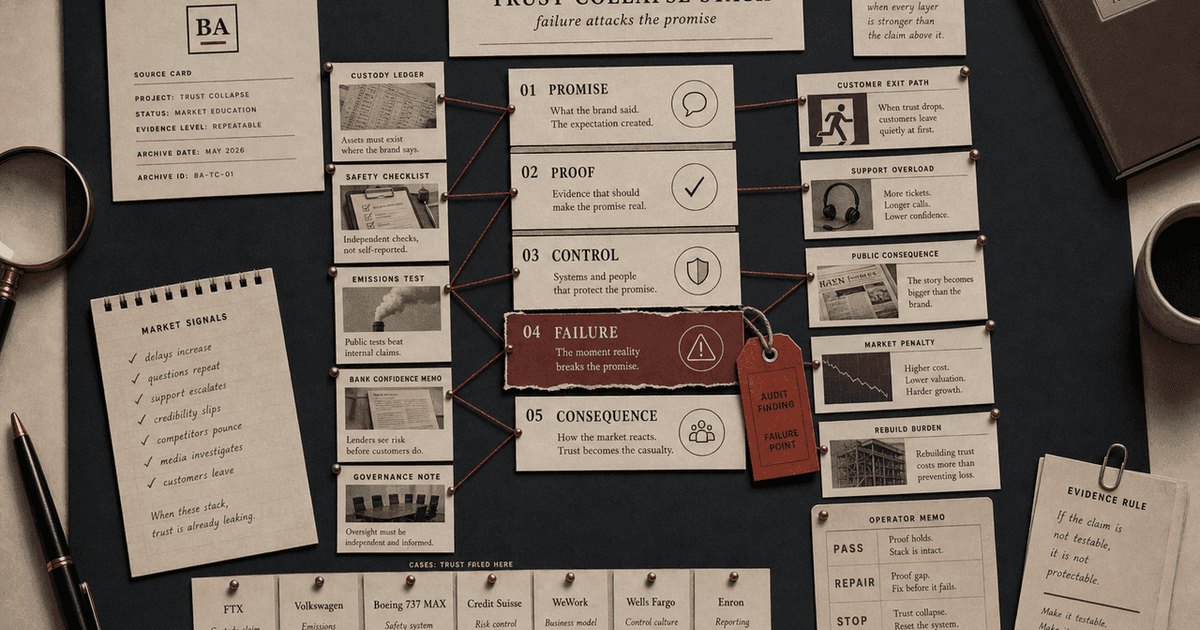
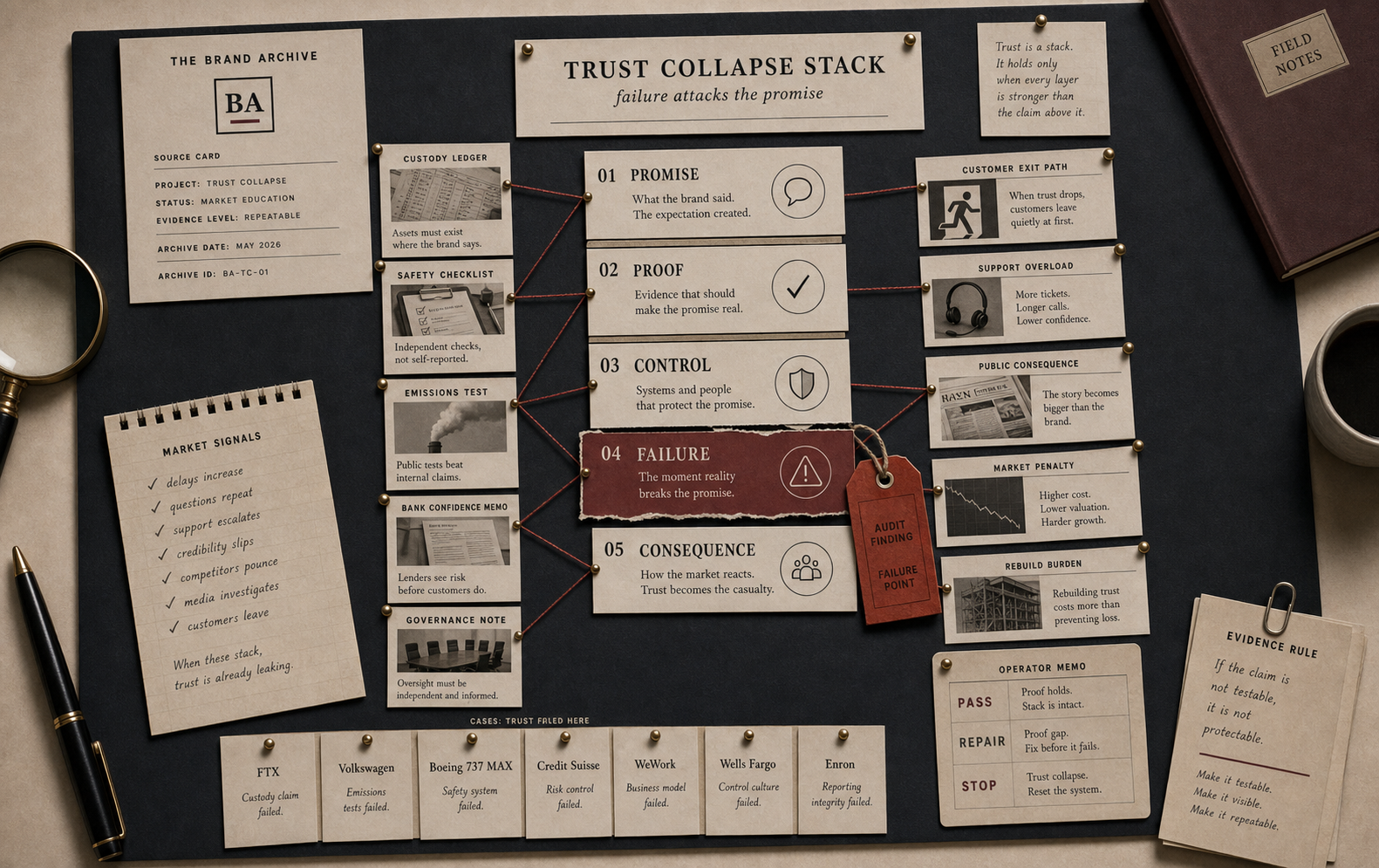
Short Answer
Trust collapse happens when failure attacks the exact promise the brand used to reduce risk. It is more severe than criticism because the market stops believing the proof path.
Trust Map
Find where the promise failed.
Theory
Trust collapses where the brand promised protection.
A brand can survive criticism when the core promise still holds.
It becomes a trust collapse when the failure strikes the promise customers used to lower risk.
Trust is a stack. A brand makes a promise, supports it with proof, protects it with controls, then asks customers to accept risk. When failure breaks one of those layers, the market starts questioning the whole stack.
The recovery cannot be only tone. Customers need to see what failed, what control changed, what proof now exists, and how the same risk will be handled next time.
How To Diagnose It
Map promise, proof, control, failure, and consequence.
Trust collapse analysis should begin with the promise customers accepted.
Then it should identify the proof and controls that should have made the promise safe.
01
Name the promise customers relied on.
The promise might be safety, custody, reliability, professional judgment, uptime, governance, quality, privacy, or recovery.
02
Find the control that should have protected it.
Trust needs a mechanism: audits, tests, custody separation, safety checks, governance, quality control, warranties, or recovery paths.
03
Map the public consequence.
Trust collapse creates penalties beyond bad press: customers leave, regulators investigate, partners hesitate, buyers demand discounts, and recovery becomes the story.
Decision Patterns
Trust collapses by promise type.
A custody failure, safety failure, governance failure, and recovery failure do not repair the same way.
The fix has to match the promise that broke.
01
Custody trust collapses when control is hidden.
If customers hand over money, data, inventory, or assets, the brand has to show where control lives and how misuse is prevented.
02
Safety trust collapses when checks fail.
Safety brands cannot rely on reassurance after a failure. The market needs visible tests, independent checks, and changed systems.
03
Governance trust collapses when story outruns control.
A company can sound visionary and still lose belief if accountability, incentives, controls, and risk ownership are unclear.
Bad Decisions
Trust repair fails when the proof path stays hidden.
Apology can start a repair. It cannot finish it.
The market has to see what changed in the system that failed.
01
The company treats trust like sentiment.
Trust is not only whether people feel better. It is whether they can see why the same risk is lower now.
02
The recovery path is unclear.
If customers cannot see what happens after failure, support, warranty, safety, custody, or governance language stays fragile.
03
The brand keeps speaking before proof is repaired.
More messaging can make the gap more visible when controls, evidence, and recovery have not changed.
Trust Collapse FAQ
What is trust collapse?
Trust collapse happens when failure attacks the promise customers relied on to feel safe: custody, safety, reliability, governance, service, quality, or control.
How is trust collapse different from bad publicity?
Bad publicity can fade while the core promise still holds. Trust collapse makes the market question whether the promise was ever protected.
What are common trust collapse examples?
Useful examples include FTX, Volkswagen Dieselgate, Boeing 737 MAX, Credit Suisse, and WeWork because each failed at a different trust layer.
Can design repair trust collapse?
Design can make proof easier to find, but it cannot replace controls, safety checks, governance, custody, service recovery, or operating evidence.
What should a brand do first after trust collapse?
Name the promise that failed, show the control that changed, publish proof customers can inspect, and make the recovery path visible.