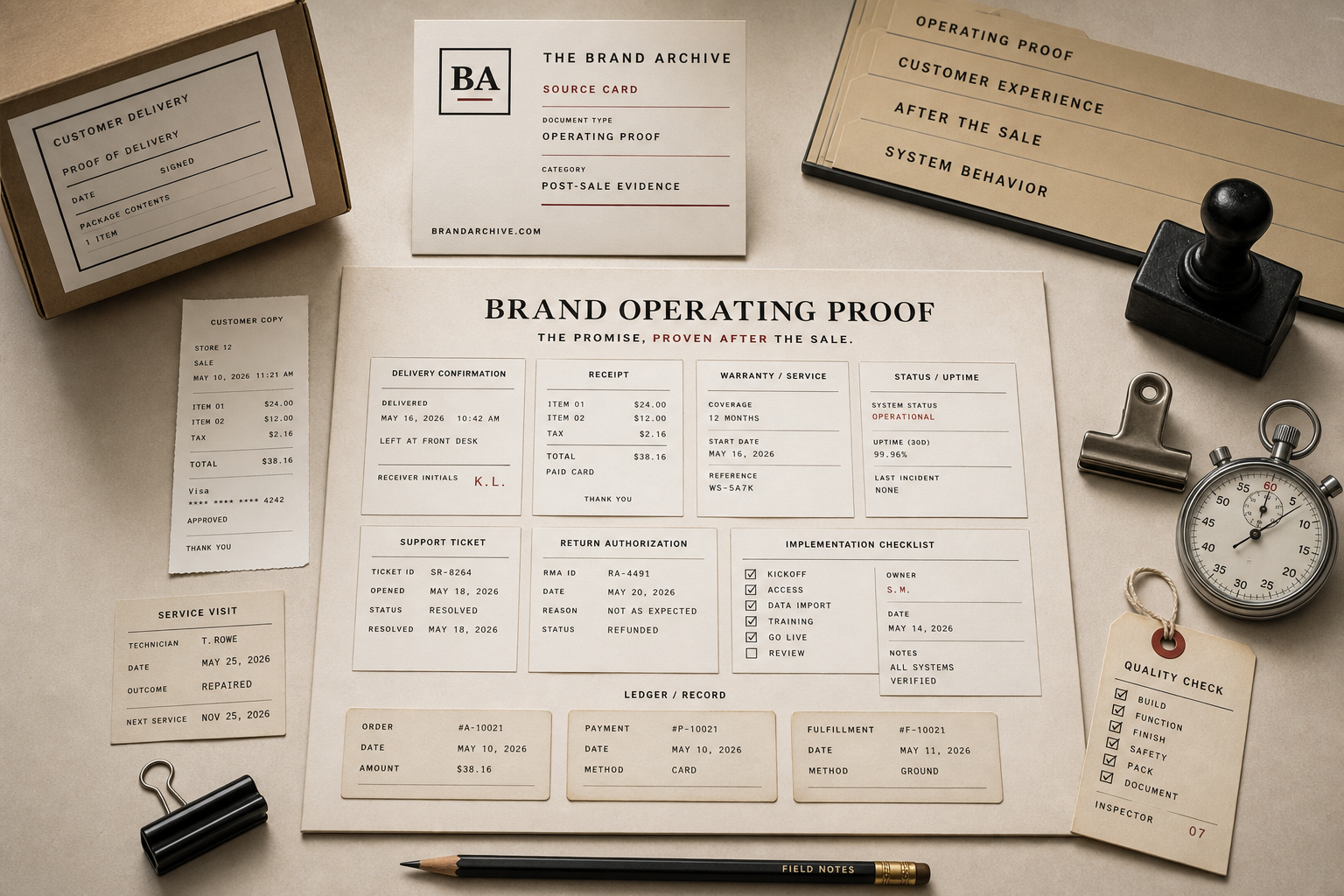
Short Answer
Operating proof is the visible evidence that the brand does what it claims. Receipts, delivery results, service paths, warranties, status pages, support behavior, quality checks, and recovery records turn a promise into something customers can inspect.
Proof Map
Turn the promise into visible evidence.
Theory
A promise becomes a brand when the operation proves it.
Brand copy can make the claim. The operation has to make the claim true after money, time, data, safety, work, or reputation is already at risk.
That proof usually appears on plain surfaces: receipts, shipping notices, settings, tickets, warranties, dashboards, checklists, status pages, repair paths, and support replies.
Operating proof is where branding stops being a surface system and becomes behavior people can point to. It answers the question customers ask after the pitch: what actually happened?
The proof does not need to be glamorous. A clear refund path, a delivery timestamp, a warranty record, a safety check, or a resolved support ticket can carry more brand trust than a campaign.
How To Build Proof
Put the evidence where the customer can see it.
Start with the brand promise, then find the surface that proves or disproves it during use.
If the proof is trapped inside operations, the customer has to trust without evidence. That is fragile.
01
Attach the promise to a proof surface.
Do not leave the promise floating in copy. Put it on the surface where the customer can check it: receipt, tracking result, statement, warranty, status page, delivery note, or service record.
02
Expose the operation customers depend on.
Many brands hide the proof because it lives inside process. That is a mistake when the buyer is risking work, data, safety, money, or time. The operation has to leave evidence.
03
Make recovery visible before failure arrives.
A brand becomes easier to trust when the customer knows what happens if the first outcome fails. Return paths, support, refunds, repair, replacement, and escalation are part of the brand system.
Decision Patterns
Match the proof to what the customer risks.
A low-price claim, a safety claim, a software claim, and a service claim each need a different proof path.
The best proof is the one a customer can understand in the moment the risk appears.
01
Use receipt proof when value is the promise.
Value brands need proof customers can compare. The basket, statement, membership terms, renewal, fee, and receipt can carry more brand meaning than a campaign line.
02
Use service proof when regret is likely.
Customers hesitate when fit, timing, condition, or repeat need is uncertain. Service proof lowers the cost of being wrong.
03
Use system proof when the brand cannot break.
Infrastructure, enterprise, safety, and technical brands need evidence of continuity. Customers want to see controls, uptime, compatibility, migration, training, checks, and support.
Bad Decisions
The market checks behavior after the brand speaks.
A brand can win attention and still fail the proof test.
When behavior, records, service, or safety contradict the promise, the contradiction becomes the brand memory.
01
The promise outruns the operation.
A confident brand claim becomes riskier when customers, regulators, employees, or operators can inspect behavior that says something else.
02
The proof exists, but customers cannot find it.
A company can have strong internal process and still lose trust if the customer sees only delay, confusion, silence, or buried help pages.
03
The identity tries to do behavior's job.
A cleaner name, logo, color, or narrative can help recognition. It cannot replace product, service, delivery, safety, support, or recovery evidence.
Brand Operating Proof FAQ
What is operating proof?
Operating proof is the visible evidence that a brand promise is true under use: receipts, delivery results, service behavior, warranties, status pages, checks, support records, returns, and recovery paths.
How is operating proof different from brand trust?
Trust is the customer's willingness to risk a decision. Operating proof is the evidence that lowers that risk after the claim is made.
What counts as operating proof?
A receipt, renewal, warranty, delivery result, status page, support ticket, repair path, implementation checklist, safety check, service record, quality control, refund, or repeat product behavior can all count.
Can a logo create operating proof?
No. A logo can make proof easier to recognize, but the proof has to come from product behavior, service, delivery, support, safety, or recovery.
What is the fastest operating proof test?
Ask what the customer can show another person after the sale to prove the promise happened. If there is no receipt, record, result, check, or recovery path, the brand is relying on belief.