Failure / Airline / National carrier / 1997-2001
British Airways and the Tailfin Rebrand That Removed the Flag Cue
British Airways' tailfin program is a rebrand-proposal warning because the creative idea weakened a recognition cue that passengers, press, and the public already understood.
Short Answer
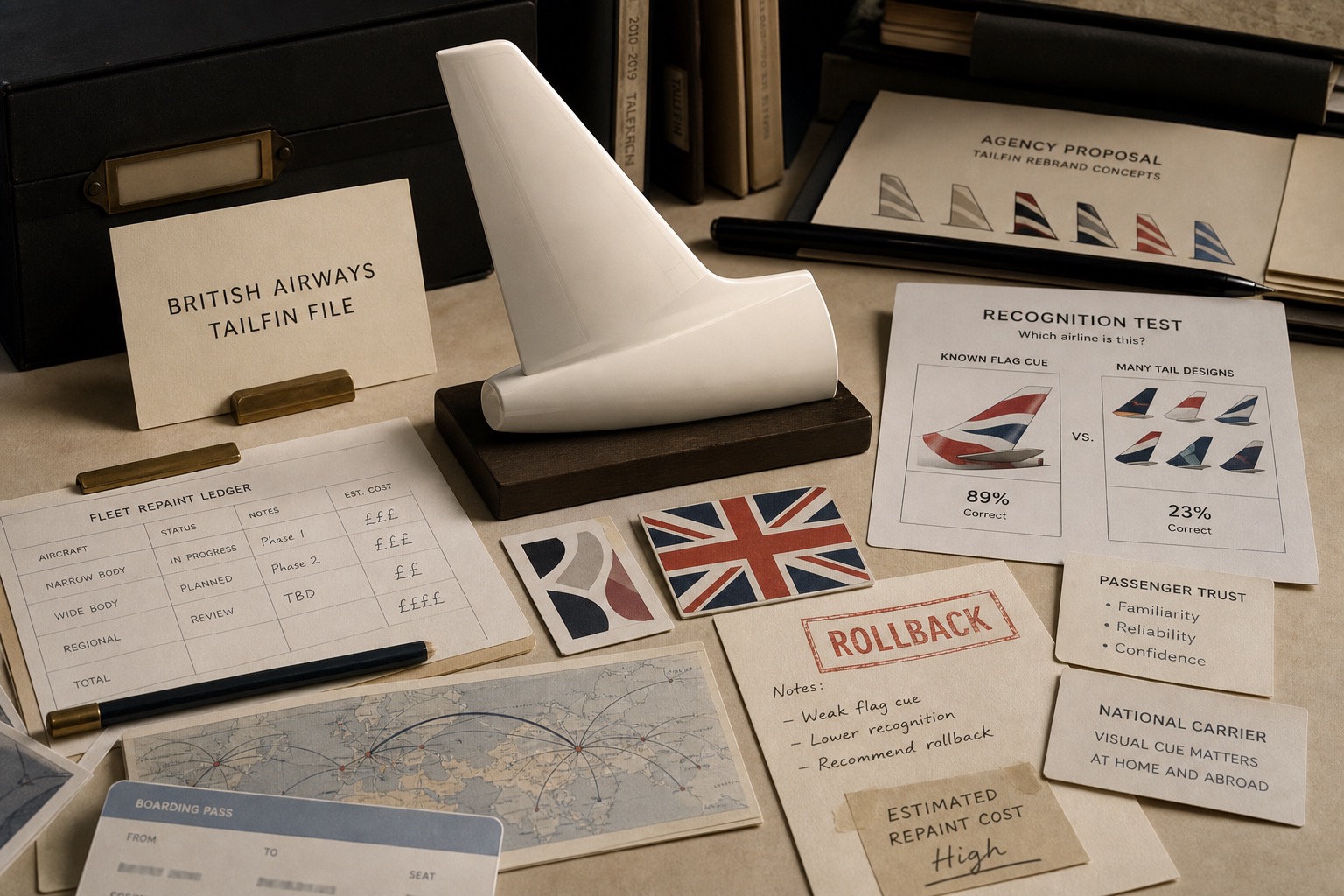
British Airways and the Tailfin Rebrand That Removed the Flag Cue is a failure case about British Airways in 1997-2001. A national carrier treated the tailfin as a global creative surface, then had to restore the flag cue people used to identify it. Before approving a rebrand proposal, test the cue buyers already use. The most expressive idea can still fail if it removes the fastest signal of trust and category memory.
Key Takeaways
- British Airways introduced its world-image tailfin designs in the late 1990s.
- The program drew public and political criticism because the Union Flag cue was reduced across the fleet.
- The airline later moved back toward a Union Flag tail identity.
- The buyer question is whether the proposal protects the cue people already use to recognize the brand.
- The decision route is agency proposal review: require recognition, stakeholder, and rollback evidence before signing.
The Decision Context
Airline identity is read under pressure: airport distance, tailfins on a stand, gate screens, boarding stress, news footage, and national-carrier memory.
British Airways had a strong public cue in the Union Flag tail. The tailfin program replaced that shared cue with a set of world-image designs that asked the public to learn a wider identity system.
What Broke
The creative idea was broader than the recognition task. A national airline can show international reach, but the fleet still has to be identified quickly.
Once the old flag cue became the thing people defended, the rebrand was no longer a design launch. It became a test of who owned the meaning of the airline.
The Buyer Question
Before approving an agency proposal, ask what cue the market already uses without help.
If the proposal removes that cue, the agency has to prove the replacement works on signage, mobile search, news photos, staff language, customer memory, and competitor comparison. Taste is too weak for that job.
The Archive Reading
British Airways belongs in this set because the failure sits between identity ambition and public recognition. The tailfin carried more than decoration.
For operators, the lesson is to protect the fastest trust signal first. A rebrand can add meaning after the old cue is secured.
Comparable Cases
Sources

People Also Ask
What happened to British Airways?
British Airways and the Tailfin Rebrand That Removed the Flag Cue is a failure case about British Airways in 1997-2001. A national carrier treated the tailfin as a global creative surface, then had to restore the flag cue people used to identify it. Before approving a rebrand proposal, test the cue buyers already use. The most expressive idea can still fail if it removes the fastest signal of trust and category memory.
Why is British Airways a failure case?
British Airways is filed as a failure case because the visible consequence sits in that decision pattern. A national carrier treated the tailfin as a global creative surface, then had to restore the flag cue people used to identify it.
What can brands learn from British Airways?
Before approving a rebrand proposal, test the cue buyers already use. The most expressive idea can still fail if it removes the fastest signal of trust and category memory.
Is British Airways still operating?
The Brand Archive marks British Airways as Active / continuing. That means the brand, company, platform, product system, or parent organization is still operating, continuing, or being actively resolved.
What should British Airways be compared with?
Compare British Airways with Consignia / Royal Mail, Gap, X to see the same decision pattern from nearby cases.