Brand System / Industrial technology / automation / infrastructure / 1847-present
Siemens and the Industrial Trust System That Made Infrastructure Legible
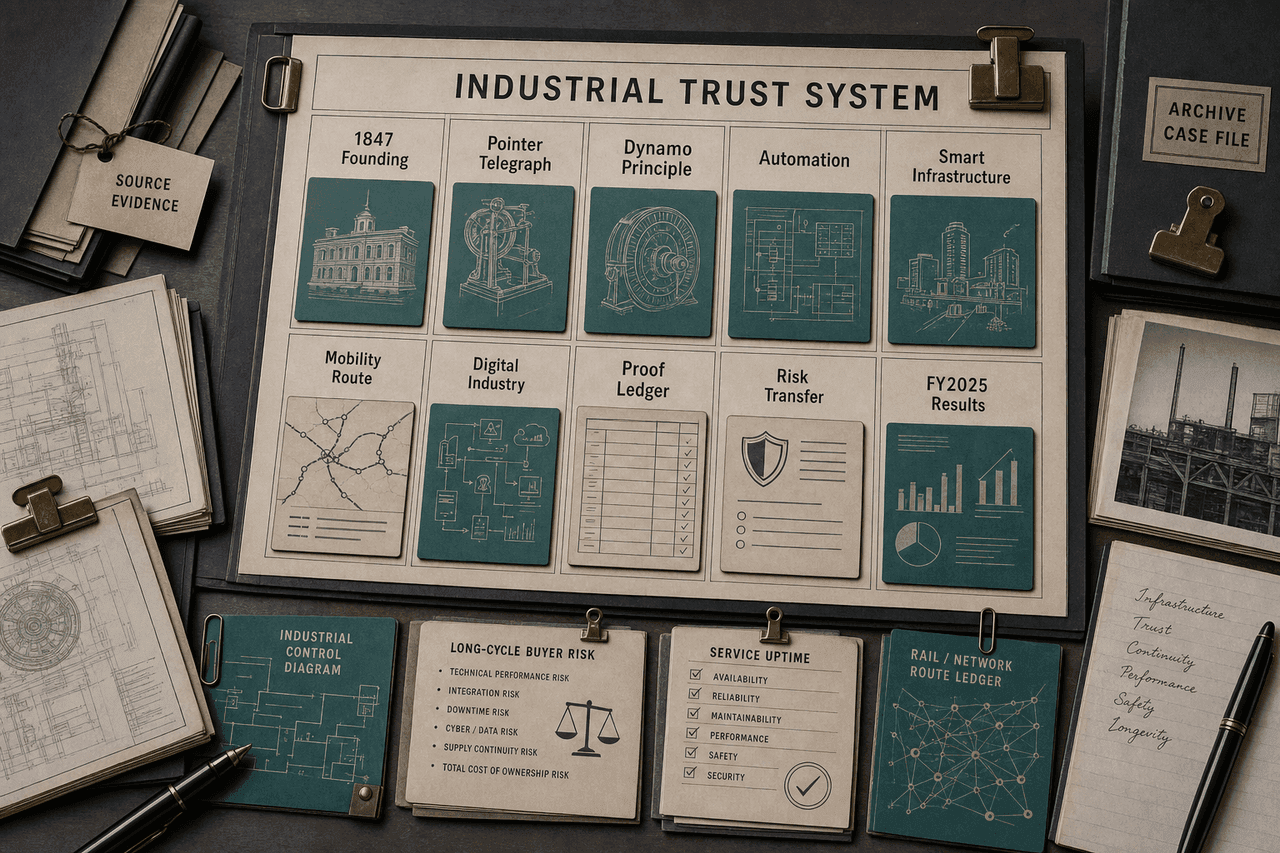
Siemens built industrial trust by linking telegraph roots, electrical engineering, automation, smart infrastructure, mobility, software, and long-cycle operating proof.
Short Answer
Siemens and the Industrial Trust System That Made Infrastructure Legible is a brand system case about Siemens in 1847-present. Siemens made industrial technology trust easier to read by tying old engineering memory to current infrastructure proof. Industrial brands earn trust when the proof sits in systems buyers cannot casually inspect: factories, grids, buildings, mobility networks, software, safety, uptime, and service. Siemens shows how a long engineering record can become a brand shortcut for infrastructure decisions.
Key Takeaways
- Siemens traces its company foundation to 1847, when Werner von Siemens and Johann Georg Halske built a business around the pointer telegraph in Berlin.
- Siemens says Werner von Siemens discovered the dynamo-electric principle in 1866 and built a dynamo machine, turning electrical engineering into larger infrastructure proof.
- The brand is useful because it connects technology with systems buyers have to trust before they can see the result: automation, smart buildings, grids, mobility, and software.
- Siemens reported fiscal 2025 revenue of EUR 78.9 billion, orders of EUR 88.4 billion, and record free cash flow of EUR 10.8 billion from continuing and discontinued operations.
- For operators, the lesson is to make invisible infrastructure trust legible through history, engineering proof, customer use, risk reduction, and service behavior.
The Decision Context
Industrial technology brands are judged before the buyer can see the full outcome. A factory line, rail system, building grid, or automation stack has to be trusted before it becomes visible proof.
That is why Siemens belongs in the archive as an industrial trust case. The brand does not depend on one consumer cue. It depends on whether a buyer believes the company can make complicated systems work over time.
The Telegraph Made Distance Operable
Siemens' history page traces the company to 1847, when Werner von Siemens and Johann Georg Halske founded Telegraphen-Bauanstalt von Siemens & Halske in Berlin around the pointer telegraph.
That origin matters because the first brand problem was already an infrastructure problem: make distance easier to operate, transmit, and trust.
The Dynamo Moved The Brand Into Power
Siemens says Werner von Siemens discovered the dynamo-electric principle in 1866 and constructed a dynamo machine. The company frames that development as a foundation for modern large-scale electric generators.
For brand analysis, the useful point is not invention for its own sake. It is the move from one device into a broader trust field: power generation, distribution, lighting, drives, and industrial use.
Infrastructure Became The Brand Surface
Many brands prove themselves in packaging or advertising. Siemens proves itself in environments where failure is expensive: factories, grids, buildings, transport systems, healthcare-adjacent technology, and industrial software.
That makes the brand surface unusually quiet. The buyer often sees specifications, installation records, service paths, uptime, compliance, and integration behavior before seeing anything that looks like branding.
Digital Industry Kept The Old Trust Useful
A long engineering record can become museum memory if the current business does not keep updating the proof. Siemens' current position depends on whether automation, software, digital twins, smart infrastructure, and mobility make the older engineering trust useful now.
That is the stronger archive reading: heritage matters only when it helps a buyer believe the next system will work.
The 2025 Results Show The Scale Of The Trust Bet
Siemens reported fiscal 2025 orders of EUR 88.4 billion, revenue of EUR 78.9 billion, Industrial Business profit of EUR 11.8 billion, net income of EUR 10.4 billion, and record free cash flow of EUR 10.8 billion from continuing and discontinued operations.
Those numbers do not prove the brand by themselves. They show the scale of decisions the brand has to support. Industrial trust is valuable because the buyer risk is large, long, technical, and hard to reverse.
The Archive Reading
Siemens starts the next balanced sprint as a normal brand/company case, but it is not a country-close move. Germany is already over the target lane. The value here is the industrial trust pattern.
For operators, the lesson is to make proof legible when the product is too complex for a quick buyer inspection. Industrial brands need memory, engineering credibility, service behavior, risk reduction, and current operating proof to point in the same direction.
Comparable Cases
Sources
People Also Ask
What happened to Siemens?
Siemens and the Industrial Trust System That Made Infrastructure Legible is a brand system case about Siemens in 1847-present. Siemens made industrial technology trust easier to read by tying old engineering memory to current infrastructure proof. Industrial brands earn trust when the proof sits in systems buyers cannot casually inspect: factories, grids, buildings, mobility networks, software, safety, uptime, and service. Siemens shows how a long engineering record can become a brand shortcut for infrastructure decisions.
Why is Siemens a brand system case?
Siemens is filed as a brand system case because the visible consequence sits in that decision pattern. Siemens made industrial technology trust easier to read by tying old engineering memory to current infrastructure proof.
What can brands learn from Siemens?
Industrial brands earn trust when the proof sits in systems buyers cannot casually inspect: factories, grids, buildings, mobility networks, software, safety, uptime, and service. Siemens shows how a long engineering record can become a brand shortcut for infrastructure decisions.
Is Siemens still operating?
The Brand Archive marks Siemens as Active / continuing. That means the brand, company, platform, product system, or parent organization is still operating, continuing, or being actively resolved.
What should Siemens be compared with?
Compare Siemens with SAP, Cisco, ASML to see the same decision pattern from nearby cases.